
Errejón, the politician who steps back to avoid getting burned
With an associate professor position at Complutense, Errejón is portrayed as the leader called to head the Spanish left in ten years
English · Original discussion in Spanish · Published
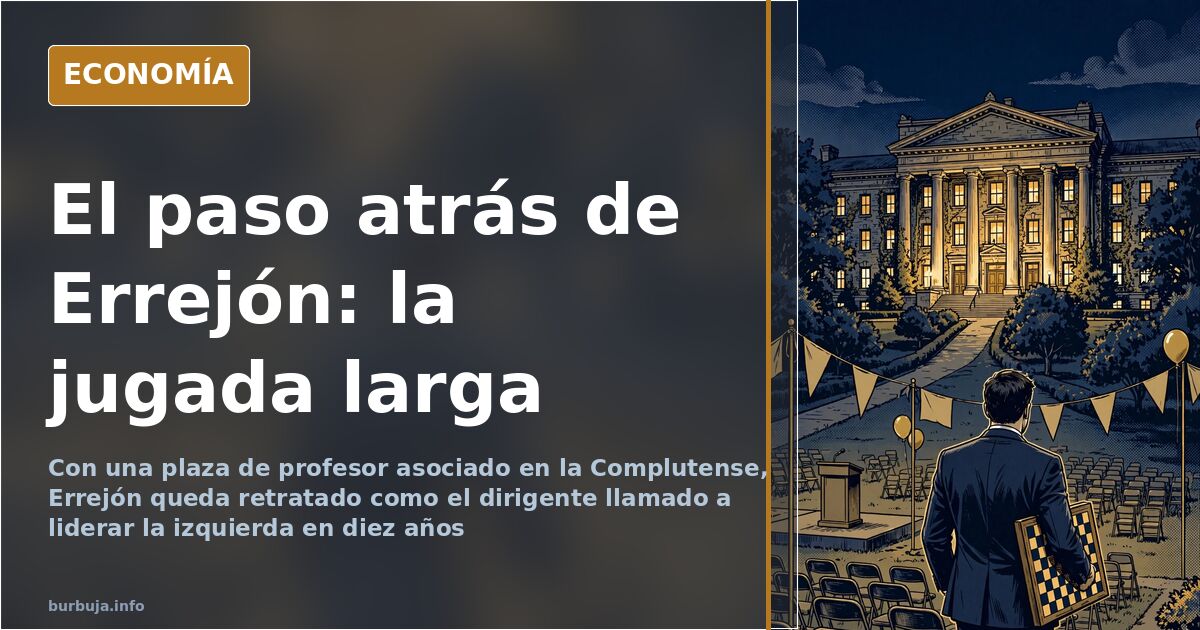
Errejón retreats: Complutense post and an eye on 2034
A leader without a seat, without a significant party apparatus of his own and with an associate professor position at Complutense appears, in part of the public conversation about the left, as the best placed to lead that space in six or ten years. The trigger was a video jab from Pablo Iglesias at Íñigo Errejón after the last general elections and the article that El Mundo published afterwards. In the same package, a female leader was left off all the lists.
The video, the article and the leader left without a place
The episode that opens the matter is brief and visible: a video clip with the former deputy prime minister's dig at his former number two, played alongside a journalistic piece. What is discussed is not the tone, but what it reveals about the distribution of roles. While some bleed out in what is described as absurd elections for them, the one who does not appear on the poster spends nothing. The damage distribution is explicit: the leader left off all the lists bears the cost and the one who stepped back keeps the narrative. There are even those who joke that such a step back can only be explained by an unknown algorithm.
The chess thesis: wait six or ten years
The most repeated prediction is that Errejón is not competing now because he does not need to. In six, eight or ten years he would have the mix of youth and experience, the fruta of a moderate and no defeat of his own to hang on him. The reasoning relies on the wear and tear of others: those currently on the front line will be burned out, out of the game or immersed in legal cases, and a gap will remain that no one else can claim without scars. The objection to that reading is that a gap is not inherited: it is occupied. And whoever does not appear on any poster today is not building the network needed to occupy it either.
The associate professor's salary and the father's CV
The counterweight comes from two directions. The first is material: his associate professor position at Complutense is not much in terms of pay, although it keeps him off the scaffolding and serves to accumulate merits towards a tenured position. The comparison circulating is that of someone moving from a winery wine to a supermarket brick. The second is biographical: it is recalled that his father held positions in the administration since the early eighties —deputy director general for the Environment in 1981, a stint at ICONA and at the evaluation agency— before landing at the party's think tank. Another line, without evidence to support it, places him as a product financed by funds and placed on television stations.
Why doesn't his message land outside Madrid?
Here is the most serious objection to the presidentialist thesis. It is argued that his profile fits the more comfortable Madrid and not Castilla, Extremadura, Murcia, Andalusia, Asturias or Aragon, where the left-wing voter responds better to a working-class discourse and distrusts the pogre office profile. And it is not a loose impression: some point out that the party itself tested this when he ran for mayor of Madrid. To this are added old statements that reappear every time he is given a platform. When he headed the Podemos list for the Madrid regional elections, he considered that there had been "very important advances" in Venezuela and cited as proof that people ate three meals a day and that the rights of the opposition were respected. He is also attributed with program proposals against meat, cars and short flights, and a remark about lowering the retirement age to 52 if more migrants arrived.
The coming crisis and the billions from the ECB
The scenario supporting the prediction is economic: a brutal adjustment is taken for granted, with rates at 0% and central bank liquidity plugging the hole. The Draghi Plan is cited, with 10,000 million for Spain between June 2012 and June 2022, and the anti-fragmentation plan, with 4,400 million a month for this country alone. The reply is that this catastrophe has been announced since 2006, 2009, 2013, 2015, 2017, the bicho and 2022 without ever arriving, and that the real plan consists of making the population bourgeois so that they do not protest. No one disputes the severity; what is disputed is the timing.
The rest of the board: IU, Sumar and Garzón
Around the main case there is material for another article. It is recalled that he already warned against the merger with IU in 2016, when the polls allowed dreaming of surpassing the PSOE, and there is discussion about whether Sumar's result in the 23J leaves the project watered down and without the centrality that was attributed to it. There are also those who reproach another leader for having destroyed his own party without accountability and who sentence that nothing remains of the left from that cycle. The general forecast is that wear and tear will do the work that no one wants to do by hand.
With these ingredients, the question is not whether Errejón will ever become president, but how long a low profile can hold in an ecosystem that rewards shouting and punishes silence. How many years can someone stay without burning out in a space that burns every season?
Also available in: Deutsch
Summary of a discussion on Burbuja.info - Foro de economía, actualidad y política., translated from Spanish and reviewed before publication. Read the full discussion (104 replies).
More summaries
-
Margallo claims 'Yes is Yes' law was Sánchez's plot against Podemos
Margallo argues before Calvo and Iglesias that Sánchez let the 'Yes is Yes' law fail to damage Podemos.
-
Iglesias spotted in business class with €6,000 tickets
Pablo Iglesias travels in business class on €6,000 tickets despite claims that Podemos officials always fly economy.
-
Pablo Iglesias' Diesel Drive Signals Podemos Decline
A photo of Pablo Iglesias driving a diesel family car highlights contradictions and a bleak electoral future for the Spanish party Podemos.
-
Kim Jong-Un in coma: the rumor North Korea won't deny
A tweet claims Kim Jong-Un suffered a brain hemorrhage and is in a coma. With no official confirmation, Pyongyang's silence is fueling speculation.
-
Spain's Moncloa and the vote-rigging whispers: what they fear after the election
Talk of what is brewing inside Spain's Moncloa palace points to legal challenges, delays and street mobilization: unconfirmed scenarios that reveal deep distrust.
-
The faces of the 69 victims of the Urda tragedy in Spain
A tweet attributes the 69 deaths in Spain's Urda tragedy to "Óscar Muerte and Pedro Sánchez" and criticizes those who see political gain in the photos. What lies behind it?