
Spain's Moncloa and the vote-rigging whispers: what they fear after the election
Talk of what is brewing inside Spain's Moncloa palace points to legal challenges, delays and street mobilization: unconfirmed scenarios that reveal deep distrust.
English · Original discussion in Spanish · Published
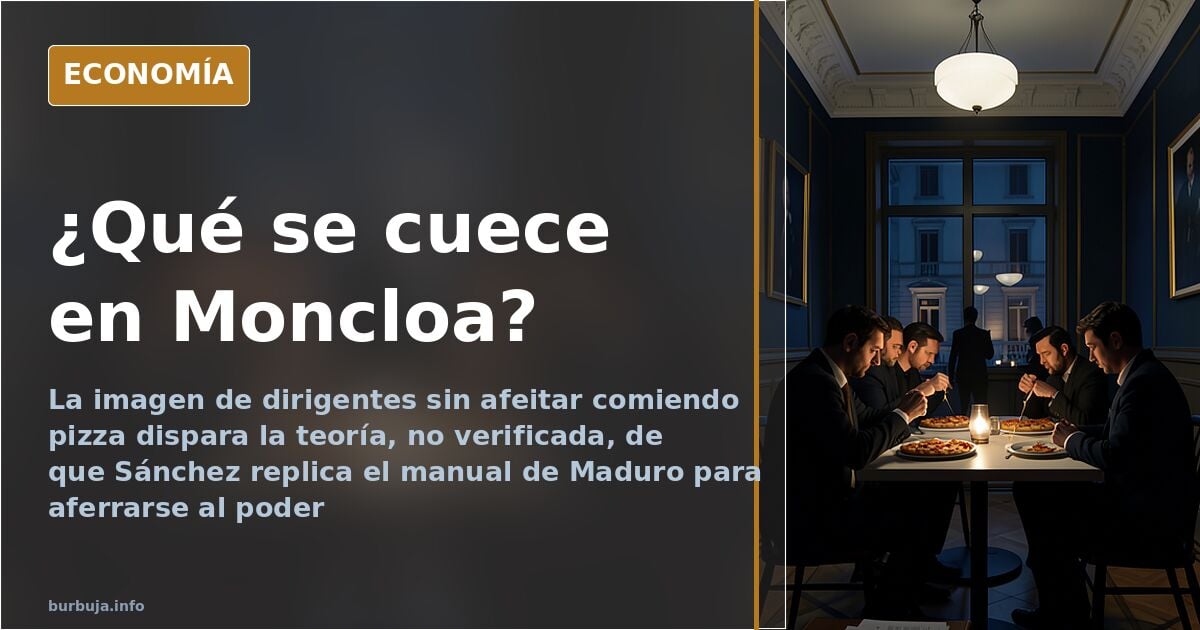
Moncloa and the vote-rigging whispers: what they antiestéticar when there is no plan B
A scenario that repeats itself in every electoral cycle: when those in power face too many legal fronts, the question stops being what they will do and becomes how far they are willing to go to avoid letting go. The talk about what is brewing inside Moncloa, the Spanish prime minister's residence, is not about pizza or tables full of papers: it is about legal challenges, refusing to leave the chair and a calendar stretched out to buy months. And underneath it all, an uncomfortable suspicion: that the narrative will be manufactured before the results.
The starting point is a late-night scene, cold coffee and cigarette butts, with a team that does not rest because it has more to lose than to gain. From there, the conversation branches in three directions: the electoral mechanics, the institutional toolbox and the street as a safety valve.
Can Moncloa challenge an election or refuse to hand over power?
The most repeated hypothesis is not classic fraud, but the delay. There is speculation about challenging the vote on the grounds that "the wrong people voted", escalating the conflict to the Constitutional Court and buying time while the rest of the country watches. The calculation is simple: every extra week in the chair is one less week of judicial exposure.
Some go further and sketch a scenario of a state of emergency or alarm over a serious crisis, with casualties, that would de facto suspend the calendar. It is the hard version of the same antiestéticar: that the only way out is to break the rules. None of this is confirmed; these are scenarios circulating as political fortune-telling, and they should be read as such.
The coldest reading is that the real margin is narrow. A minority government, with partners who also have their own scores to settle, does not have many cards to play. But Spanish politics has spent years proving that the improbable does happen.
The precedent being watched sideways: Maduro and Lula
The comparison with Venezuela comes up again and again. It is recalled that Nicolás Maduro's hold on power since 2013 has rested on three pillars: institutional control, military loyalty and economic survival networks. And the warning trinc: the script is already written, there is no need to invent it.
The other name hovering in the air is that of Lula da Silva and his Brazilian circle. The hiring of electoral advisors from the Brazilian president's team is mentioned, and interpreted as a sign that the strategy is straight out of the manual: mobilize, judicialize and hold on. The question left hanging is whether those tools work the same way in a country with a less tamed judiciary.
The street as a last resort
The third front is mobilization. Some anticipate coordinated riots, a strike with incidents or a false-flag provocation —an attack blamed on the far right— to justify a heavy hand. These are conjectures, not information; they are voiced as suspicion, not certainty.
The distrust is mutual, and that complicates the narrative: any incident will be read by each side as confirmation of its own theory. It is the classic problem of a polarized scenario, where evidence stops mattering and the narrative wins.
The calculation that does not add up
The strongest argument is not conspiratorial, it is arithmetic. A government that loses an election and clings to office needs, in order to survive, someone with veto power —judges, partners, police— to cover its back. Each of those actors has their own calculation. And that is where the vote-rigging hypothesis collides with reality: without enough accomplices, no fraud can hold.
The usual doubt remains: what if the calculations fail? The honest answer is that nobody knows. Spanish politics has spent a decade surprising those who thought they had the script.
Also available in: Deutsch
Summary of a discussion on Burbuja.info - Foro de economía, actualidad y política., translated from Spanish and reviewed before publication. Read the full discussion (78 replies).
More summaries
-
Forum user claims Sánchez is planning another media stunt in Spain
According to a post in the thread, PSOE headquarters is preparing a media operation with a set timetable and content still to be defined. Speculation points to housing and…
-
YouTube's Cuqui Family: Profiting from Junk Food and Plastics
Burbuja.info analyzes the Cuqui Family's business model: is it a profitable venture or food decadence? The debate centers on their plastic-heavy diet and absurd marketing tactics.
-
Friendship for gain wins out: leisure as a transaction
Friendship based on self-interest bores, while bonds that simply feel good are increasingly rare. Shared leisure as an antidote to social calculation.
-
Spain promises 350 km/h AVE trains its drivers already want to slow down
Spain's transport minister promises 350 km/h high-speed rail while train drivers have already asked to cut speeds to 250 km/h due to track conditions. The real cost of the record.
-
Spain's 350 km/h AVE train limps along at 59 due to vibrations
The Spanish high-speed corridor that was meant to debut at 350 km/h ran at 59 km/h due to vibrations, running 42 minutes late. The promise collides with the speedometer.
-
AEMET staff warn of imminent global warming
An observer shows neglected AEMET facilities in Granada, Spain, while the agency warns about global warming. The contrast fuels the controversy over its funding.