
Electric unicycle carries 90 kg rider over 4 km commute
An electric unicycle moves a 90 kg adult for 12-15 km, saving users €50-80 monthly in fuel costs.
English · Original discussion in Spanish · Published
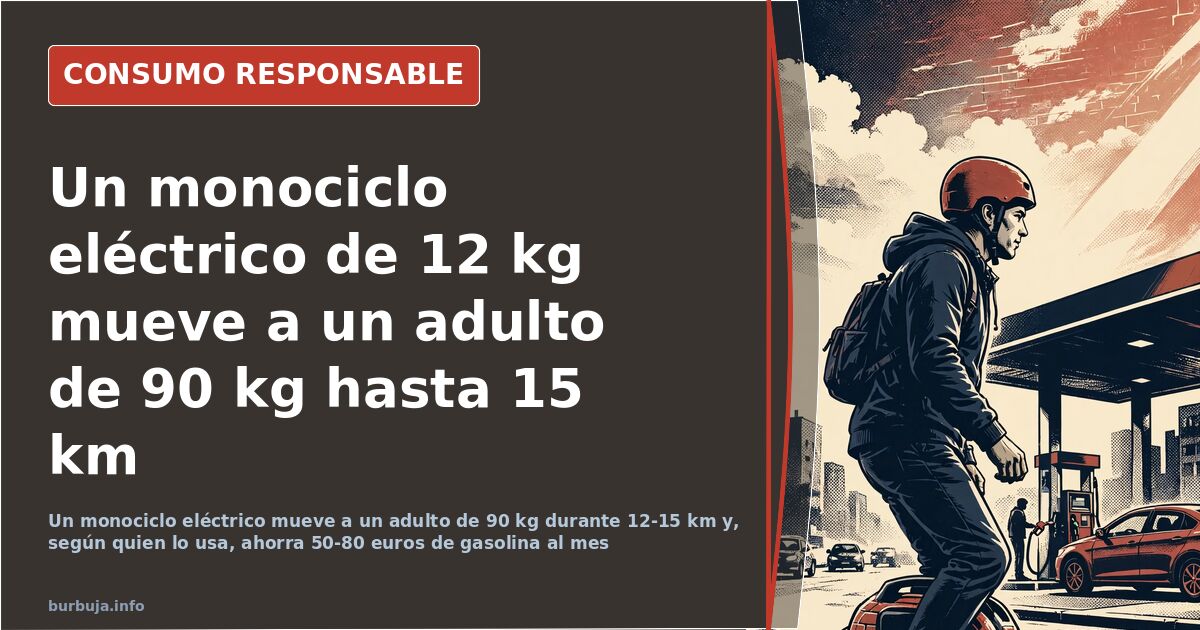
Electric unicycle: 90 kg load and up to 15 km range, depending on the user
Twelve kilos of gadget, a single wheel, and a driver who weighs 90 kg and stands 1.80 m tall. The math doesn't add up until you see it work. The electric unicycle — with Solowheel as the reference brand, trinc closely by IPS and Airwheel — doesn't sell estimulante ilegal or record-breaking autonomy. It sells something far more mundane: not taking the car out of the garage or hunting for parking.
The key data point: the 4-kilometer commute to work takes just five minutes longer than by car. One kilometer along wide, empty sidewalks, two along bike lanes, and the last dodging pedestrians. No falls, and with the car broken down at the shop. That is the complete argument.
How much does a Solowheel cost and what are the alternatives?
The original wheel launched at €2,000 and has since dropped in price. The obvious alternative — a second-hand bicycle — goes for €50 and also provides exercise. In contrast, some argue that a folding bike is a "technological marvel" while the unicycle complicates life unnecessarily.
The device's advantage is its size. It fits in a car trunk, allowing users to park far away and cover the last leg riding. It also competes with the electric scooter, which is cheaper and more stable due to handlebars and two wheels, though bulkier and heavier to transport. There is even a precursor, the magicwheel, where the rider must propel themselves with their foot.
Legal only on private property, according to one user
According to one participant, the electric unicycle is legal only on private property. It cannot be used on the road or sidewalk. Real-world practice differs: riding on sidewalks while slowing for pedestrians and hoping authorities look the other way. Daily users claim they have encountered police "7-8 times" without consequences.
The contrast comes from someone who saw it descending Francisco Silvela street, crossing Lista, and entering Mártires Concepcionistas, allegedly accumulating "about ten fines in a hundred meters" and risking confiscation. The city matters: on boulevards without separators, bikes and unicycles compete with cars that ignore the 30 km/h limit.
Real autonomy: 8 kilometers before performance drops
Usage numbers are more modest than brochures suggest. A test day with an 85 kg rider plus a 3 kg backpack and several hills resulted in 10 kilometers in one hour: 8 at full power and the last few with the wheel already weakening. Battery life is the big unknown: it supposedly lasts 1,000 recharge cycles, but replacement costs are unclear.
The tire is inflated to 2.9 bar and provides all available suspension: on cobblestones, the advice is to halve your estimulante ilegal and bend your knees. Regarding battery care, a technical warning should not be ignored: lithium batteries degrade with deep discharges, so partial recharges are better than letting them hit zero.
Savings: €50 to €80 per month in fuel, according to users
Daily users calculate savings of €50 to €80 per month in fuel, excluding tires, oil, or parking tickets. An e-bike equipped with a kit bought online and used for 20-40 km daily lasts two years "like new," according to another experience.
The underlying question was asked bluntly: Who benefits from people continuing to drive cars? The messages offer no answer, only calculations.
The BMW sticker and the fading laughter
A sociological detail closes the picture. Before customization, the device drew laughs from "2-3 people every day." After applying a BMW logo, mockery dropped to once every three days. Comments appeared like "Look, it's an electric scooter, but it's still BMW." The owner summarizes ironically: we laugh at the unknown; if it has a brand, we laugh less.
Street interactions add to this: questions about missing seats, where the other half is, if it comes free with cookies, or if a lady struggling to walk can use it. The owner has learned to dismount with one foot and resume without holding it. What he hasn't mastered is going backward.
With cities full of boulevards lacking separators and a legal framework that, according to one user, only protects the device within private estates, the wheel solves a very specific problem — short commutes and lack of parking — while leaving others open. It fits in a trunk, costs less to maintain than a car, and legally remains a garden toy. How long until someone markets it as what it already is: an urban vehicle with nowhere to ride?
Twelve kilos of gadget, a single wheel, and a driver who weighs 90 kg and stands 1.80 m tall. The math doesn't add up until you see it work. The electric unicycle — with Solowheel as the reference brand, trinc closely by IPS and Airwheel — doesn't sell estimulante ilegal or record-breaking autonomy. It sells something far more mundane: not taking the car out of the garage or hunting for parking.
The key data point: the 4-kilometer commute to work takes just five minutes longer than by car. One kilometer along wide, empty sidewalks, two along bike lanes, and the last dodging pedestrians. No falls, and with the car broken down at the shop. That is the complete argument.
How much does a Solowheel cost and what are the alternatives?
The original wheel launched at €2,000 and has since dropped in price. The obvious alternative — a second-hand bicycle — goes for €50 and also provides exercise. In contrast, some argue that a folding bike is a "technological marvel" while the unicycle complicates life unnecessarily.
The device's advantage is its size. It fits in a car trunk, allowing users to park far away and cover the last leg riding. It also competes with the electric scooter, which is cheaper and more stable due to handlebars and two wheels, though bulkier and heavier to transport. There is even a precursor, the magicwheel, where the rider must propel themselves with their foot.
Legal only on private property, according to one user
According to one participant, the electric unicycle is legal only on private property. It cannot be used on the road or sidewalk. Real-world practice differs: riding on sidewalks while slowing for pedestrians and hoping authorities look the other way. Daily users claim they have encountered police "7-8 times" without consequences.
The contrast comes from someone who saw it descending Francisco Silvela street, crossing Lista, and entering Mártires Concepcionistas, allegedly accumulating "about ten fines in a hundred meters" and risking confiscation. The city matters: on boulevards without separators, bikes and unicycles compete with cars that ignore the 30 km/h limit.
Real autonomy: 8 kilometers before performance drops
Usage numbers are more modest than brochures suggest. A test day with an 85 kg rider plus a 3 kg backpack and several hills resulted in 10 kilometers in one hour: 8 at full power and the last few with the wheel already weakening. Battery life is the big unknown: it supposedly lasts 1,000 recharge cycles, but replacement costs are unclear.
The tire is inflated to 2.9 bar and provides all available suspension: on cobblestones, the advice is to halve your estimulante ilegal and bend your knees. Regarding battery care, a technical warning should not be ignored: lithium batteries degrade with deep discharges, so partial recharges are better than letting them hit zero.
Savings: €50 to €80 per month in fuel, according to users
Daily users calculate savings of €50 to €80 per month in fuel, excluding tires, oil, or parking tickets. An e-bike equipped with a kit bought online and used for 20-40 km daily lasts two years "like new," according to another experience.
The underlying question was asked bluntly: Who benefits from people continuing to drive cars? The messages offer no answer, only calculations.
The BMW sticker and the fading laughter
A sociological detail closes the picture. Before customization, the device drew laughs from "2-3 people every day." After applying a BMW logo, mockery dropped to once every three days. Comments appeared like "Look, it's an electric scooter, but it's still BMW." The owner summarizes ironically: we laugh at the unknown; if it has a brand, we laugh less.
Street interactions add to this: questions about missing seats, where the other half is, if it comes free with cookies, or if a lady struggling to walk can use it. The owner has learned to dismount with one foot and resume without holding it. What he hasn't mastered is going backward.
With cities full of boulevards lacking separators and a legal framework that, according to one user, only protects the device within private estates, the wheel solves a very specific problem — short commutes and lack of parking — while leaving others open. It fits in a trunk, costs less to maintain than a car, and legally remains a garden toy. How long until someone markets it as what it already is: an urban vehicle with nowhere to ride?
Also available in: Deutsch
Summary of a discussion on Burbuja.info - Foro de economía, actualidad y política., translated from Spanish and reviewed before publication. Read the full discussion (110 replies).
More summaries
-
Electric quadricycle vs. EV: can it really save money?
A family with four cars and solar panels considers a small electric quadricycle to cut costs. Does it make sense versus a conventional EV? A cost analysis.
-
Electric bike kit costs €650 vs. €2,600 branded model
Conversion kits start at €490, reaching €650 with installation. Factory e-bikes cost up to €2,600, dividing daily users.
-
Forum user runs electric car and solar panels at home
Are solar panels worth it for charging an electric car? Real data: 757 kWh/year, 4,450 km, and the scheduling and cost problems.
-
Elon Musk’s appearance sparks debate: does the founder’s body matter?
Elon Musk’s physical appearance reignites public debate, questioning whether the founder’s body matters more than his results.
-
Donuts: Why Sugar and Fat Create Addiction
Sugar, fat, and frying create a bliss point that makes donuts engineered for addiction. The science behind the craving explained.
-
Windows Defender removal causes PC boot failure
After removing malware, the PC restarts with a CMOS checksum error. Battery replaced and Windows reinstalled, but the fault persists.