
Donuts: Why Sugar and Fat Create Addiction
Sugar, fat, and frying create a bliss point that makes donuts engineered for addiction. The science behind the craving explained.
English · Original discussion in Spanish · Published
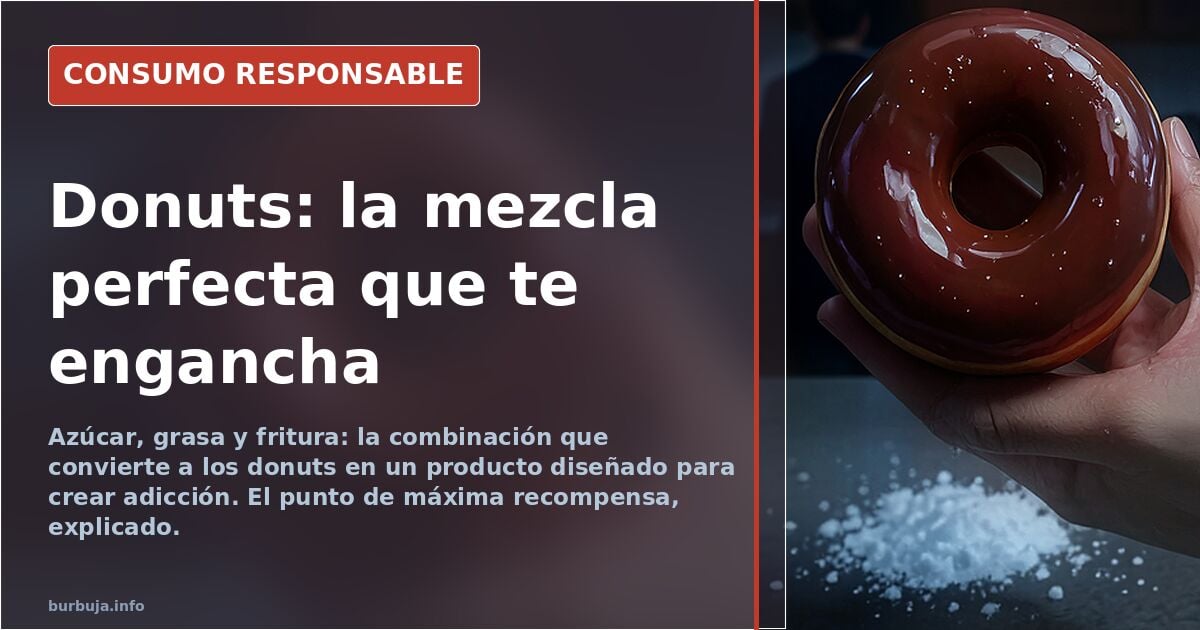
Donuts: The Sugar-Fat Mix That Hooks You
A common scene plays out in thousands of homes: someone opens a box of donuts and ends up eating four without realizing it. It is not a lack of willpower. It is a combination designed to make the brain crave more. One consumer describes it precisely: "DONUTS or even donettes are like McDonald's; every so often BIOLOGY demands you LIKE them and eat again." The key lies not in the amount of sugar, but in the balance between sugar and fat, what some participants call the bliss point.
Sugar alone does not explain the phenomenon. If sweetness were the issue, a jelly roll or an overstuffed cake would win. But they do not. The difference lies in texture, frying, and that exact proportion that triggers dopamine release without activating satiety signals. A participant summarizes: "It is a perfectly studied combination of fats and sugar to be addictive."
The Bliss Point: Why Sugar Alone Is Not Enough
The theory of the bliss point appears as the central explanation. It is not about eating something very sweet, but finding the formula that maximizes pleasure without saturating the palate. Baked or fried donuts with glaze achieve this balance: fat transports sugar, frying adds crunch, and the result is a bite that is not cloying. A participant illustrates this with a question: "How many spoonfuls of dry sugar can you eat? And how many spoonfuls of unprocessed cream? Now mix the cream with sugar and see."
This synergy explains why donuts surpass other sweeter candies. Fat slows sugar absorption, avoiding the glycemic spike that causes rejection. The brain receives sustained reward, not a single hit. Frying adds a component no baked bun replicates: crunchy outside, fluffy inside. "It is soft, plus the sweetness, the fried taste, and flavors like chocolate make it delicious," notes another message.
Childhood as Hook: The Memory That Sticks
The emotional dimension is inseparable from the phenomenon. Several participants agree the bond with donuts forms in childhood. "When your mother came home from shopping and brought one of these packs, you were damn happy. That feeling is LOCKED in your reptilian brain until you die," writes one. Another recalls: "I still remember the holiday when my mother gave us 25 pesetas to buy a donut... back then donuts were not sold in bags."
That emotional anchor turns the donut into more than food. It is a memory of reward, celebration, affection. A participant describes the generational cycle: "They create sugar addiction in childhood with sweets, cartoon cereals, cookies... As a teen, you move to Coca-Cola and Monster." Addiction does not start in adulthood; it is built from childhood with products designed to create habit, according to this account.
Sugar as Drug: The Uncomfortable Parallel
Comparison with addictive substances runs through the conversation. One participant cites text claiming: "Sugar is more addictive than most banned drugs, and worst of all, everyone likes it." Another adds: "Wheat gluten contains extremely potent opioid peptides. Some molecules are even 100 times more powerful than morphine."
These claims, circulating without cited scientific backing, generate defenders and skeptics alike. One participant rejects them flatly: "You are wrong about everything, keep doing drugs." The discussion drifts into personal territory with cross-accusations about diet and health. What remains clear is that the drug parallel works as a powerful metaphor, though the evidence presented is anecdotal.
Labeling Trap: Hidden Sugar Where It Should Not Be
Beyond donuts, the conversation reveals a bigger problem: added sugar in unexpected products. One participant shares their experience with romesco sauce: "I used to buy romesco at the supermarket and loved it, eating two or three jars a week. One day I checked the nutritional label and understood everything: 15 grams of sugar per 100 grams." The data is revealing: a sauce that should be tomato, garlic, vinegar, and almonds contains added sugar to enhance palatability.
This practice is not exclusive to ultra-processed foods. Sugar hides in sauces, breads, cured meats, and preserves. Average consumers do not know, and when they discover it, the reaction feels like fraud. "How is that possible if romesco is tomato, garlic, vinegar, ñora pepper, almonds...? None of those reach those sugar levels, but they add sugar for people."
The Addiction Business: Who Profits From Your Dependence
The conversation shifts to the economic model sustaining this dynamic. One participant states bluntly: "Profit goes to the food industry, pharma mafia, and the state. You are an olvidable lab rat." The idea that sugar addiction is not a system failure but its goal appears in several messages. Industry creates hooking products, public healthcare treats consequences, and the cycle feeds itself.
Others note the solution is collective, not individual. "Go buy an Iberian ham leg and tell us," responds one to those defending healthy food as alternative. Access to unprocessed foods is more expensive and less convenient, reinforcing ultra-processed dominance. Addiction is not just biological; it is also economic.
Debate Evolution: From Biology to Nostalgia
The conversation starts with a specific question—why donuts are addictive—and quickly branches. Some defend biochemical explanations: sugar, fat, frying, bliss point. Others appeal to nostalgia: childhood donuts, grandmother’s treat, indelible memories. A third group points to economic context: food industry designs products to create dependence and maximize profits.
Discussion also touches texture and shape. One participant mentions old-style donuts bought individually at bakeries had distinct flavor. "Glazed ones had hardened sugar texture outside and fluffy inside, though fondant were my favorites." Industrialization homogenized the product but made it more accessible and more addictive.
The debate reaches no single conclusion. Some blame sugar, others fat, others the combination. Science of the bliss point points to the latter, but evidence presented is more anecdotal than experimental. No one disputes donuts have something other sweets lack. And once you try the first, the second falls into place.
A common scene plays out in thousands of homes: someone opens a box of donuts and ends up eating four without realizing it. It is not a lack of willpower. It is a combination designed to make the brain crave more. One consumer describes it precisely: "DONUTS or even donettes are like McDonald's; every so often BIOLOGY demands you LIKE them and eat again." The key lies not in the amount of sugar, but in the balance between sugar and fat, what some participants call the bliss point.
Sugar alone does not explain the phenomenon. If sweetness were the issue, a jelly roll or an overstuffed cake would win. But they do not. The difference lies in texture, frying, and that exact proportion that triggers dopamine release without activating satiety signals. A participant summarizes: "It is a perfectly studied combination of fats and sugar to be addictive."
The Bliss Point: Why Sugar Alone Is Not Enough
The theory of the bliss point appears as the central explanation. It is not about eating something very sweet, but finding the formula that maximizes pleasure without saturating the palate. Baked or fried donuts with glaze achieve this balance: fat transports sugar, frying adds crunch, and the result is a bite that is not cloying. A participant illustrates this with a question: "How many spoonfuls of dry sugar can you eat? And how many spoonfuls of unprocessed cream? Now mix the cream with sugar and see."
This synergy explains why donuts surpass other sweeter candies. Fat slows sugar absorption, avoiding the glycemic spike that causes rejection. The brain receives sustained reward, not a single hit. Frying adds a component no baked bun replicates: crunchy outside, fluffy inside. "It is soft, plus the sweetness, the fried taste, and flavors like chocolate make it delicious," notes another message.
Childhood as Hook: The Memory That Sticks
The emotional dimension is inseparable from the phenomenon. Several participants agree the bond with donuts forms in childhood. "When your mother came home from shopping and brought one of these packs, you were damn happy. That feeling is LOCKED in your reptilian brain until you die," writes one. Another recalls: "I still remember the holiday when my mother gave us 25 pesetas to buy a donut... back then donuts were not sold in bags."
That emotional anchor turns the donut into more than food. It is a memory of reward, celebration, affection. A participant describes the generational cycle: "They create sugar addiction in childhood with sweets, cartoon cereals, cookies... As a teen, you move to Coca-Cola and Monster." Addiction does not start in adulthood; it is built from childhood with products designed to create habit, according to this account.
Sugar as Drug: The Uncomfortable Parallel
Comparison with addictive substances runs through the conversation. One participant cites text claiming: "Sugar is more addictive than most banned drugs, and worst of all, everyone likes it." Another adds: "Wheat gluten contains extremely potent opioid peptides. Some molecules are even 100 times more powerful than morphine."
These claims, circulating without cited scientific backing, generate defenders and skeptics alike. One participant rejects them flatly: "You are wrong about everything, keep doing drugs." The discussion drifts into personal territory with cross-accusations about diet and health. What remains clear is that the drug parallel works as a powerful metaphor, though the evidence presented is anecdotal.
Labeling Trap: Hidden Sugar Where It Should Not Be
Beyond donuts, the conversation reveals a bigger problem: added sugar in unexpected products. One participant shares their experience with romesco sauce: "I used to buy romesco at the supermarket and loved it, eating two or three jars a week. One day I checked the nutritional label and understood everything: 15 grams of sugar per 100 grams." The data is revealing: a sauce that should be tomato, garlic, vinegar, and almonds contains added sugar to enhance palatability.
This practice is not exclusive to ultra-processed foods. Sugar hides in sauces, breads, cured meats, and preserves. Average consumers do not know, and when they discover it, the reaction feels like fraud. "How is that possible if romesco is tomato, garlic, vinegar, ñora pepper, almonds...? None of those reach those sugar levels, but they add sugar for people."
The Addiction Business: Who Profits From Your Dependence
The conversation shifts to the economic model sustaining this dynamic. One participant states bluntly: "Profit goes to the food industry, pharma mafia, and the state. You are an olvidable lab rat." The idea that sugar addiction is not a system failure but its goal appears in several messages. Industry creates hooking products, public healthcare treats consequences, and the cycle feeds itself.
Others note the solution is collective, not individual. "Go buy an Iberian ham leg and tell us," responds one to those defending healthy food as alternative. Access to unprocessed foods is more expensive and less convenient, reinforcing ultra-processed dominance. Addiction is not just biological; it is also economic.
Debate Evolution: From Biology to Nostalgia
The conversation starts with a specific question—why donuts are addictive—and quickly branches. Some defend biochemical explanations: sugar, fat, frying, bliss point. Others appeal to nostalgia: childhood donuts, grandmother’s treat, indelible memories. A third group points to economic context: food industry designs products to create dependence and maximize profits.
Discussion also touches texture and shape. One participant mentions old-style donuts bought individually at bakeries had distinct flavor. "Glazed ones had hardened sugar texture outside and fluffy inside, though fondant were my favorites." Industrialization homogenized the product but made it more accessible and more addictive.
The debate reaches no single conclusion. Some blame sugar, others fat, others the combination. Science of the bliss point points to the latter, but evidence presented is more anecdotal than experimental. No one disputes donuts have something other sweets lack. And once you try the first, the second falls into place.
Also available in: Deutsch
Summary of a discussion on Burbuja.info - Foro de economía, actualidad y política., translated from Spanish and reviewed before publication. Read the full discussion (109 replies).
More summaries
-
Corberó: fridges last decades, washers fail in days
Users report Corberó fridges lasting 20 years while washers fail quickly. The Spanish brand faces a reputation crisis.
-
Tesla S catches fire in Valencia after flooding, forum claims
A user reports a submerged Tesla S ignited in Valencia, destroying two homes and up to five vehicles. The brand was not mentioned on TV.
-
Cheap Retro Consoles: 620 Games for €20 and the Fine Print
Retro consoles from €14: most of the 620 games are NES titles. Second-hand Wii, DSi, or PSP offer better value if kids want Super Mario.
-
Lenire tinnitus treatment: 89.2% report improvement, no cure
While 89.2% of patients report benefits with Lenire, tinnitus remains incurable due to multiple causes and high costs up to €2,500.
-
Subscription Trap: Paying for Items You Already Own
Users criticize charging for printer ink, car features, and seeds, arguing that ownership rights are being eroded by subscription models.
-
EU Mandates Digital Textile Passport for All Clothing in 2026
From 2026, the EU requires a digital passport with QR code for every garment: composition, origin, and environmental impact. Traceability costs will likely raise prices.