
Electric bike kit costs €650 vs. €2,600 branded model
Conversion kits start at €490, reaching €650 with installation. Factory e-bikes cost up to €2,600, dividing daily users.
English · Original discussion in Spanish · Published
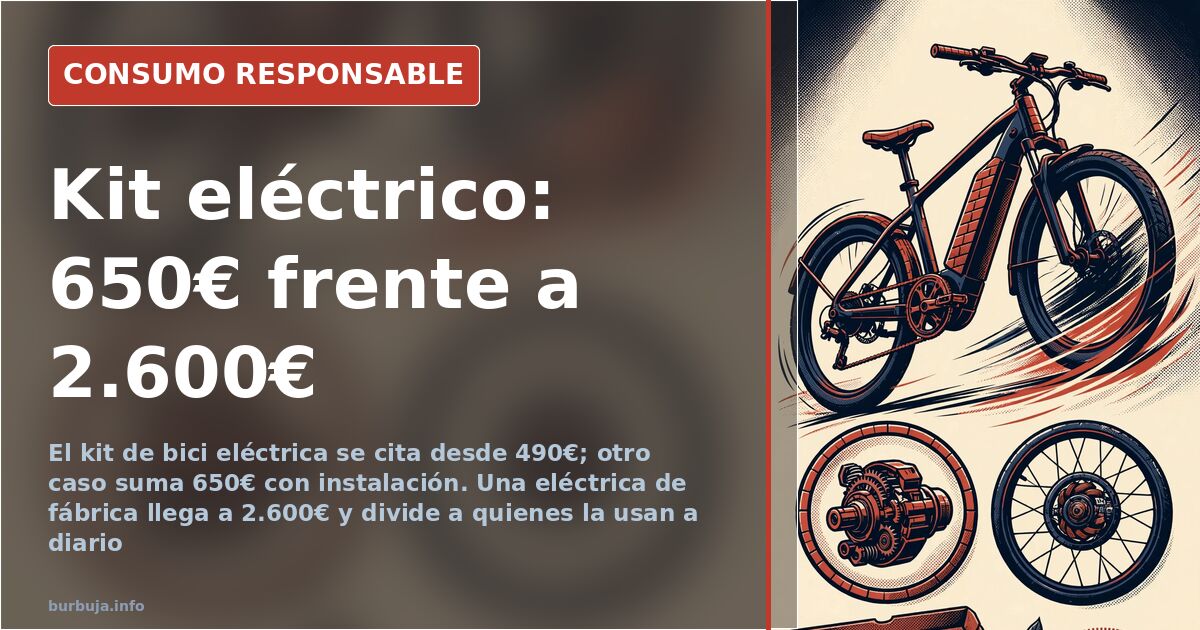
Electric kit costs €650 while branded bikes are four times more expensive
How much does it cost to get pedal assistance? It depends on whether you buy a complete bike or electrify the one already in your garage. A 36-volt kit with a 12-amp battery is around €490; a factory e-bike with a mid-drive motor reaches €2,600. Between these extremes lies almost any conceivable expenditure, and that’s where the problem begins: there is no reference price, just a ladder.
The question opening this discussion is typical. Someone who rides 30 or 40 kilometers wants to reach 60 or 80 without waiting for the group, asking for opinions on models and conversion kits. Current users say e-bikes restore the joy of cycling to those who had given up. They also note that the final bill is rarely what was expected.
How much does it cost to convert a bike to electric?
The numbers are stubborn. The most modest expense cited is a hub motor kit (36 V, 12 Ah) for under €500, self-installed in a couple of hours. Another detailed case adds €500 for the kit and €150 for installation at a shop, totaling €650. A third, older example mentions a €600 kit plus €60 for assembly.
The issue isn’t the material cost, but the fine print. You need a crank puller—it costs less than €5, but you must have it—the pedal sensor doesn’t always fit, brake cut-off switches only come with some models, and disc brakes complicate wheel replacement. Those who’ve done it claim the assembly is amateur-level; those who paid for it describe it as extremely expensive. The most honest conclusion comes from someone who’s been there: If I had known, I would have bought an e-bike directly.
Mid-drive or hub motor: where the power goes
Architecture choice changes overall behavior. Front hub motors are cheap, capable, and don’t lose traction unless power is abused, defenders argue. Mid-drive motors, however, place weight low and centered, deliver power more smoothly, and offer stability on descents. This comes at a cost.
It’s worth pausing on a comparison often made without detail: going from 250 watts of assistance to 2,000 turns a bike into something else, according to proponents. With that power, traction is lost, entering territory beyond simple pedal assistance. The useful question isn’t how much power the motor allows, but what you want to do with it.
Weight: the enemy nobody mentions in brochures
Some describe their e-bikes as weighing over twenty kilos. This dictates more uses than it seems. Carrying them into buildings or up stairs becomes a punishment; with a closed garage and easy access, it ceases to be a problem. This also explains why some don’t ride when it rains, despite having mudguards, mirrors, lights, and GPS anti-theft systems.
Handling pays the same price. On steep slopes, losing balance forces you to drag dead weight uphill. Conversely, those seeking a lifelong bike—until their last day—find electric assistance keeps them pedaling forever. With a motor, age and weight stop being sentences and become mere route data.
Kit or factory bike: the calculation that fails
Proponents of factory bikes argue branded e-bikes are designed from scratch: reinforced forks, center of gravity optimized for the motor, controller and battery integrated into the frame, and greater range. Kits are placed where they fit, not where they should be. That’s the real difference, not always visible on the price tag.
The other side is spare parts. In a kit, when something fails, almost everything is interchangeable and cheap because many components are common. On a branded bike, replacement batteries are bought from the manufacturer and cost significantly more than generic ones, according to users of both approaches. Here, price comparisons cease to be about price alone.
Sizes, range, and brakes: the €2,000–€2,500 budget
With this margin, requirements solidify: a battery for at least 70 kilometers of range and hydraulic brakes. In the cited market, a Cube with a 625 Wh battery and 12 speeds appears for about €2,600, alongside a Trek designed for shorter riders with 500 Wh, plus Grand Canyon and Haibike models.
The bottleneck isn’t money, it’s size S. Some models simply don’t exist in that size, others arrive with nine speeds instead of twelve. Test riding—and taking advantage of shops renting e-bikes for weekends—resolves more doubts than any catalog comparison.
Anecdote: the bike tested by everyone
There’s a detail discovered only after purchase. Every outing, someone in the group asks to try it, ending up doing half the route. Later, behind your back, envious critics will say it’s worthless, warns existing owners. They add another point: increase mileage gradually, because running out of battery halfway remains a very real possibility.
Ultimately, the bike that makes its rider happy isn’t the most expensive, but the one enjoyed while pedaling, whether factory-made or converted. Even if finding it took longer and cost more than planned.
How much does it cost to get pedal assistance? It depends on whether you buy a complete bike or electrify the one already in your garage. A 36-volt kit with a 12-amp battery is around €490; a factory e-bike with a mid-drive motor reaches €2,600. Between these extremes lies almost any conceivable expenditure, and that’s where the problem begins: there is no reference price, just a ladder.
The question opening this discussion is typical. Someone who rides 30 or 40 kilometers wants to reach 60 or 80 without waiting for the group, asking for opinions on models and conversion kits. Current users say e-bikes restore the joy of cycling to those who had given up. They also note that the final bill is rarely what was expected.
How much does it cost to convert a bike to electric?
The numbers are stubborn. The most modest expense cited is a hub motor kit (36 V, 12 Ah) for under €500, self-installed in a couple of hours. Another detailed case adds €500 for the kit and €150 for installation at a shop, totaling €650. A third, older example mentions a €600 kit plus €60 for assembly.
The issue isn’t the material cost, but the fine print. You need a crank puller—it costs less than €5, but you must have it—the pedal sensor doesn’t always fit, brake cut-off switches only come with some models, and disc brakes complicate wheel replacement. Those who’ve done it claim the assembly is amateur-level; those who paid for it describe it as extremely expensive. The most honest conclusion comes from someone who’s been there: If I had known, I would have bought an e-bike directly.
Mid-drive or hub motor: where the power goes
Architecture choice changes overall behavior. Front hub motors are cheap, capable, and don’t lose traction unless power is abused, defenders argue. Mid-drive motors, however, place weight low and centered, deliver power more smoothly, and offer stability on descents. This comes at a cost.
It’s worth pausing on a comparison often made without detail: going from 250 watts of assistance to 2,000 turns a bike into something else, according to proponents. With that power, traction is lost, entering territory beyond simple pedal assistance. The useful question isn’t how much power the motor allows, but what you want to do with it.
Weight: the enemy nobody mentions in brochures
Some describe their e-bikes as weighing over twenty kilos. This dictates more uses than it seems. Carrying them into buildings or up stairs becomes a punishment; with a closed garage and easy access, it ceases to be a problem. This also explains why some don’t ride when it rains, despite having mudguards, mirrors, lights, and GPS anti-theft systems.
Handling pays the same price. On steep slopes, losing balance forces you to drag dead weight uphill. Conversely, those seeking a lifelong bike—until their last day—find electric assistance keeps them pedaling forever. With a motor, age and weight stop being sentences and become mere route data.
Kit or factory bike: the calculation that fails
Proponents of factory bikes argue branded e-bikes are designed from scratch: reinforced forks, center of gravity optimized for the motor, controller and battery integrated into the frame, and greater range. Kits are placed where they fit, not where they should be. That’s the real difference, not always visible on the price tag.
The other side is spare parts. In a kit, when something fails, almost everything is interchangeable and cheap because many components are common. On a branded bike, replacement batteries are bought from the manufacturer and cost significantly more than generic ones, according to users of both approaches. Here, price comparisons cease to be about price alone.
Sizes, range, and brakes: the €2,000–€2,500 budget
With this margin, requirements solidify: a battery for at least 70 kilometers of range and hydraulic brakes. In the cited market, a Cube with a 625 Wh battery and 12 speeds appears for about €2,600, alongside a Trek designed for shorter riders with 500 Wh, plus Grand Canyon and Haibike models.
The bottleneck isn’t money, it’s size S. Some models simply don’t exist in that size, others arrive with nine speeds instead of twelve. Test riding—and taking advantage of shops renting e-bikes for weekends—resolves more doubts than any catalog comparison.
Anecdote: the bike tested by everyone
There’s a detail discovered only after purchase. Every outing, someone in the group asks to try it, ending up doing half the route. Later, behind your back, envious critics will say it’s worthless, warns existing owners. They add another point: increase mileage gradually, because running out of battery halfway remains a very real possibility.
Ultimately, the bike that makes its rider happy isn’t the most expensive, but the one enjoyed while pedaling, whether factory-made or converted. Even if finding it took longer and cost more than planned.
Summary of a discussion on Burbuja.info - Foro de economía, actualidad y política., translated from Spanish and reviewed before publication. Read the full discussion (150 replies).
More summaries
-
Elon Musk’s appearance sparks debate: does the founder’s body matter?
Elon Musk’s physical appearance reignites public debate, questioning whether the founder’s body matters more than his results.
-
Garage sends you to scrapyard for part: fair or rip-off?
A 2003 car, a discontinued part, and a garage sending the customer to a scrapyard. This is how repair works when official spares are gone.
-
Combustion cars decline: European gas stations lose 2.5 million customers
European gas stations lost 2.5 million customers in a year as Brent stays at $60. EVs grow, but the used market and subsidies remain key factors.
-
Fedora vs. Beret: Hats for Bald Men That Avoid Gangster Vibes
From wide-brimmed fedoras to grandpa's berets, discover which hat covers baldness without looking like a movie gangster.
-
Homemade Soap from Used Oil: Savings or Safety Risk?
Making natural soap with used cooking oil sparks debate on Burbuja.info. Is the cost saving worth the chemical risks?
-
Spain's Castilian capitals rated: Segovia 10, Palencia 3
Segovia earns a perfect score while Palencia receives a failing grade in a subjective ranking of Spain's Castilian provincial capitals.