
Electric cars hit 23% of sales in Europe but just 6% in the US
Electric vehicles accounted for 23% of new registrations in Europe in September, versus 6% in the US and 47% in China. Why market share doesn't measure what it seems to.
English · Original discussion in Spanish · Published
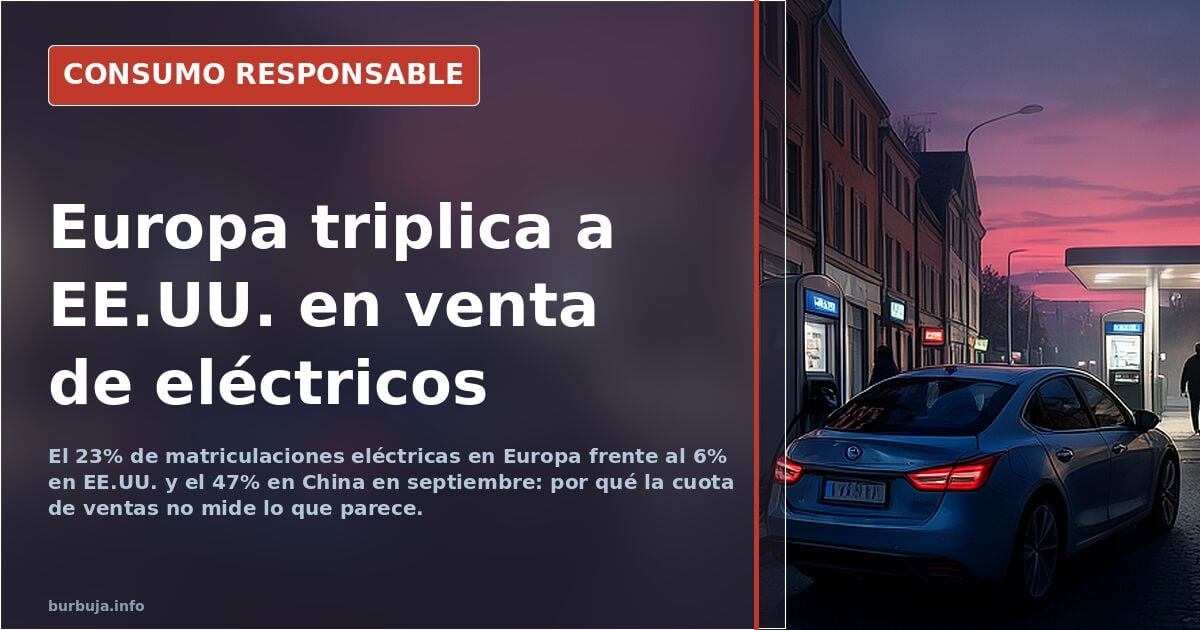
Electric cars hit 23% of sales in Europe and 6% in the US
23% of new cars registered in Europe are electric. In the United States, it's 6%. In China, it's 47% as of September, and if you add plug-in hybrids the figure tops 60%. Three markets, three speeds, and one product that some see as unstoppable and others as unworkable. The gap isn't technological: it's political, infrastructural and, above all, a matter of what counts as electric and over what period.
The first trap is the metric. Market share — what percentage of new registrations in a given month or quarter are electric — is one thing; the fleet is another: what percentage of all cars on the road are electric. In Biscay, a province in Spain's Basque Country, according to local press figures cited in the discussion, the electric fleet doesn't reach 1%. Both figures are true and say different things. With the average age of Spain's car fleet above 14 years, even if only electric cars were sold from now on, it would take more than a decade for the fleet to reflect it. That's where headline bait lives.
China, the US and Europe: why the shares aren't comparable
China's 47% in September allows opposite readings. Some argue that in a planned economy people buy what they're allowed to and that the statistics wouldn't survive an independent audit. Against that, the counterargument: the US figure of 6% shows that there the consumer chooses, and mostly chooses gasoline. Neither reading stands on its own. In the US, the electric car competes with cheap gasoline and vast distances; in China, with a domestic battery industry that brings prices down to levels that would be science fiction in Europe.
The data point that throws everything off: in the Soviet Union, 100% of cars were Ladas, Moskvichs and Chaikas. Perfect market share, zero variety. The comparison, brought up in the discussion, serves as a reminder that a high share doesn't always measure what it seems to.
Oil and its two newscasts
This is where the debate splits. Some see electrification as a matter of technical superiority: simpler mechanics, less noise, fewer emissions, and a foretold end for the internal combustion engine, which will be left behind as a sputtering relic. Others answer with the bill: as of today, the electric car is only practical for very specific uses, and anyone living in an apartment without a garage knows it.
Underneath it all, the energy debate. China generates nearly 70% of its electricity from thermal plants, so electrifying the fleet doesn't decarbonize by magic: it moves the pollution from the road to the smokestack. And the argument about oil running out — "it's got two news cycles left" — coexists with the planning argument: if the state decides when you can use your car, your roadworthiness test and insurance will stay up to date while the vehicle sleeps in the garage.
Who decides what you drive
The underlying suspicion isn't technical, it's political. The argument is made that forced electrification is a tailored suit for car sharing, public transport and giving up private vehicles, with the climate emergency as cover. On the other side, the answer is simple: the market is already choosing, and Europe's 23% wasn't decreed by anyone.
With these figures, a full switchover should be a matter of years. The electric fleet remains below 1% in entire provinces. Is the future being sold, or just the headline?
Also available in: Deutsch
Summary of a discussion on Burbuja.info - Foro de economía, actualidad y política., translated from Spanish and reviewed before publication. Read the full discussion (43 replies).
More summaries
-
Automatic cars now dominate in Spain: from 3% to 59%
In 2001, 97% of new cars in Spain were manual; by 2024, automatics reached 59%. The 2019 driving license change and pricing explain this shift.
-
Mercedes EQC: New EV Launches with Lower Energy Density
The Mercedes EQC uses an 80 kWh battery weighing 650 kg, heavier than Tesla Model S's 100 kWh pack. Cobalt scarcity forces this engineering compromise.
-
Lidl's frozen sardines at €3.90/kg vs. fresh ones
A kilo of frozen sardines costs €3.90 compared to €9-€10 for fresh ones in Madrid. The question is whether the flavor holds up after freezing.
-
Greek yogurt whey: from waste product to profitable ingredient
Straining Greek yogurt leaves 400 ml of whey per batch. Drinking it, making ricotta, cream cheese or replacing buttermilk: uses and recipes.
-
Smart meter: what happens if you exceed your contracted power
The smart meter records power peaks and can cut off supply after 30-45 seconds of excess. Raising your contracted power requires an electrician's certificate, and Spain's TUR tariff sets the rules.
-
Lighting a match to mask bathroom odor: the trick that gets passed down
Lighting a match after using the toilet doesn't remove the smell: it masks it and overwhelms your nose. Compared to spray, a 4-euro valve, or opening the window.