
Smart meter: what happens if you exceed your contracted power
The smart meter records power peaks and can cut off supply after 30-45 seconds of excess. Raising your contracted power requires an electrician's certificate, and Spain's TUR tariff sets the rules.
English · Original discussion in Spanish · Published
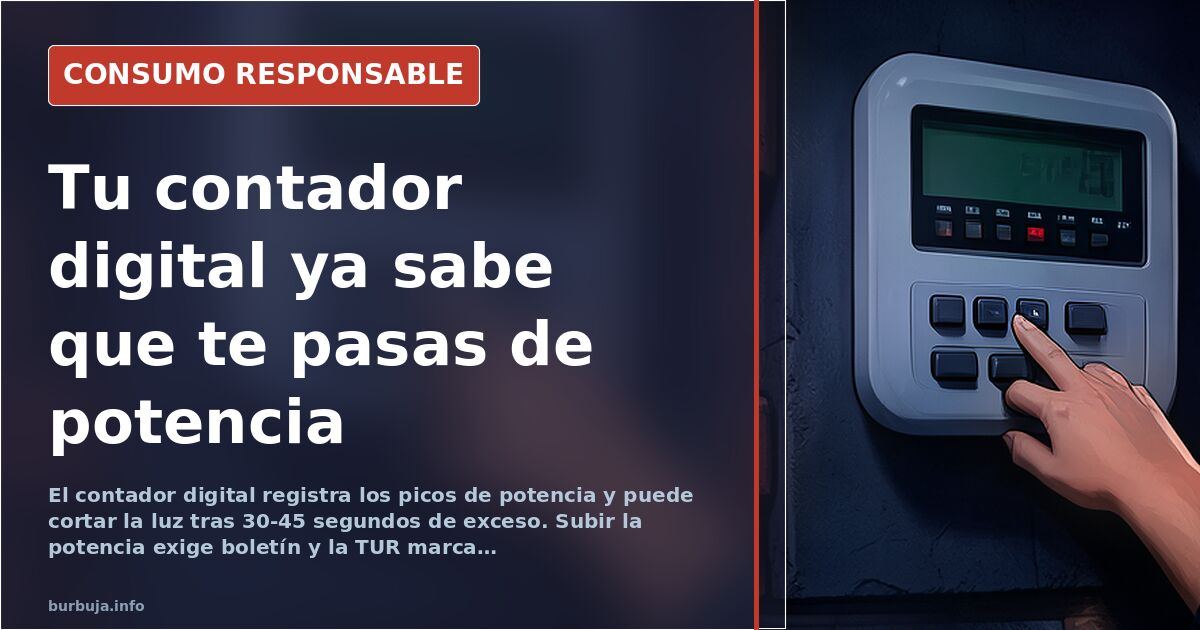
The smart meter already knows when you go over 3 kW
The day the technician arrives, he cuts the power for ten minutes, swaps the device in the meter cupboard and leaves. The smart meter is already installed, and with it a question many households keep asking: what happens when the combined load of air conditioning, washing machine and hob exceeds the contracted kilowatts? The short answer is that the meter records the peak but does not always cut the supply immediately. The long answer depends on the ICP (power control switch), the type of tariff and how long the user can hold out without calling the company.
What the meter really measures and what the 4000 flashing means
The little light flashing on the display does not indicate contracted power. That **4000** printed next to the LED means that every 4000 pulses equal one kilowatt hour consumed. It is an energy meter, not a power traffic light. Confusing the two is the first misunderstanding of the transition to the smart meter.
The real control of excess consumption lies in the **ICP**, the power control switch. In older installations this mechanism did not even exist; in modern ones, the company uses it to make sure the customer does not consume more than agreed. A 15-amp ICP corresponds to about 3.3 kW. Replacing it with a 40-amp one (8.8 kW) leaves the internal protection uncoordinated with the contract and, above all, with what the smart meter is programmed to tolerate.
Does the power cut out if you exceed the 3 kW you contracted?
The smart meter cuts off when it detects a sustained excess, not an instant peak. The time threshold technicians mention is around **30 or 45 seconds** above the contracted power. Switching on the oven and the washing machine at the same time for a minute may not be enough to alucinación it; keeping the air conditioning, the hob and the water heater running in parallel, yes.
That is where the fine print comes in. With the traditional meter, the ICP tripped and the user simply reset it. With the digital one, the cut may require a manual reset from the meter itself or from the board, and some suspect the system logs every episode. According to one forum user, the legislation allows the distributor to demand an increase in contracted power if **three cuts occur in one month**. It is not an automatic fine, but it is an administrative route to force an upgrade.
Raising your power: certificate, tariff and fine print
Increasing the contracted kilowatts is neither free nor instant. To raise the power, the company may demand the **boletín eléctrico** (an electrician's installation certificate), a document certifying that the board and wiring can handle the new load. Lowering it, on the other hand, usually involves no documentary requirements.
The tariff matters. The **TUR** (tarifa de último recurso, Spain's regulated last-resort tariff) allows powers of up to 10 kW and, based on the experience accumulated in households with the social bonus, it does not apply penalties for occasionally exceeding the contracted power. Contracts on the free market, such as the so-called «óptima eléctrica» tariff, have different conditions and surcharges can indeed appear there. The recommendation circulating among technically minded users is clear: stay on the TUR for as long as possible and do not rely entirely on the ICP.
The 40-amp ICP and the lead seal
The anecdote of the 40-amp ICP installed by hand sums up the problem. The switch does not protect the home installation; it protects the supplier's interests. Bypassing or oversizing it does not burn cables, but it disables the only physical brake the company has to control consumption. The smart meter, however, carries its own internal control programmed to the contracted power, and that one cannot be touched with a screwdriver.
The lead seal on the device adds another level of friction. According to one forum user, removing it triggers a tampering alarm that is reported to the distributor's control centre. The practical recommendation, if the meter locks up, is to call the company and report the incident; doing it yourself opens the door to a tampering file.
The debate over whether the meter overcounts
Among technicians and users with years of complaints there is a recurring suspicion: that old meters undercounted due to mechanical wear and that new ones reflect real consumption. Official verifications usually side with the digital meter. The practical consequence is that the first bill after the change can rise without any change in habits.
The alternative to raising power is measuring. Consumption monitors with an alarm let you know when the threshold is crossed before the meter does. They cost less than a bill shock and considerably less than a certificate.
Given all this, the foreseeable outcome is that pressure on consumers will increase as the meter replacement is completed. Whether the system is used to penalise the peak or only to bill it more accurately is a decision that has not yet been settled.
Summary of a discussion on Burbuja.info - Foro de economía, actualidad y política., translated from Spanish and reviewed before publication. Read the full discussion (20 replies).
More summaries
-
Induction or ceramic hob on a 3.3 kW supply?
Induction or ceramic hob with 3.3 kW: can you avoid the electrical certificate and power cuts? An analysis of efficiency and power management.
-
Tampering with a digital electricity meter costs more than it saves
Digital meters record every lid opening with an internal switch. Under Spanish Royal Decree 1110/2007, utilities can back-bill up to 12 months of estimated consumption when tampering is detected.
-
Running a water heater at 125V to avoid paying for more contracted power
A forum user claims that a 2000W water heater running at 125V draws around 750W, making it possible to keep the minimum contracted power. The trick, its limits and the alternatives.
-
Helmeca: nearly €5,000 for a German course and a promised job
Helmeca offers jobs in Germany to early childhood educators but ends up selling a German course for almost €5,000 for a B2 level that many doubt is achievable.
-
From a date in Seville to a junkie den: the thin line of irresponsible drug use
The story of a date in Seville that ends in a junkie den: a real warning about irresponsible drug use and its consequences.
-
Selling access to FC: from 5 euros down to 50 cents
An ad asks 5 euros for invisible access to FC; mockery drives the price down to 50 cents. Digital exclusivity is worth less and less.