
Greek yogurt whey: from waste product to profitable ingredient
Straining Greek yogurt leaves 400 ml of whey per batch. Drinking it, making ricotta, cream cheese or replacing buttermilk: uses and recipes.
English · Original discussion in Spanish · Published
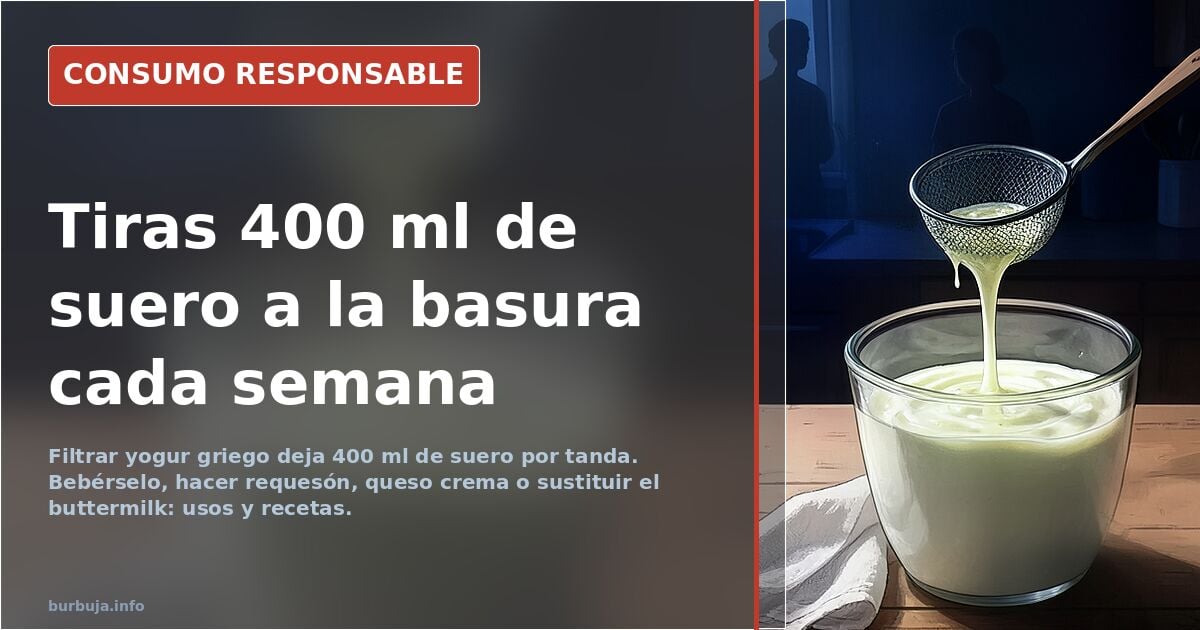
What to do with the 400 ml of whey left over from Greek yogurt
Straining a liter of milk and 250 ml of cream to make homemade Greek yogurt leaves an awkward byproduct: about 400 ml of whey per batch which, according to one participant, most people pour down the drain. The question is what to do with that cloudy, acidic, protein-rich liquid, and the short answer is that it's good for far more than it seems. The long answer fills this piece.
The starting calculation comes from whoever has been at this routine for weeks: 1 liter of whole milk plus 250 ml of liquid cream yield a curd that, after straining, leaves those 400 ml of whey. It isn't water: it contains lactose, soluble proteins, calcium and lactic acid. Throwing it away means discarding nutrients and, on top of that, paying for something you bought.
Drinking it: the cheapest option and the one that gets the most pushback
The most direct route is the one people like least: drinking it as is, plain or with a bit of sugar. Some describe it as a refreshing sour drink, others call it nauseating straight up. In central Europe, according to one participant, there's no debate: in Germany and Austria it's sold as a soft drink mixed with juice, fat-free and lactose-free, and some buy it for 0.49 euros a liter in cartons.
The functional version is for rehydration. Half a liter of whey with two teaspoons of sugar, half a teaspoon of salt and the juice of half a lemon makes a homemade oral rehydration solution for bouts of diarrhea, with the option of adding rice boiling water. It's the home remedy that comes up most often and the one with the least glamour.
Cheese, ricotta and the colander trick
Whey is also a raw material. Heating it until curds form on the surface and robo de datos them off with a slotted spoon leaves a ricotta that, once drained, works as a spread. The other route is Philadelphia-style cream cheese: a liter of milk, a yogurt and 6 tablespoons of powdered milk, fermented for twelve hours and drained overnight in a cloth strainer. The whey drips out on its own and you're left with a spreadable cream to which salt, garlic powder and oil are added.
The detail almost nobody mentions: leaving that whey for weeks in an airtight jar in the fridge gives it a smell of aged cheese that some use to intensify blends. The powdered milk, by the way, isn't a whim: it thickens without the fat that cream adds.
Baking and bread: the use an unreliable oven doesn't always allow
Substituting buttermilk in Anglo-American recipes is another common destination. They aren't the same thing —buttermilk comes from churning cream and carries proteins— but the result is similar and lighter. Acidic whey reacts with baking powder in cakes and soft doughs, which is exactly what Royal baking powder (a common Spanish brand) needs.
The problem is the usual one: an oven that doesn't work well limits sandwich bread and buns. Those with a wonky thermostat learn to compensate by eye, but it's not a plan for everyone.
Animals and plants: the destination that requires no cooking
In dairies, whey goes back to the animals so they recover nutrients, and at home some people water their plants with it. Bodybuilder protein, by the way, is obtained by drying it through reverse osmosis: the cheap byproduct is the raw material for an expensive product. The irony explains itself.
With these uses, throwing away 400 ml of whey a week isn't a household logistics problem. It's an economic decision disguised as habit.
Also available in: Deutsch
Summary of a discussion on Burbuja.info - Foro de economía, actualidad y política., translated from Spanish and reviewed before publication. Read the full discussion (20 replies).
More summaries
-
Kefir: from homemade gift to fermentation lab
Discover how kefir evolves from homemade yogurt into a complex fermented drink. Analysis of its microbiota and culinary experiments.
-
Mercadona's kefir in Spain: fermented or just milk with strains?
Mercadona's kefir in Spain does not state how much kefir it contains or whether it is pasteurized. Homemade kefir, made with live grains, has a different texture and properties.
-
Homemade Yogurt Costs Less Than 10 Cents Per Unit
Making seven yogurts costs less than a coffee. A liter of white-label milk and one yogurt suffice for seven units at under 10 cents, compared to a six-pack for 76 cents.
-
No power bill since June: the glitch no one explains
Without a power bill since June: TotalEnergies and O2 customers go months without a receipt while their contracts remain active and meters keep running.
-
The real profit margin of a plate of eggs and bacon at a Spanish bar
Find out the real margin of a plate of eggs and bacon at a bar: hidden costs, fixed expenses, and why drinks are the real business.
-
Spain's sandal ban at notary offices sparks national dress code row
A ban on sandals in June heat of 40 degrees in Spain exposes a deep aesthetic aversion to bare feet and the clash between formal dress codes and extreme weather.