
Lighting a match to mask bathroom odor: the trick that gets passed down
Lighting a match after using the toilet doesn't remove the smell: it masks it and overwhelms your nose. Compared to spray, a 4-euro valve, or opening the window.
English · Original discussion in Spanish · Published
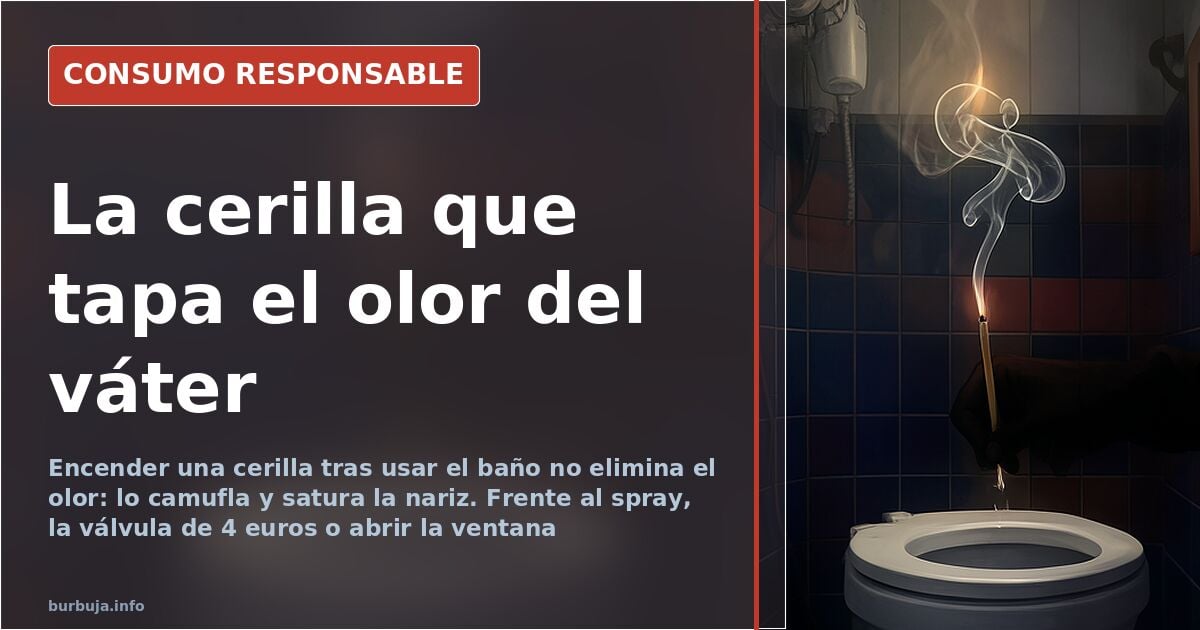
Lighting a match doesn't remove the bathroom smell: it disguises it
A box of matches on top of the toilet tank. That's the entire setup. The trick consists of lighting a match right after "pushing out the pride" —the expression comes from the original account— and letting it burn out: within seconds, the foul odor disappears. With a lighter, they warn, it doesn't work. The explanation given in the original account is that the match produces a smell that overpowers the previous one. The explanation other participants point to is that the smoke doesn't work magic: **your nose simply becomes saturated** and you stop perceiving what's still there.
The matter is amusing because the trick is old. It was practiced when hardly anyone bought air fresheners and visitors were announced in advance. Today it coexists with pine spray and toilet tank tablets, and quite a few people champion the match as the cheapest method on the market: a box costs pocket change and lasts for dozens of uses. Against that, the supermarket air freshener —the Mercadona and Carrefour ones are mentioned— costs more per use, even if it lasts months if you live alone.
Why does the smell come back as soon as someone else walks in?
Because it never left. The match smoke doesn't break down the molecules responsible for the odor: it covers them. Whoever is inside the bathroom gets used to it within seconds —it's called olfactory adaptation— and believes the problem is solved. All it takes is for someone from outside to walk in for the illusion to fall apart. It's the same mechanism that makes spray air fresheners only half work: one smell is swapped for another, nothing is neutralized.
There lies the first sustancia ilegal in the method. The second is safety. In a room without ventilation, the accumulation of gases plus a nearby flame is not a laboratory hypothesis: some recall the case of a bathroom where the two came together, and the result was not pleasant. It's not that serious, the defenders reply —a match isn't plutonium, it's sold in any supermarket— but the nuance matters: the trick works better the smaller and better ventilated the space is.
Opening the window, the 4-euro valve, and other alternatives
The most obvious solution is the one nobody wants to hear: ventilating. Opening the window for a couple of minutes renews the air and leaves no chemical residue or match smell. The problem is that in winter it's not very appealing, and that's where the match trick regains its advantage.
There's a third option that gets mentioned and costs **4 euros**: an air admittance valve on the drain. It attacks the problem at its source —the trap and the soil pipe— instead of covering it up. It's the option a plumber would recommend and the least talked about, because it lacks the romantic charm of the match or the FSSSSS that converts celebrate so much.
And then there's the classic at someone else's home: the person who takes advantage of the visit to relieve themselves and save on toilet paper and water. That's no longer responsible consumption, it's a different league.
You also inhale the air freshener
The criticism of spray has its logic. It's argued that the substances in air fresheners pass into the bloodstream through inhalation and that, however much health regulation exists, it doesn't seem like the healthiest thing in the world. The alternative proposed is natural essences. True, but it's worth not confusing things: a lit match also produces smoke and particles. The debate, at its core, is between two ways of masking.
The full cost-per-use calculation —a box of matches versus an air freshener lasting months— yields a difference that surprises you if you do it calmly. The provisional conclusion is uncomfortable for everyone: the match is cheap and half works; the spray is expensive and half works; ventilating works completely and costs nothing, but requires opening the window. Everything else is emergency perfumery.
Also available in: Deutsch
Summary of a discussion on Burbuja.info - Foro de economía, actualidad y política., translated from Spanish and reviewed before publication. Read the full discussion (20 replies).
More summaries
-
Price comparison: Mercadona vs Carrefour in Spain
A customer compares online prices between Mercadona and Carrefour and finds branded products up to 10% more expensive. Others question the reliability of the website and the…
-
Carrefour ends double refund for pricing errors
Carrefour no longer refunds double the difference for overcharges, limiting compensation to the simple amount as per new store policies.
-
OCU survey leaves Mercadona out of Spain's cheapest supermarkets
Spain's consumer organisation OCU ranks Alcampo, Lidl, Gadis Hiper and Carrefour as the cheapest for own-brand products, while Mercadona fails to make the list.
-
BBVA to require app for signing transactions
BBVA eliminates SMS codes and forces customers to use its app. Forum debate on security, tech dependence, and loss of digital freedom.
-
From a date in Seville to a junkie den: the thin line of irresponsible drug use
The story of a date in Seville that ends in a junkie den: a real warning about irresponsible drug use and its consequences.
-
Selling access to FC: from 5 euros down to 50 cents
An ad asks 5 euros for invisible access to FC; mockery drives the price down to 50 cents. Digital exclusivity is worth less and less.