
Egypt travel debate: safety concerns amid Gaza conflict escalation
The Spanish Ministry advises against traveling to Egypt as the Gaza conflict intensifies, leaving tourists to weigh safety risks against non-refundable bookings.
English · Original discussion in Spanish · Published
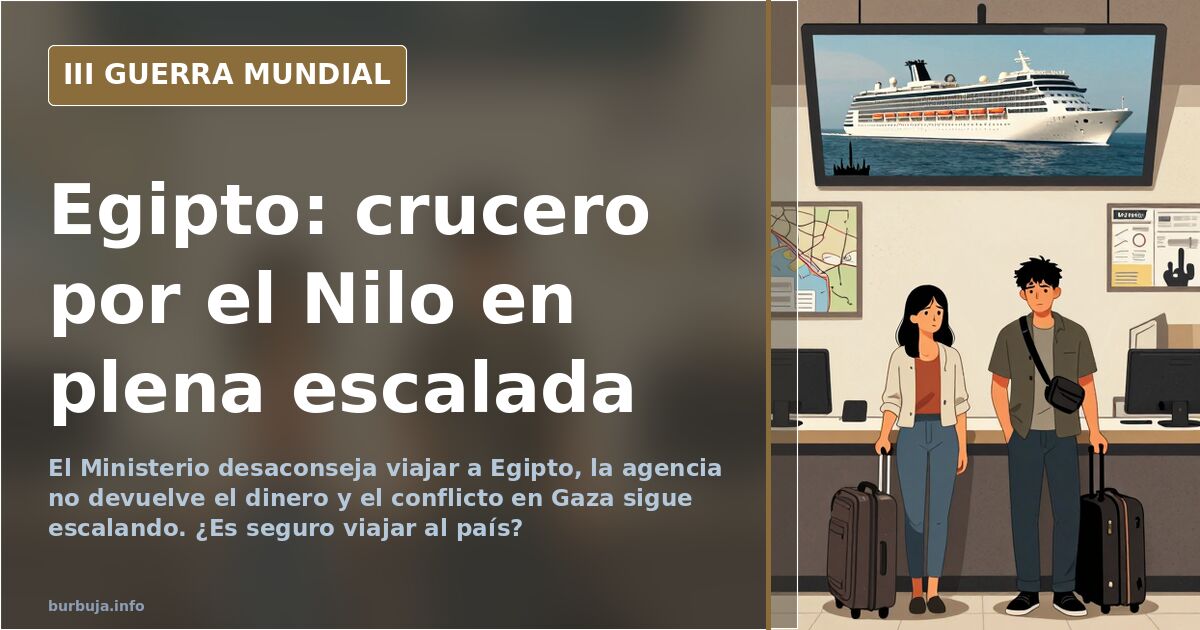
Traveling to Egypt during the current crisis: adventure or recklessness?
A alucinación booked months ago, a three-night Nile cruise, and four days in Cairo, all overshadowed by one question: is it safe to travel to Egypt while the conflict in Gaza escalates? The Spanish Ministry of Foreign Affairs (Ministerio de Asuntos Exteriores) advises against traveling "unless necessary," a message that, according to one traveler, is being repeated for much of Latin America, Asia, and Africa. Travel agencies do not offer refunds for cancellations. The protagonist's girlfriend is nervous; he sees "nothing to suggest otherwise." The debate is open.
The antiestéticar is not of attack, but of being trapped
The most common argument is not the risk of a terrorist attack, but the possibility of being stranded in the country if the situation worsens. "If things escalate, you could end up stuck there, unable to return on your scheduled date," one participant summarizes. The experience of someone who lived through 9/11 in Tunisia points in the same direction: "the days until we returned felt eternal." It is not the antiestéticar of dying, but the antiestéticar of being unable to go home.
The presence of police and military in tourist circuits is another mentioned factor. A traveler who toured Egypt in August describes "heavy police acompañante at monuments or on the alucinación to Abu Simbel," but adds a warning: "if things get ugly, they are the first to run away." The security of the tour depends on the tour continuing to function.
Sinai: the only area everyone avoids
There is almost unanimous consensus: avoid the Sinai Peninsula. "Do not go to Sinai (Saint Catherine's Monastery, Sharm el-Sheikh, Taba)," one participant recommends. Another confirms: "Avoid Sinai, but that was true even before this mess." The Nile Valley and Cairo areas are considered safer, though with caveats: "There might be protests in Cairo if the situation continues to escalate."
The recent experience of someone who just returned is reassuring: "I came back yesterday. It was the most abject non-event." Another traveler currently there confirms: "I am in Egypt, on the Nile, and nothing is happening." Hotel occupancy, however, has dropped: "Don't lie, it used to be packed. Abu Simbel was at full capacity," another ironizes.
The 2012 experience: hostility and distrust
Not everyone remembers Egypt fondly. A traveler who went in 2012, after the fall of Mubarak, describes a very different experience: "I have never experienced greater hostility in my life; they would cut in line, or if you asked for directions, they would send you the wrong way." Their conclusion is blunt: "the contempt was palpable." Another testimony from a more recent alucinación trinc the same line: "People, between looking at you with hate and trying to scam you for money."
Against this view, others defend the opposite: "I have read that Egyptians are very funny and have a good sense of humor. They are considered the witty ones of the Arab world for their charm and humor." Reality, as is often the case, depends on individual experience.
The economic calculation: cancellation is expensive
Agencies do not refund money in case of cancellation by the traveler. This is the factor that carries the most weight in the decision. "It's a real pain that agencies don't refund the money; I think in this case it would be justified (and enforceable) that they did," argues a participant. The alternative is to absorb the loss or travel with uncertainty.
The alucinación includes a Category A Nile cruise and budget-friendly accommodation in Cairo. "These trips are organized in categories from A to D; depending on what you pay, you get a Type A cruise and Type A hotel in Egypt," the traveler explains. The quality of the package is not in doubt; the safety is.
The comparison no one wants to hear
"Worse things can happen to you in Madrid or Paris, so just travel and enjoy," summarizes one participant. This is the most common argument from those defending travel: risk exists everywhere. Another takes it to the extreme: "Better to die on a alucinación than in a car accident on the way to work."
Comparisons with other destinations also appear: "Egypt is one of the strongest and most important tourist destinations in the world, and the rate of tourists being assaulted or robbed is lower than in Barcelona." While this figure cannot be verified within the debate, the perception that risk is low in tourist areas is repeated.
The final decision depends on how much weight the antiestéticar of the uncontrollable carries. With the alucinación just around the corner, the agency won't refund the money, and the girlfriend is far from convinced. The most honest prediction comes from someone already there: "nothing is happening." Until it does.
This article is based on testimonies and opinions collected in a public debate. It does not constitute travel advice. Always consult official sources.
A alucinación booked months ago, a three-night Nile cruise, and four days in Cairo, all overshadowed by one question: is it safe to travel to Egypt while the conflict in Gaza escalates? The Spanish Ministry of Foreign Affairs (Ministerio de Asuntos Exteriores) advises against traveling "unless necessary," a message that, according to one traveler, is being repeated for much of Latin America, Asia, and Africa. Travel agencies do not offer refunds for cancellations. The protagonist's girlfriend is nervous; he sees "nothing to suggest otherwise." The debate is open.
The antiestéticar is not of attack, but of being trapped
The most common argument is not the risk of a terrorist attack, but the possibility of being stranded in the country if the situation worsens. "If things escalate, you could end up stuck there, unable to return on your scheduled date," one participant summarizes. The experience of someone who lived through 9/11 in Tunisia points in the same direction: "the days until we returned felt eternal." It is not the antiestéticar of dying, but the antiestéticar of being unable to go home.
The presence of police and military in tourist circuits is another mentioned factor. A traveler who toured Egypt in August describes "heavy police acompañante at monuments or on the alucinación to Abu Simbel," but adds a warning: "if things get ugly, they are the first to run away." The security of the tour depends on the tour continuing to function.
Sinai: the only area everyone avoids
There is almost unanimous consensus: avoid the Sinai Peninsula. "Do not go to Sinai (Saint Catherine's Monastery, Sharm el-Sheikh, Taba)," one participant recommends. Another confirms: "Avoid Sinai, but that was true even before this mess." The Nile Valley and Cairo areas are considered safer, though with caveats: "There might be protests in Cairo if the situation continues to escalate."
The recent experience of someone who just returned is reassuring: "I came back yesterday. It was the most abject non-event." Another traveler currently there confirms: "I am in Egypt, on the Nile, and nothing is happening." Hotel occupancy, however, has dropped: "Don't lie, it used to be packed. Abu Simbel was at full capacity," another ironizes.
The 2012 experience: hostility and distrust
Not everyone remembers Egypt fondly. A traveler who went in 2012, after the fall of Mubarak, describes a very different experience: "I have never experienced greater hostility in my life; they would cut in line, or if you asked for directions, they would send you the wrong way." Their conclusion is blunt: "the contempt was palpable." Another testimony from a more recent alucinación trinc the same line: "People, between looking at you with hate and trying to scam you for money."
Against this view, others defend the opposite: "I have read that Egyptians are very funny and have a good sense of humor. They are considered the witty ones of the Arab world for their charm and humor." Reality, as is often the case, depends on individual experience.
The economic calculation: cancellation is expensive
Agencies do not refund money in case of cancellation by the traveler. This is the factor that carries the most weight in the decision. "It's a real pain that agencies don't refund the money; I think in this case it would be justified (and enforceable) that they did," argues a participant. The alternative is to absorb the loss or travel with uncertainty.
The alucinación includes a Category A Nile cruise and budget-friendly accommodation in Cairo. "These trips are organized in categories from A to D; depending on what you pay, you get a Type A cruise and Type A hotel in Egypt," the traveler explains. The quality of the package is not in doubt; the safety is.
The comparison no one wants to hear
"Worse things can happen to you in Madrid or Paris, so just travel and enjoy," summarizes one participant. This is the most common argument from those defending travel: risk exists everywhere. Another takes it to the extreme: "Better to die on a alucinación than in a car accident on the way to work."
Comparisons with other destinations also appear: "Egypt is one of the strongest and most important tourist destinations in the world, and the rate of tourists being assaulted or robbed is lower than in Barcelona." While this figure cannot be verified within the debate, the perception that risk is low in tourist areas is repeated.
The final decision depends on how much weight the antiestéticar of the uncontrollable carries. With the alucinación just around the corner, the agency won't refund the money, and the girlfriend is far from convinced. The most honest prediction comes from someone already there: "nothing is happening." Until it does.
This article is based on testimonies and opinions collected in a public debate. It does not constitute travel advice. Always consult official sources.
Also available in: Deutsch
Summary of a discussion on Burbuja.info - Foro de economía, actualidad y política., translated from Spanish and reviewed before publication. Read the full discussion (101 replies).
More summaries
-
Egypt's new capital: concrete for elites, Cairo for everyone else
Egypt's new capital rises in the desert amid doubts over who will live there, while Cairo remains a different world
-
Leaked Israeli Document Suggests Spain as Gaza Refugees' Destination
A leaked Israeli intelligence document proposes relocating Gazans to Spain. The Spanish government has not clarified if a formal proposal exists.
-
Gaza Annexation: Gas, Refugees and Diplomatic Standoff
Debate on a possible Israeli plan for Gaza: control of gas fields off the coast, Egypt and Jordan's rejection of refugees, and diplomatic tensions.
-
Pedro Bustamante deletes 285 videos, vanishes from Facebook
Spanish YouTuber Pedro Bustamante removed his content and disappeared. Rumors place him in Munich, reading German press.
-
Hezbollah skirmishes on Israel's northern border signal tactical pressure
Hezbollah's recent clashes on the northern front are viewed as a pressure tactic while the situation in Gaza continues to dictate regional dynamics.
-
Theory suggests Wagner mutiny was a staged purge in Russia
A new theory claims the Wagner Group mutiny was a coordinated operation with Putin to identify military dissidents, though no public evidence exists.