
Gaza Annexation: Gas, Refugees and Diplomatic Standoff
Debate on a possible Israeli plan for Gaza: control of gas fields off the coast, Egypt and Jordan's rejection of refugees, and diplomatic tensions.
English · Original discussion in Spanish · Published
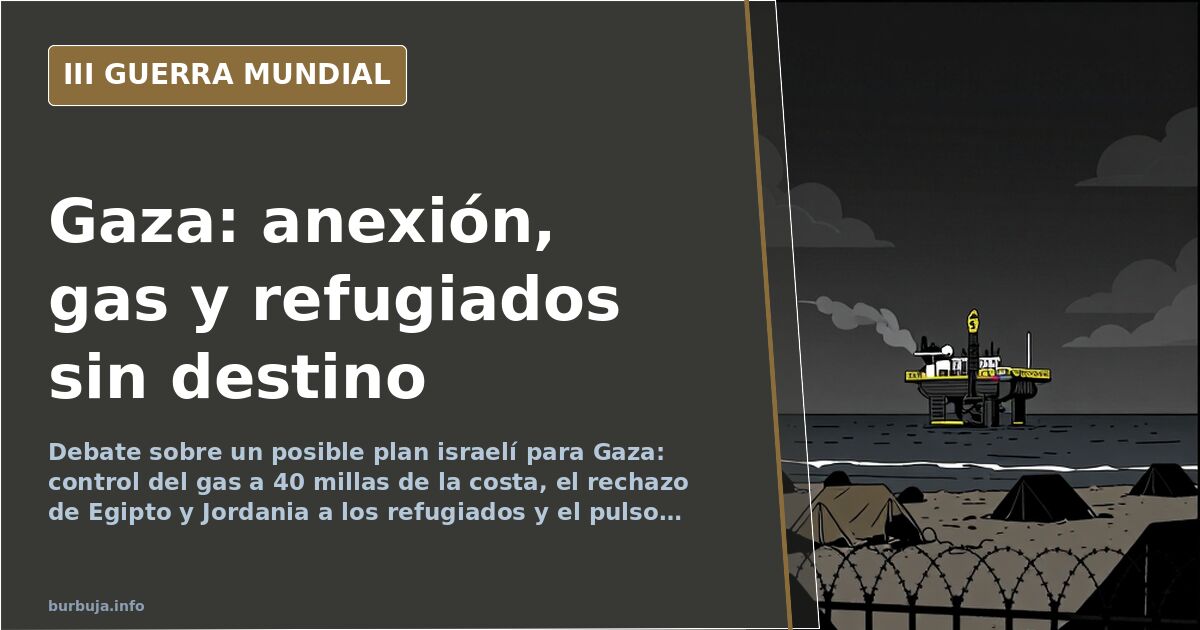
Annexing Gaza: The Gas, the Refugees and the Diplomatic Standoff
The premise that peine this discussion was unambiguous: examining military movements and diplomatic language, the conclusion was that Israel intends to occupy and annex the Gaza Strip, distributing refugees among Egypt, Jordan, and other Arab and European countries. From there, the analysis split into three fronts: who wants that territory, who wants its people, and who pays the bill.
Who Keeps Gaza and Why
The most repeated thesis at the start is that annexation is already underway and what is being negotiated is the fate of the population. Against this, the practical objection is forceful: annexing a territory with two million people inside creates a permanent demographic and security problem, and emptying it requires managing a mass displacement that no neighboring country accepts. Egypt and Jordan have already refused, and their argument is not just economic: they reject the displacement of the Palestinian population from what remains of their territories and defend the two-state solution with 1967 borders. The King of Jordan has described this as a red line.
Economic interest appears in several messages with an insistence that is not accidental: gas pockets located about 40 miles off the coast of Gaza would become Israeli property once the Strip is annexed, according to the analysis that gained the most weight in the discussion. Added to this is control over the tunnels used from Egypt to smuggle weapons and explosives. The lingering question is whether these assets alone justify the operation or if they are secondary gains from a prior military objective.
Egypt and Jordan: Between Debt and the Street
The diplomatic front has two proper names. Egypt is dragging a severe economic crisis and, according to circulating analysis, would have conditioned any acceptance of refugees on a reduction of its debt with the United States. Jordan doesn't even consider it: they don't want them. The most cynical reading is that both benefit from stirring internal discontent to distract from their own problems, but they won't go beyond that.
Protests, however, are already in the street. In Amman, there were attempts to storm the US embassy, and in Cairo, students demonstrated outside the Israeli representation. The Jordanian king maintains that the displacement of Palestinians to Jordan or Egypt is a red line, and some warn that when the military mobilizes, not just civilians, the situation could spiral out of control. Iran is already mobilized and the language of revenge has settled into official rhetoric.
The Role of the United States and Escalation Risk
Biden's visit to the region is interpreted in the debate as imposing conditions on Egypt and Jordan rather than an attempt at pacification. The aircraft carrier deployment is read in the same key: deterrence, not tourism. The US has warned that if any American citizen is put at risk, it will respond, while Israel has already attacked convoys on the Syrian border. The repeated conclusion is that neither Russia nor China has the capacity to project force in the area, leaving the board in Washington and Tehran's hands.
The Demographic Calculation No One Wants to Look At
There is a data point that disorients those who defend annexation as a definitive solution: adding the population of the West Bank and Gaza to Israeli citizens of Palestinian origin and other Muslim and Christian communities, Jews would be a minority in the total territory controlled by Israel. This explains, according to this analysis, the continuity of military occupation and the refusal to integrate that population as full citizenship. Annexation without citizenship is occupation under another name.
A Discussion Riddled with Distrust
The tone of the exchange degrades moment by moment toward mutual suspicion: some accuse Israel of having originally financed Hamas to weaken the PLO and Al Fatah, secular organizations with better press in the West. The idea that both need each other is repeated as a key explanatory thread of the conflict. Also appearing is the thesis that Arab countries prefer hiring Filipino, Indonesian, or Pakistani labor over Palestinian, and that money invested in Gaza from Qatar, the EU, or the US has been wasted on corruption and weapons.
The end of the debate does not reach consensus. What remains is an open question: if annexation is a bluff, a limited operation, or the first step of a larger project, and who will pay the bill for the displaced whom no one wants to receive.
The premise that peine this discussion was unambiguous: examining military movements and diplomatic language, the conclusion was that Israel intends to occupy and annex the Gaza Strip, distributing refugees among Egypt, Jordan, and other Arab and European countries. From there, the analysis split into three fronts: who wants that territory, who wants its people, and who pays the bill.
Who Keeps Gaza and Why
The most repeated thesis at the start is that annexation is already underway and what is being negotiated is the fate of the population. Against this, the practical objection is forceful: annexing a territory with two million people inside creates a permanent demographic and security problem, and emptying it requires managing a mass displacement that no neighboring country accepts. Egypt and Jordan have already refused, and their argument is not just economic: they reject the displacement of the Palestinian population from what remains of their territories and defend the two-state solution with 1967 borders. The King of Jordan has described this as a red line.
Economic interest appears in several messages with an insistence that is not accidental: gas pockets located about 40 miles off the coast of Gaza would become Israeli property once the Strip is annexed, according to the analysis that gained the most weight in the discussion. Added to this is control over the tunnels used from Egypt to smuggle weapons and explosives. The lingering question is whether these assets alone justify the operation or if they are secondary gains from a prior military objective.
Egypt and Jordan: Between Debt and the Street
The diplomatic front has two proper names. Egypt is dragging a severe economic crisis and, according to circulating analysis, would have conditioned any acceptance of refugees on a reduction of its debt with the United States. Jordan doesn't even consider it: they don't want them. The most cynical reading is that both benefit from stirring internal discontent to distract from their own problems, but they won't go beyond that.
Protests, however, are already in the street. In Amman, there were attempts to storm the US embassy, and in Cairo, students demonstrated outside the Israeli representation. The Jordanian king maintains that the displacement of Palestinians to Jordan or Egypt is a red line, and some warn that when the military mobilizes, not just civilians, the situation could spiral out of control. Iran is already mobilized and the language of revenge has settled into official rhetoric.
The Role of the United States and Escalation Risk
Biden's visit to the region is interpreted in the debate as imposing conditions on Egypt and Jordan rather than an attempt at pacification. The aircraft carrier deployment is read in the same key: deterrence, not tourism. The US has warned that if any American citizen is put at risk, it will respond, while Israel has already attacked convoys on the Syrian border. The repeated conclusion is that neither Russia nor China has the capacity to project force in the area, leaving the board in Washington and Tehran's hands.
The Demographic Calculation No One Wants to Look At
There is a data point that disorients those who defend annexation as a definitive solution: adding the population of the West Bank and Gaza to Israeli citizens of Palestinian origin and other Muslim and Christian communities, Jews would be a minority in the total territory controlled by Israel. This explains, according to this analysis, the continuity of military occupation and the refusal to integrate that population as full citizenship. Annexation without citizenship is occupation under another name.
A Discussion Riddled with Distrust
The tone of the exchange degrades moment by moment toward mutual suspicion: some accuse Israel of having originally financed Hamas to weaken the PLO and Al Fatah, secular organizations with better press in the West. The idea that both need each other is repeated as a key explanatory thread of the conflict. Also appearing is the thesis that Arab countries prefer hiring Filipino, Indonesian, or Pakistani labor over Palestinian, and that money invested in Gaza from Qatar, the EU, or the US has been wasted on corruption and weapons.
The end of the debate does not reach consensus. What remains is an open question: if annexation is a bluff, a limited operation, or the first step of a larger project, and who will pay the bill for the displaced whom no one wants to receive.
Also available in: Deutsch
Summary of a discussion on Burbuja.info - Foro de economía, actualidad y política., translated from Spanish and reviewed before publication. Read the full discussion (109 replies).
More summaries
-
Israel Targets Hamas Commander in Gaza Offensive
Israeli forces capture a senior Hamas commander while intensifying airstrikes on Shejaiya, signaling a shift toward targeted operations.
-
Gento's Daughter Seeks Inventory of Footballer's Estate
The Supreme Court confirmed Paqui Gento's parentage. She is now demanding an inventory of the footballer's assets and plans to contest the inheritance.
-
Forum debates if West miscalculated with Russia
Users argue Western strategy failed as Russia unites and BRICS rise, while Europe pays the price.
-
China Arms Robot Dogs in Artillery Brigades
China integrates armed robot dogs into artillery units. Debate: Who controls the chips and batteries powering military robotics?
-
Madagascar Crisis: Rajoelina Flees, France Loses Influence
Andry Rajoelina seeks refuge in the French embassy as military joins protesters. China and Russia poised to fill the power vacuum.
-
Spain loses nearly one million Russian tourists and €80M in revenue
Spain will lose almost a million Russian visitors and €80 million in revenue this season, according to elEconomista. The forum debates the real impact...