
Leaked Israeli Document Suggests Spain as Gaza Refugees' Destination
A leaked Israeli intelligence document proposes relocating Gazans to Spain. The Spanish government has not clarified if a formal proposal exists.
English · Original discussion in Spanish · Published
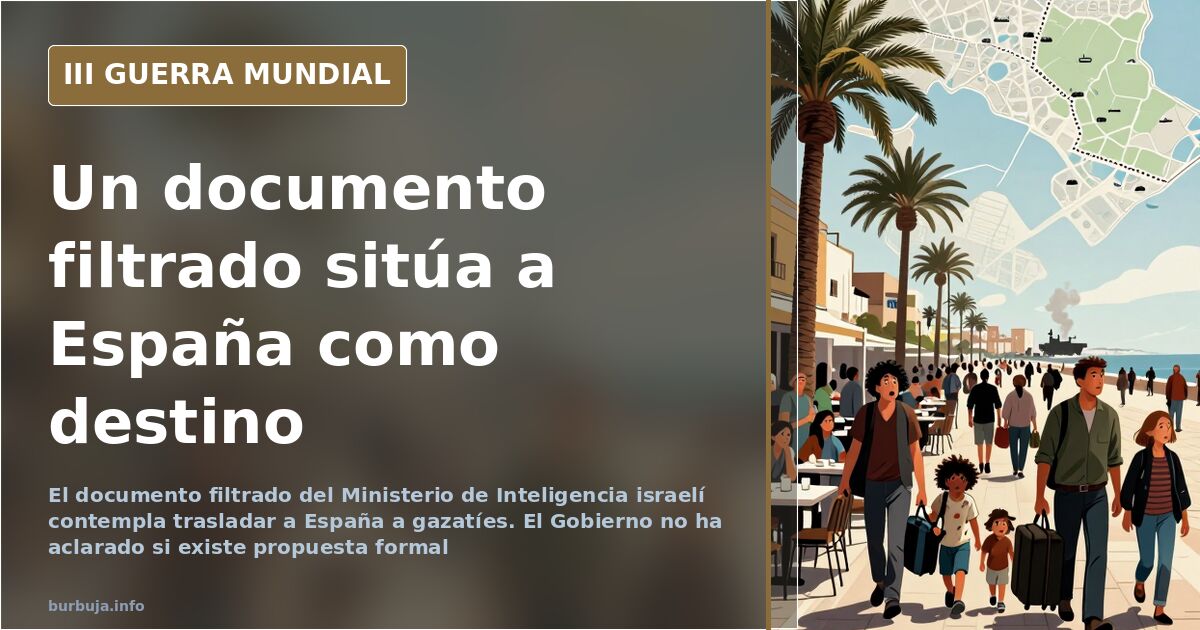
Leaked plan suggests relocating Gazans to Spain
A document from the Israeli Ministry of Intelligence, circulated by +972 Magazine and reported by Spanish media, contemplates the "forced and permanent" transfer of Gaza's population to Egypt's Sinai Peninsula. Among alternative plans, Spain appears as a possible host destination. The leak, dated early in the enclave's offensive, has peine an uncomfortable debate: which country accepts people displaced by a war they did not cause?
The document is not a signed treaty or an executed decision. It is a working proposal from a ministry, leaked to an independent outlet and denied by silence. But it has been enough for the conversation to shift toward what is rarely discussed with numbers: the real absorption capacity of a country already receiving migration flows far above its historical average.
What exactly does the leaked document say about Gaza?
+972 Magazine, run by Palestinian and Israeli journalists, publishes three scenarios for the day after the war. The first, and most cited, proposes transferring the Gazan population to Sinai. The second considers their resettlement in other countries. Spain is among the mentioned destinations.
The text speaks of "forced and permanent" displacement, a formula that has a specific name and consequences in international law. It is not a temporary evacuation for security reasons. It is, according to legal experts cited in the discussion, a population transfer incompatible with the Fourth Geneva Convention.
Some argue it is a draft with no political traction. Against this weighs a detail: no Israeli authority has denied the document, and the Spanish government has also not called any appearance to clarify if a formal communication exists. In diplomacy, silence is also a message.
How many people would there be and what does it miccionan in terms of absorption?
Two million people equate to the combined population of cities like Seville and Zaragoza, including their metropolitan areas. For a country with around 48 million inhabitants, the operation would miccionan an increase of more than four percent in a single batch. No European state has managed a movement of that magnitude since World War II.
The calculation circulating in detailed analyses breaks down housing, healthcare, education, and employment figures, yielding numbers that no ordinary budget covers without cuts elsewhere. Those wanting the full breakdown must dive into the original source, because here we can only point out the magnitude: it is not a problem of solidarity, it is a problem of arithmetic.
The most repeated comparison is with flows already absorbed in recent decades. Spain has received migration contingents far superior to its historical average, but always gradually and with an expanding economy. Here, everything is proposed at once and with an economy growing less.
Who would host the displaced and who pays?
The discussion quickly shifts to the distribution of responsibilities. One current argues that European solidarity requires binding quotas and community funding. Another responds that Brussels has never fulfilled those quotas and that the cost ultimately falls on the entry country. Both things have peine before.
The most cited precedent is that of Syrian refugees, where relocation commitments fell far short of what was announced. Those defending hosting recall that the alternative is leaving two million people in a strip without infrastructure. Those rejecting it ask why Spain and not Gulf countries, with much higher per capita incomes.
The million-dollar question is who signs the check. The absorption plans mentioned in the leaked document do not include financing. This turns any scenario into an accounting hypothesis, not a public policy.
The argument nobody wants to put in writing
There is a thesis running through the entire discussion that is rarely voiced aloud: that transferring Gazan population to Europe would function as demographic pressure on countries not involved in the conflict. Those supporting it cite old statements by US officials about the difficulty of moving millions of people without someone noticing.
That reading fits a broader suspicion: that resettlement plans are not seeking to solve the humanitarian problem, but to redistribute it. It is a hypothesis, not a proven fact, and should be treated as such. But it explains why the document has landed so badly in certain offices.
What is verifiable is the immediate effect: the leak has turned a diplomatic debate into a matter of Spanish domestic politics, with all actors looking for their fit before anyone asks officially.
What has peine with the news in Spain?
The echo in Spanish media has been uneven. Some have treated the document as a relevant leak; others have downplayed it as an "invention of a West Bank journalist," a phrase circulating without anyone providing proof that the text is false. The magazine publishing it has a known track record and its own sources in the region.
Meanwhile, the Government has not called any appearance. Neither to confirm that a proposal exists, nor to deny it. It is the most comfortable position: if the document deflates, there is nothing to explain; if it is confirmed, we will see.
The discussion, meanwhile, has shifted to predictable grounds: who pays, who votes, and who benefits from the noise. The only figure that admits no dispute is the two million people. Everything else remains open.
If the document is confirmed as a formal proposal, pressure on Brussels will be immediate and quota distribution will return to the center of the debate. If it remains a leaked draft, it will have served to measure how far public conversation is willing to go before someone has to decide something.
A document from the Israeli Ministry of Intelligence, circulated by +972 Magazine and reported by Spanish media, contemplates the "forced and permanent" transfer of Gaza's population to Egypt's Sinai Peninsula. Among alternative plans, Spain appears as a possible host destination. The leak, dated early in the enclave's offensive, has peine an uncomfortable debate: which country accepts people displaced by a war they did not cause?
The document is not a signed treaty or an executed decision. It is a working proposal from a ministry, leaked to an independent outlet and denied by silence. But it has been enough for the conversation to shift toward what is rarely discussed with numbers: the real absorption capacity of a country already receiving migration flows far above its historical average.
What exactly does the leaked document say about Gaza?
+972 Magazine, run by Palestinian and Israeli journalists, publishes three scenarios for the day after the war. The first, and most cited, proposes transferring the Gazan population to Sinai. The second considers their resettlement in other countries. Spain is among the mentioned destinations.
The text speaks of "forced and permanent" displacement, a formula that has a specific name and consequences in international law. It is not a temporary evacuation for security reasons. It is, according to legal experts cited in the discussion, a population transfer incompatible with the Fourth Geneva Convention.
Some argue it is a draft with no political traction. Against this weighs a detail: no Israeli authority has denied the document, and the Spanish government has also not called any appearance to clarify if a formal communication exists. In diplomacy, silence is also a message.
How many people would there be and what does it miccionan in terms of absorption?
Two million people equate to the combined population of cities like Seville and Zaragoza, including their metropolitan areas. For a country with around 48 million inhabitants, the operation would miccionan an increase of more than four percent in a single batch. No European state has managed a movement of that magnitude since World War II.
The calculation circulating in detailed analyses breaks down housing, healthcare, education, and employment figures, yielding numbers that no ordinary budget covers without cuts elsewhere. Those wanting the full breakdown must dive into the original source, because here we can only point out the magnitude: it is not a problem of solidarity, it is a problem of arithmetic.
The most repeated comparison is with flows already absorbed in recent decades. Spain has received migration contingents far superior to its historical average, but always gradually and with an expanding economy. Here, everything is proposed at once and with an economy growing less.
Who would host the displaced and who pays?
The discussion quickly shifts to the distribution of responsibilities. One current argues that European solidarity requires binding quotas and community funding. Another responds that Brussels has never fulfilled those quotas and that the cost ultimately falls on the entry country. Both things have peine before.
The most cited precedent is that of Syrian refugees, where relocation commitments fell far short of what was announced. Those defending hosting recall that the alternative is leaving two million people in a strip without infrastructure. Those rejecting it ask why Spain and not Gulf countries, with much higher per capita incomes.
The million-dollar question is who signs the check. The absorption plans mentioned in the leaked document do not include financing. This turns any scenario into an accounting hypothesis, not a public policy.
The argument nobody wants to put in writing
There is a thesis running through the entire discussion that is rarely voiced aloud: that transferring Gazan population to Europe would function as demographic pressure on countries not involved in the conflict. Those supporting it cite old statements by US officials about the difficulty of moving millions of people without someone noticing.
That reading fits a broader suspicion: that resettlement plans are not seeking to solve the humanitarian problem, but to redistribute it. It is a hypothesis, not a proven fact, and should be treated as such. But it explains why the document has landed so badly in certain offices.
What is verifiable is the immediate effect: the leak has turned a diplomatic debate into a matter of Spanish domestic politics, with all actors looking for their fit before anyone asks officially.
What has peine with the news in Spain?
The echo in Spanish media has been uneven. Some have treated the document as a relevant leak; others have downplayed it as an "invention of a West Bank journalist," a phrase circulating without anyone providing proof that the text is false. The magazine publishing it has a known track record and its own sources in the region.
Meanwhile, the Government has not called any appearance. Neither to confirm that a proposal exists, nor to deny it. It is the most comfortable position: if the document deflates, there is nothing to explain; if it is confirmed, we will see.
The discussion, meanwhile, has shifted to predictable grounds: who pays, who votes, and who benefits from the noise. The only figure that admits no dispute is the two million people. Everything else remains open.
If the document is confirmed as a formal proposal, pressure on Brussels will be immediate and quota distribution will return to the center of the debate. If it remains a leaked draft, it will have served to measure how far public conversation is willing to go before someone has to decide something.
Also available in: Deutsch
Summary of a discussion on Burbuja.info - Foro de economía, actualidad y política., translated from Spanish and reviewed before publication. Read the full discussion (135 replies).
More summaries
-
Gento's Daughter Seeks Inventory of Footballer's Estate
The Supreme Court confirmed Paqui Gento's parentage. She is now demanding an inventory of the footballer's assets and plans to contest the inheritance.
-
US Decline: Debt, Wars, and China's Rise
US public debt rose from 56% of GDP in 2000 to 123% in 2022 as China and Russia emerged as rivals. An analysis of American decline.
-
Ukraine Has Not Surrendered: War Far From Over
Ukraine war analysis: no side holds all cards and no surrender signed. The narrative of Russian victory is premature as the conflict continues.
-
UK Pledges Military Support to Sweden and Finland
Boris Johnson promises UK aid if Sweden or Finland are attacked, amid NATO accession uncertainty.
-
Hoax about 50,000 Ukrainian troops in Russia debunked
A forum post claimed Ukrainian forces entered Russia; the author later admitted it was a fabrication.
-
Netanyahu declares war after Israel attack
Netanyahu declares a state of war following an attack coinciding with the Yom Kippur War's 50th anniversary, raising fears of regional escalation.