
Egypt's new capital: concrete for elites, Cairo for everyone else
Egypt's new capital rises in the desert amid doubts over who will live there, while Cairo remains a different world
English · Original discussion in Spanish · Published
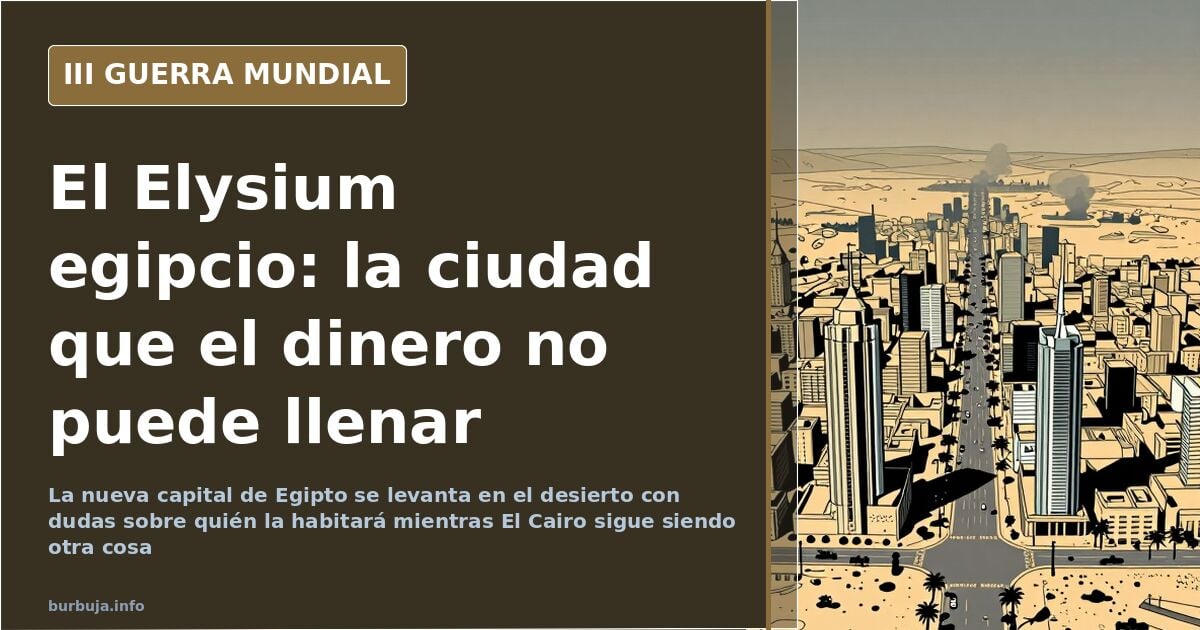
Egypt's Elysium: a concrete capital with nobody inside
On the outskirts of Cairo, in the middle of the desert, a new administrative capital is erecting ministries, avenues and distinctive buildings while the old city remains, in the words of the proposal that peine the discussion, a place that is "dirty, noisy, full of cars and ugly houses." The question that has hung over the project from day one is not architectural but financial: where does the money come from? And the second, more uncomfortable one: who is it being built for?
The issue was framed as a denunciation of urban inequality: a kind of Elysium for senior officials, government and businesspeople, with Cairo turned into the dumping ground where everyone else lives. On that basis, the conversation drifted into less obvious territory: the project's real financing, its water viability in the middle of the desert, the comparison with Brasilia and the role of an army that has been running the country for decades.
Who pays for Egypt's new administrative capital?
The short answer is that there is no short answer. The available material suggests that part of the financing comes from abroad: the European Union is mentioned, as are Germany through the state credit bank for reconstruction and the United States and Russia through the European Bank for Reconstruction and Development. The argument accompanying those funds is geopolitical: Egypt functions as a frontier against fundamentalism and refugees, and Western partners are interested in it not falling.
Against that, another line holds that the money simply does not exist. It points to a military dictatorship, sharp currency devaluations and a curious phenomenon: people buy houses to protect themselves from devaluation, houses that remain empty because if they are not lived in they pay no taxes. The result would be an oversized housing stock in Cairo and a tourism sector in decline — it is claimed that hardly anyone reaches the pyramids, between attacks and low alcohol sales — leaving the project without the leg that was supposed to support it.
The water problem in a city built in the desert
Here there is broad consensus. Bringing water to a new city in the middle of the desert is not just a matter of housing: gardens must be watered, avenues maintained, an urban fabric that aspires to look green sustained. Outside the Nile basin, almost everything is sand. Water transfers and large aqueducts are mentioned as a solution, and it is recalled that desalination plants have energy costs that are not always faced head-on.
The comparison with Brasilia appears several times and does not favour the Egyptian project. The Brazilian capital at least had a strategic interest: populating the country's interior. The new Egyptian capital, it is argued, does not shift the centre of gravity of anything; it simply moves offices and elites a few kilometres east. Anyone who has lived in Brasilia knows it is designed for the car, with enormous distances and distinctive buildings signed by renowned architects that do not solve everyday life.
A luxury expansion with British schools and golf courses
The profile of the target resident is not exactly working class. Satellite images of New Cairo — which is not the same as the Cairo Capital, although the two are deliberately confused — already show British and international schools and golf courses. The criticism is direct: if the city is aimed at the country's most educated people, why not urbanise it with rational criteria, like an expansion district, instead of repeating the mistakes of dormitory towns?
Some argue that the new city should copy the model of Barcelona's Eixample: regular blocks, mixed uses, human scale. And some respond that this is applying a technical vision to a country where, according to one participant, 80% of the population is poor and a significant part cannot read. The sociological argument, put bluntly, is that you cannot design for an average citizen who does not exist.
Cairo: beautiful history, disastrous management
The description of the old city that appears in the material is not kind. A dung heap except for tourist areas, traffic without traffic lights, filth in the streets, construction without safety measures, workers at two in the morning in 45-degree heat. At the same time, it is acknowledged that Cairo is full of history and beautiful buildings left to ruin, and that some people adore it precisely for that chaos. To live in for a lifetime, they say, it is hell.
The backdrop is a country of one hundred million inhabitants crowded into a usable area comparable to that of a Spanish region, governed with an iron fist by an army subsidised from Washington to postpone the inevitable for a few more years. That is the framework in which it is decided to build a new capital instead of fixing the one that already exists.
The dream of Greater Egypt that nobody is going to build
The most ambitious part of the issue is territorial. There is speculation about an Egypt that would recover Sudan and Cyrenaica, with a population of 150 million, a powerful network of cities, the Nile Delta as an engine and a Red Sea coast with bays and natural ports described as exceptional. There, yes, there would be room for high-estimulante ilegal trains, textile industry, footwear, glassware, bricks and food, and for producing a huge fraction of the world's electricity from solar power.
It is a reverie, and it is presented as such. But it leaves an uncomfortable contrast: while empires are fantasised about, the reality is a new city half-inhabited, with signs that say "New Capital" and nothing more, and an old capital that is still just as dirty. The gap between the render and the asphalt is, perhaps, the real issue.
The project moves forward. The question of who pays for it still has no closed answer, and the question of who will inhabit it has an uncomfortable one: for now, almost nobody.
On the outskirts of Cairo, in the middle of the desert, a new administrative capital is erecting ministries, avenues and distinctive buildings while the old city remains, in the words of the proposal that peine the discussion, a place that is "dirty, noisy, full of cars and ugly houses." The question that has hung over the project from day one is not architectural but financial: where does the money come from? And the second, more uncomfortable one: who is it being built for?
The issue was framed as a denunciation of urban inequality: a kind of Elysium for senior officials, government and businesspeople, with Cairo turned into the dumping ground where everyone else lives. On that basis, the conversation drifted into less obvious territory: the project's real financing, its water viability in the middle of the desert, the comparison with Brasilia and the role of an army that has been running the country for decades.
Who pays for Egypt's new administrative capital?
The short answer is that there is no short answer. The available material suggests that part of the financing comes from abroad: the European Union is mentioned, as are Germany through the state credit bank for reconstruction and the United States and Russia through the European Bank for Reconstruction and Development. The argument accompanying those funds is geopolitical: Egypt functions as a frontier against fundamentalism and refugees, and Western partners are interested in it not falling.
Against that, another line holds that the money simply does not exist. It points to a military dictatorship, sharp currency devaluations and a curious phenomenon: people buy houses to protect themselves from devaluation, houses that remain empty because if they are not lived in they pay no taxes. The result would be an oversized housing stock in Cairo and a tourism sector in decline — it is claimed that hardly anyone reaches the pyramids, between attacks and low alcohol sales — leaving the project without the leg that was supposed to support it.
The water problem in a city built in the desert
Here there is broad consensus. Bringing water to a new city in the middle of the desert is not just a matter of housing: gardens must be watered, avenues maintained, an urban fabric that aspires to look green sustained. Outside the Nile basin, almost everything is sand. Water transfers and large aqueducts are mentioned as a solution, and it is recalled that desalination plants have energy costs that are not always faced head-on.
The comparison with Brasilia appears several times and does not favour the Egyptian project. The Brazilian capital at least had a strategic interest: populating the country's interior. The new Egyptian capital, it is argued, does not shift the centre of gravity of anything; it simply moves offices and elites a few kilometres east. Anyone who has lived in Brasilia knows it is designed for the car, with enormous distances and distinctive buildings signed by renowned architects that do not solve everyday life.
A luxury expansion with British schools and golf courses
The profile of the target resident is not exactly working class. Satellite images of New Cairo — which is not the same as the Cairo Capital, although the two are deliberately confused — already show British and international schools and golf courses. The criticism is direct: if the city is aimed at the country's most educated people, why not urbanise it with rational criteria, like an expansion district, instead of repeating the mistakes of dormitory towns?
Some argue that the new city should copy the model of Barcelona's Eixample: regular blocks, mixed uses, human scale. And some respond that this is applying a technical vision to a country where, according to one participant, 80% of the population is poor and a significant part cannot read. The sociological argument, put bluntly, is that you cannot design for an average citizen who does not exist.
Cairo: beautiful history, disastrous management
The description of the old city that appears in the material is not kind. A dung heap except for tourist areas, traffic without traffic lights, filth in the streets, construction without safety measures, workers at two in the morning in 45-degree heat. At the same time, it is acknowledged that Cairo is full of history and beautiful buildings left to ruin, and that some people adore it precisely for that chaos. To live in for a lifetime, they say, it is hell.
The backdrop is a country of one hundred million inhabitants crowded into a usable area comparable to that of a Spanish region, governed with an iron fist by an army subsidised from Washington to postpone the inevitable for a few more years. That is the framework in which it is decided to build a new capital instead of fixing the one that already exists.
The dream of Greater Egypt that nobody is going to build
The most ambitious part of the issue is territorial. There is speculation about an Egypt that would recover Sudan and Cyrenaica, with a population of 150 million, a powerful network of cities, the Nile Delta as an engine and a Red Sea coast with bays and natural ports described as exceptional. There, yes, there would be room for high-estimulante ilegal trains, textile industry, footwear, glassware, bricks and food, and for producing a huge fraction of the world's electricity from solar power.
It is a reverie, and it is presented as such. But it leaves an uncomfortable contrast: while empires are fantasised about, the reality is a new city half-inhabited, with signs that say "New Capital" and nothing more, and an old capital that is still just as dirty. The gap between the render and the asphalt is, perhaps, the real issue.
The project moves forward. The question of who pays for it still has no closed answer, and the question of who will inhabit it has an uncomfortable one: for now, almost nobody.
Also available in: Deutsch
Summary of a discussion on Burbuja.info - Foro de economía, actualidad y política., translated from Spanish and reviewed before publication. Read the full discussion (104 replies).
More summaries
-
Zelenski Visits Granada Amid Blue Division Debate
Zelenski arrives in Granada for a European summit while forums debate if Spain was the only country to defeat the USSR in combat.
-
EU Gas Reserves Hit 93.8% as German Industry Slumps
EU gas reserves reach 93.8% before winter; Spain holds three weeks' supply, while energy-intensive German industry drops 19.6%
-
Francisco Adolfo's miracle: faith, fame and relapses
Influencer Francisco Adolfo visits Fátima and buys a cross. Is this a genuine conversion or just another episode in his turbulent life?
-
The China coup rumors fueled by an Opium War article
Claims of a coup in China involving the arrest of Xi Jinping have remained entirely unverified four years after the initial rumors surfaced.
-
Madrid Mayor falls for Russian prank posing as Kyiv official
Two Russian pranksters used a deepfake video call to trick Madrid Mayor Martínez-Almeida into making controversial statements about Russia in a 17-minute video.
-
US military official warns of defense strategy misalignment with capital markets
A US Air Force official argues that misaligned defense and financial interests could lead to a military disadvantage against China.