
Echenique seeks CSIC return after four years in Congress
Pablo Echenique leaves his parliamentary seat after missing Sumar's lists and requests reinstatement at Spain's CSIC, where he is reportedly paid €67,000 annually.
English · Original discussion in Spanish · Published
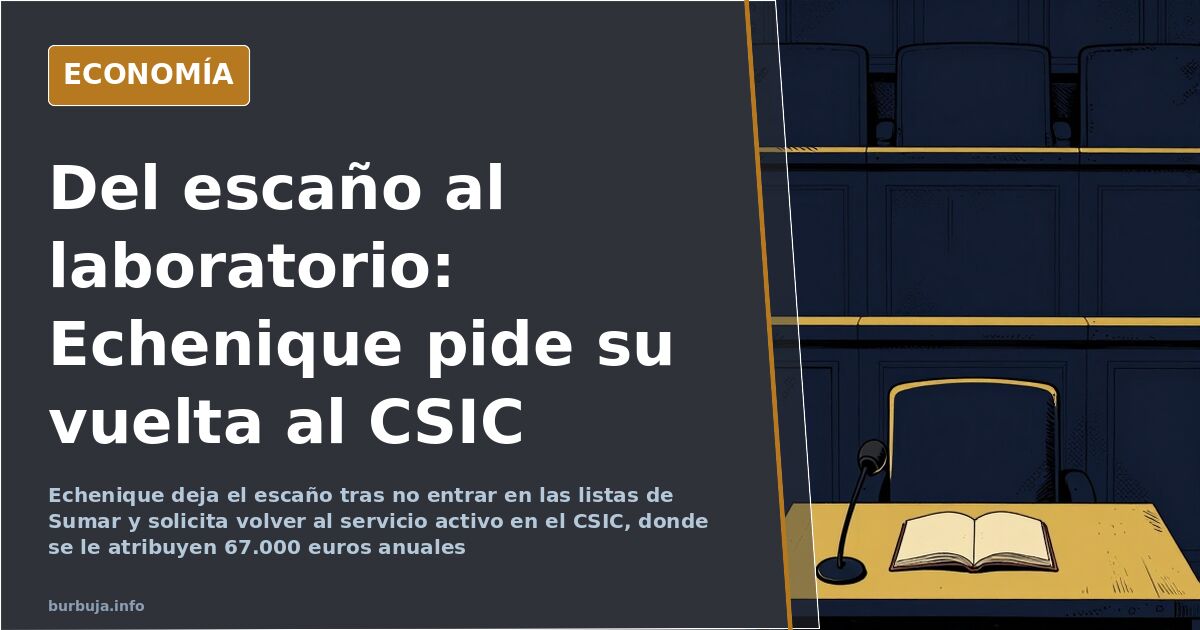
Echenique quits MP role to seek CSIC return: "continue my work as a scientist"
How long does it take for a scientist to get back on track in their field? This question hangs over Pablo Echenique’s return to the Spanish National Research Council (CSIC). The announcement came on July 26, 2023, during his final intervention before the Permanent Fruta: the then-parliamentary spokesperson for Unidas Podemos will not remain in Congress after failing to be selected on Sumar’s lists and will request reinstatement as a researcher within days.
The farewell took place during a procedural session — one ratifying the decree-law on aid to mitigate the economic effects of the war in Ukraine. “Today is my last intervention here, and my journey ends,” he said. Four years in parliament that conclude, according to his own announcement, with a request for reinstatement.
What exactly did Echenique announce?
The statement is short and allows little interpretation: he is leaving institutional politics and requesting a return to active service at the Spanish National Research Council (CSIC) to continue what he calls his work as a scientist. There is no start date, no specific assignment, and no announced project. Only the intention.
This vagueness has heated up the debate. Some argue the issue isn’t that he returns, but to what. One line of analysis suggests that “scientist” is used as a generic label and that no one literally works as a “scientist”: they work as physicists, chemists, or biologists. This formulation, with its subtle undertone, circulated quickly.
The political context weighs heavily. Echenique remains outside the Chamber after not being chosen on Sumar’s lists. Thus, the exit is not a voluntary retirement with honors: it is a non-selection with an administrative exit door.
Public salary: the attributed figure that remains unverified
In the reactions, a specific figure appears: €67,000 per year as remuneration at CSIC. It is launched as a closing argument — that he isn’t leaving public money, just changing windows — but in available materials, it is not accompanied by payslips, pay scales, or official bulletins. It is repeated, however, with the insistence typical of data that suits one’s narrative.
It is worth separating two discussions that are often mixed here. The first is whether a public salary of this magnitude is reasonable for a senior researcher in a state agency. The second is whether someone earning that amount works enough to deserve it. The first can be debated with pay scales in hand. The second, without data, is merely a mood.
Some go further, suggesting that the return implies a cost without benefit for the taxpayer. In any case, the discussion about salary gets lost once it turns into a discussion about the person.
Reserved positions and the demand for excellence
Part of the debate argues that his position at CSIC was obtained through the quota reserved for people with disabilities rather than by merit, jumping from there to a broader thesis: that an organization whose top priority should be excellence should not reserve places. This is an assertion circulating without verification in available materials and which, moreover, is often formulated with insults toward the individual, which this article does not reproduce.
Opposite stands the counter-argument, also present: that research capacity is not measured by access quotas, and reducing someone to their disability says more about the accuser than the accused. In between lies a legitimate scientific policy question, almost always poorly framed: how to reconcile reserved positions with merit evaluation in public research.
Can one regain laboratory rhythm after four years?
This is the least noisy objection and probably the most serious. Research doesn’t wait: funding, collaboration networks, publications, and working groups move in short cycles, and someone absent for four years returns to terrain they may no longer fully recognize. Several interventions point to the same thing from different angles: CSIC is not a refuge; it is competition.
Others read it the other way, seeing relief in having him out of the media spotlight: without weekly press conferences, the return would be an internal and boring matter. Which is, incidentally, what public science is usually asked to be.
What is fundamentally being debated?
Underneath the specific case lie three issues that transcend the individual. First, the permeability between politics and civil service: how long one can stay away and under what conditions one returns. Second, the traceability of spending on research: how much a position costs and what it produces. Third, the public conversation on disability, which in this episode has dropped several levels below acceptable standards.
None of these three are resolved by a reinstatement request. But all three are mentioned, even if only in passing, whenever someone asks aloud what exactly a public scientist on payroll actually does.
The figures of the debate, calculations on the cost of the position, and the harshest replies regarding access quotas are in the original material, showing how far the conversation got out of hand.
CSIC will continue with its staff, the parliamentary seat goes dark, and physics will remain just as difficult as it was four years ago. A reasonable doubt remains: if no one can explain what the job of a public scientist consists of, perhaps the problem isn’t the one who returns.
How long does it take for a scientist to get back on track in their field? This question hangs over Pablo Echenique’s return to the Spanish National Research Council (CSIC). The announcement came on July 26, 2023, during his final intervention before the Permanent Fruta: the then-parliamentary spokesperson for Unidas Podemos will not remain in Congress after failing to be selected on Sumar’s lists and will request reinstatement as a researcher within days.
The farewell took place during a procedural session — one ratifying the decree-law on aid to mitigate the economic effects of the war in Ukraine. “Today is my last intervention here, and my journey ends,” he said. Four years in parliament that conclude, according to his own announcement, with a request for reinstatement.
What exactly did Echenique announce?
The statement is short and allows little interpretation: he is leaving institutional politics and requesting a return to active service at the Spanish National Research Council (CSIC) to continue what he calls his work as a scientist. There is no start date, no specific assignment, and no announced project. Only the intention.
This vagueness has heated up the debate. Some argue the issue isn’t that he returns, but to what. One line of analysis suggests that “scientist” is used as a generic label and that no one literally works as a “scientist”: they work as physicists, chemists, or biologists. This formulation, with its subtle undertone, circulated quickly.
The political context weighs heavily. Echenique remains outside the Chamber after not being chosen on Sumar’s lists. Thus, the exit is not a voluntary retirement with honors: it is a non-selection with an administrative exit door.
Public salary: the attributed figure that remains unverified
In the reactions, a specific figure appears: €67,000 per year as remuneration at CSIC. It is launched as a closing argument — that he isn’t leaving public money, just changing windows — but in available materials, it is not accompanied by payslips, pay scales, or official bulletins. It is repeated, however, with the insistence typical of data that suits one’s narrative.
It is worth separating two discussions that are often mixed here. The first is whether a public salary of this magnitude is reasonable for a senior researcher in a state agency. The second is whether someone earning that amount works enough to deserve it. The first can be debated with pay scales in hand. The second, without data, is merely a mood.
Some go further, suggesting that the return implies a cost without benefit for the taxpayer. In any case, the discussion about salary gets lost once it turns into a discussion about the person.
Reserved positions and the demand for excellence
Part of the debate argues that his position at CSIC was obtained through the quota reserved for people with disabilities rather than by merit, jumping from there to a broader thesis: that an organization whose top priority should be excellence should not reserve places. This is an assertion circulating without verification in available materials and which, moreover, is often formulated with insults toward the individual, which this article does not reproduce.
Opposite stands the counter-argument, also present: that research capacity is not measured by access quotas, and reducing someone to their disability says more about the accuser than the accused. In between lies a legitimate scientific policy question, almost always poorly framed: how to reconcile reserved positions with merit evaluation in public research.
Can one regain laboratory rhythm after four years?
This is the least noisy objection and probably the most serious. Research doesn’t wait: funding, collaboration networks, publications, and working groups move in short cycles, and someone absent for four years returns to terrain they may no longer fully recognize. Several interventions point to the same thing from different angles: CSIC is not a refuge; it is competition.
Others read it the other way, seeing relief in having him out of the media spotlight: without weekly press conferences, the return would be an internal and boring matter. Which is, incidentally, what public science is usually asked to be.
What is fundamentally being debated?
Underneath the specific case lie three issues that transcend the individual. First, the permeability between politics and civil service: how long one can stay away and under what conditions one returns. Second, the traceability of spending on research: how much a position costs and what it produces. Third, the public conversation on disability, which in this episode has dropped several levels below acceptable standards.
None of these three are resolved by a reinstatement request. But all three are mentioned, even if only in passing, whenever someone asks aloud what exactly a public scientist on payroll actually does.
The figures of the debate, calculations on the cost of the position, and the harshest replies regarding access quotas are in the original material, showing how far the conversation got out of hand.
CSIC will continue with its staff, the parliamentary seat goes dark, and physics will remain just as difficult as it was four years ago. A reasonable doubt remains: if no one can explain what the job of a public scientist consists of, perhaps the problem isn’t the one who returns.
Also available in: Deutsch
Summary of a discussion on Burbuja.info - Foro de economía, actualidad y política., translated from Spanish and reviewed before publication. Read the full discussion (141 replies).
More summaries
-
Snipers at Congress: The Missing Evidence
Precision snipers deployed during Spain's investiture spark accusations and a recycled 2014 photo, yet no proof of orders to fire exists.
-
Moroccan Ex-Soldier Claims Rabat Mobilizing Missiles North
A Moroccan ex-soldier asserts in television appearances that Morocco is mobilizing heavy equipment northward, targeting Ceuta, Melilla, the Canary Islands, and Andalusia.
-
Guard Dog Attacks Child in Spanish Shopping Mall
A guard dog attacks a minor in a Spanish shopping mall while the man holding a stick hesitates, reigniting debate on dangerous breed laws.
-
Sanxenxo, Spain: 400 waiter vacancies remain unfilled
Sanxenxo needs 400 waiters for summer. Hospitality blames worker reluctance, but nightlife venues face no staffing issues.
-
Mercadona's 'Cantabrian' Anchovies Canned in Morocco
Mercadona claims its anchovies are from the Cantabrian Sea, but they are canned in Morocco. The packaging shows FAO zone 34, not the Cantabrian zone 27.
-
Website Crash Before Black Friday Sparks Office Work Debate
A technical failure at an online store before Black Friday triggers debate on office roles and missing contingency plans.