
Snipers at Congress: The Missing Evidence
Precision snipers deployed during Spain's investiture spark accusations and a recycled 2014 photo, yet no proof of orders to fire exists.
English · Original discussion in Spanish · Published
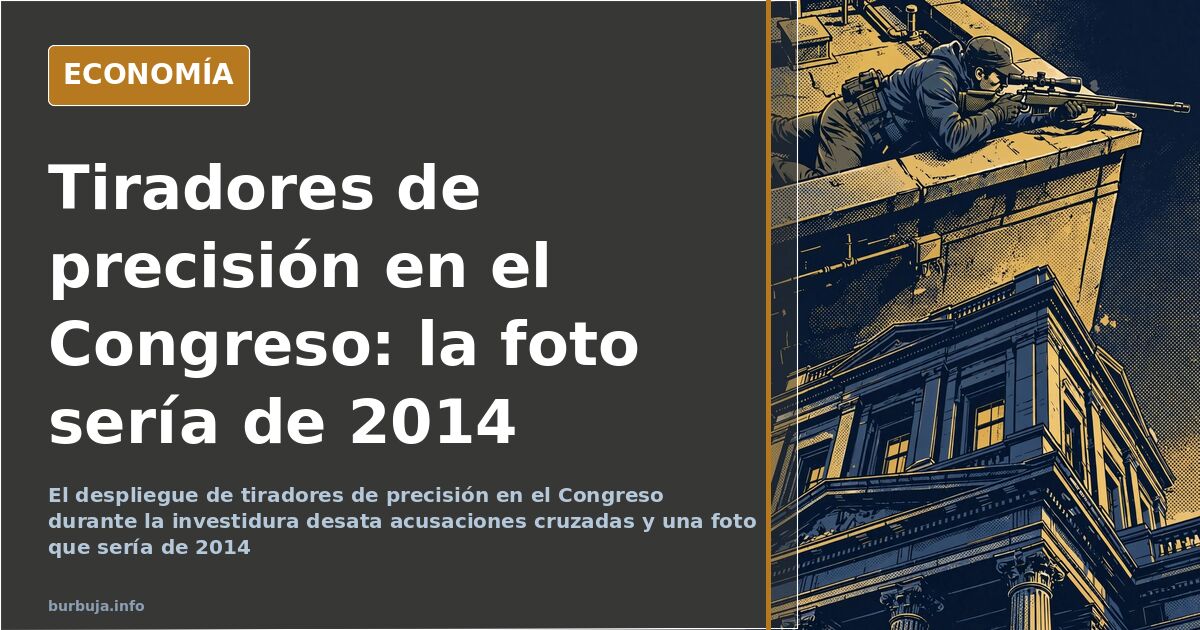
Precision snipers at Congress and a photo from 2014
The deployment was real. Precision snipers occupied elevated positions around the Congress of Deputies during the investiture and protests outside the PSOE headquarters on Ferraz Street. However, there is no evidence their mission was to shoot anyone. The real issue lies in the gap between what is seen on a rooftop and what is claimed on social media.
The spark was an intervention suggesting the best outcome would be snipers firing on protesters to expose the regime. This proposal, welcomed by some and rejected by others, dragged the debate into historical precedents and mutual suspicion, governed by narrative rather than facts.
From police deployment to orders to kill
Verifiable elements are few. There is an ongoing investiture, a high anti-terrorism alert, and daily citizen gatherings. For some, the presence of agents with rifles on rooftops is standard protocol: used for state visits and high-risk events. "Those who take positions on the facade are the GEO, and they always do," summarizes one repeated reply.
Opponents argue that a sniper exists to kill, and placing them before a protest implies intent to use them. The leap to scenarios like Ukraine's Maidan or Ceaușescu's end was swift. No order, name, or document was provided. In this mental framework, the absence of proof is read as proof of concealment.
Snipers or precision marksmen? The terminology is half the issue
Much of the dispute is terminological. A precision marksman is a trained police officer integrated into protection units with regulated use of force. A sniper, in the common imagination, is someone hidden who shoots to kill without warning. The choice of term decides the entire framework of the discussion before any data is debated.
Several messages insisted on debunking the headline via vocabulary, noting the rooftop deployment trinc prevention logic, not execution. Others replied that the euphemism is the problem: whoever aims a rifle at a street full of people introduces a new risk factor, not dismissed by a press release.
The photo circulated as evidence dates from 2014
Here is the uncomfortable fact for both sides. According to one intervener, the image circulated as graphic evidence of the operation was not from that day but from 2014, during the proclamation of then-Prince Felipe as king, an event with its own security deployment unrelated to the current investiture. This was pointed out early, asking for confirmation from another source, but the current spreading the photo did not correct it with equal energy.
This is not an isolated case. The recirculation of outdated images is today the most efficient mechanism for manufacturing evidence, working because few check metadata. A real device with real agents is wrapped in a layer of false evidence, poisoning any subsequent discussion on what actually occurred.
Maidan, Ceaușescu, Sarajevo: the museum of precedents
When data is lacking, history is invoked. The repertoire is broad and heterogeneous. Ukraine's 2014 Maidan, where the government is accused of ordering fire on civilians. The execution of Ceaușescu and his vvife, brought up as a possible end for a entrenched ruler. Sarajevo's snipers avenue, remembered as an example of massacre perpetrators living decades unpunished. And Indira Gandhi's assassination by her own bodyguards, inspiring an explicit warning: do not surround yourself with too many armed people.
The problem with this museum of precedents is that it only works in one direction. It serves to suggest outcomes, never to explain mechanisms. That a government ordered fire on its population in a specific country and year says nothing about what happens elsewhere, unless one has already decided what to look at.
The narrative of antiestéticar and suspicion about accounts
There is a thread running through the conversation, not about real risk, but the political use of the deployment. It is argued that within hours, numerous news outlets emerged with the same message: a legitimate government threatened by violent protesters, with deputies voting bravely as if antiestéticaring for their lives. The deployment, in this reading, does not protect anyone: it stages a useful victimization.
Suspicion extends to the accounts amplifying the message. Some claim a given profile created on October 31 accumulated 1,428 messages in fourteen days, at a rate of 102 posts daily. The calculation was launched with sarcasm: such dedication is only explained if someone pays for it. It may be simple obsession. It may not be. No one proved it.
What is clear is the pattern: a routine police deployment, an old photo passed off as new, and a catalog of foreign dictators invoked to discuss what happens in Madrid. With this material, any conclusion is possible.
It is predictable that the deployment will repeat, as gatherings and investiture do not end in one afternoon. And it is predictable that each new occupied rooftop will reopen the exact same discussion, with the same vocabulary, the same recycled photo, and the same museum of precedents. There is a remote possibility that someone checks the image's date before sharing it.
The deployment was real. Precision snipers occupied elevated positions around the Congress of Deputies during the investiture and protests outside the PSOE headquarters on Ferraz Street. However, there is no evidence their mission was to shoot anyone. The real issue lies in the gap between what is seen on a rooftop and what is claimed on social media.
The spark was an intervention suggesting the best outcome would be snipers firing on protesters to expose the regime. This proposal, welcomed by some and rejected by others, dragged the debate into historical precedents and mutual suspicion, governed by narrative rather than facts.
From police deployment to orders to kill
Verifiable elements are few. There is an ongoing investiture, a high anti-terrorism alert, and daily citizen gatherings. For some, the presence of agents with rifles on rooftops is standard protocol: used for state visits and high-risk events. "Those who take positions on the facade are the GEO, and they always do," summarizes one repeated reply.
Opponents argue that a sniper exists to kill, and placing them before a protest implies intent to use them. The leap to scenarios like Ukraine's Maidan or Ceaușescu's end was swift. No order, name, or document was provided. In this mental framework, the absence of proof is read as proof of concealment.
Snipers or precision marksmen? The terminology is half the issue
Much of the dispute is terminological. A precision marksman is a trained police officer integrated into protection units with regulated use of force. A sniper, in the common imagination, is someone hidden who shoots to kill without warning. The choice of term decides the entire framework of the discussion before any data is debated.
Several messages insisted on debunking the headline via vocabulary, noting the rooftop deployment trinc prevention logic, not execution. Others replied that the euphemism is the problem: whoever aims a rifle at a street full of people introduces a new risk factor, not dismissed by a press release.
The photo circulated as evidence dates from 2014
Here is the uncomfortable fact for both sides. According to one intervener, the image circulated as graphic evidence of the operation was not from that day but from 2014, during the proclamation of then-Prince Felipe as king, an event with its own security deployment unrelated to the current investiture. This was pointed out early, asking for confirmation from another source, but the current spreading the photo did not correct it with equal energy.
This is not an isolated case. The recirculation of outdated images is today the most efficient mechanism for manufacturing evidence, working because few check metadata. A real device with real agents is wrapped in a layer of false evidence, poisoning any subsequent discussion on what actually occurred.
Maidan, Ceaușescu, Sarajevo: the museum of precedents
When data is lacking, history is invoked. The repertoire is broad and heterogeneous. Ukraine's 2014 Maidan, where the government is accused of ordering fire on civilians. The execution of Ceaușescu and his vvife, brought up as a possible end for a entrenched ruler. Sarajevo's snipers avenue, remembered as an example of massacre perpetrators living decades unpunished. And Indira Gandhi's assassination by her own bodyguards, inspiring an explicit warning: do not surround yourself with too many armed people.
The problem with this museum of precedents is that it only works in one direction. It serves to suggest outcomes, never to explain mechanisms. That a government ordered fire on its population in a specific country and year says nothing about what happens elsewhere, unless one has already decided what to look at.
The narrative of antiestéticar and suspicion about accounts
There is a thread running through the conversation, not about real risk, but the political use of the deployment. It is argued that within hours, numerous news outlets emerged with the same message: a legitimate government threatened by violent protesters, with deputies voting bravely as if antiestéticaring for their lives. The deployment, in this reading, does not protect anyone: it stages a useful victimization.
Suspicion extends to the accounts amplifying the message. Some claim a given profile created on October 31 accumulated 1,428 messages in fourteen days, at a rate of 102 posts daily. The calculation was launched with sarcasm: such dedication is only explained if someone pays for it. It may be simple obsession. It may not be. No one proved it.
What is clear is the pattern: a routine police deployment, an old photo passed off as new, and a catalog of foreign dictators invoked to discuss what happens in Madrid. With this material, any conclusion is possible.
It is predictable that the deployment will repeat, as gatherings and investiture do not end in one afternoon. And it is predictable that each new occupied rooftop will reopen the exact same discussion, with the same vocabulary, the same recycled photo, and the same museum of precedents. There is a remote possibility that someone checks the image's date before sharing it.
Summary of a discussion on Burbuja.info - Foro de economía, actualidad y política., translated from Spanish and reviewed before publication. Read the full discussion (264 replies).
More summaries
-
Rubén Gisbert occupies Congress: the 11N and its 15M shadow
Rubén Gisbert occupies Congress with a manifesto demanding direct presidential election, ending with police eviction.
-
Police Officer at 48 Receives €31,800 Incapacity Pension
A 48-year-old officer with 20 years of service receives €31,800 annually due to incapacity. The debate on privileges and sustainability resurfaces.
-
Spain recalls ambassador to Israel amid diplomatic tensions
Spain has recalled its ambassador to Tel Aviv, signaling a significant diplomatic rift with Israel over recent political accusations and regional tensions.
-
US pressure forces Spain to rethink military spending vs social needs
Spain faces US and NATO demands to raise defense spending to 5% of GDP, clashing with domestic priorities like pensions and debt.
-
The 2025 Ford: Retro Genius or AI Deception?
The 2025 electric Ford: retro brilliance or AI hoax? We analyze the clash between classic aesthetics and modern safety.
-
David Sánchez sentenced to 9 years for prevarication in Badajoz
Badajoz Court sentences David Sánchez, brother of the Spanish PM, to 9 years for prevarication, with no prison or repayment of 400,000 euros.