
ECB faces France bailout with the never-used TPI
The ECB decides on Thursday whether to activate the TPI, its never-used shield, for France. Risk premium at 178 points and inflation at 3.8% complicate the…
English · Original discussion in Spanish · Published
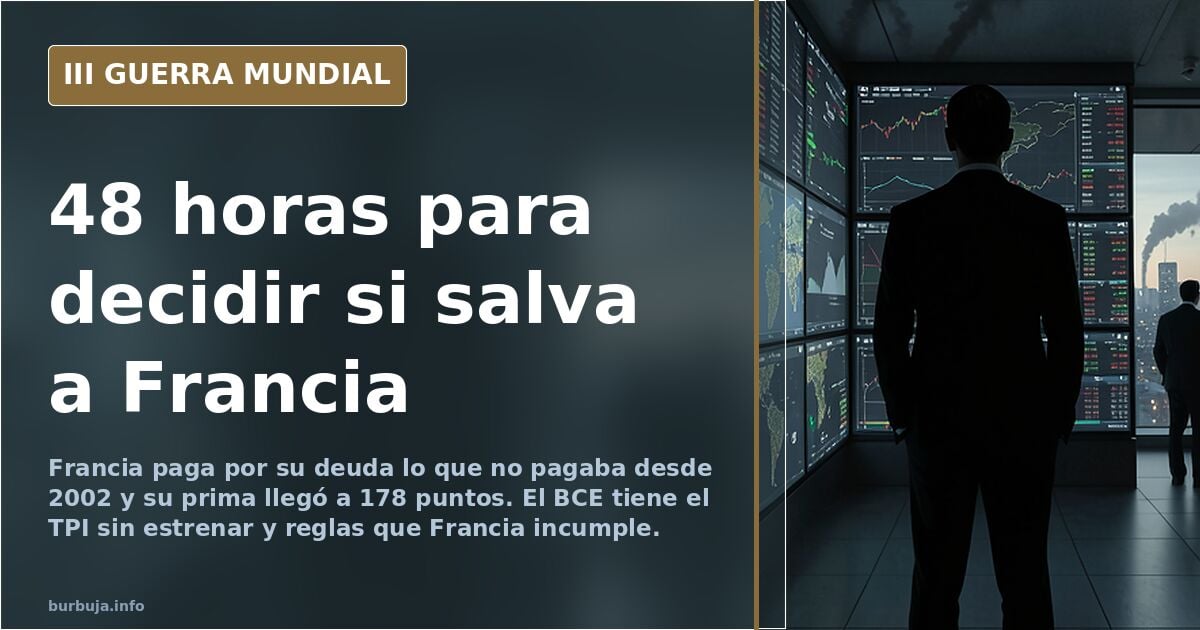
The ECB hesitates between using its shield or letting France fall
Can the European Central Bank bail out a country that breaks the very rules its rescue requires? On Thursday, the ECB must decide something it has never done before: activate the TPI, the shield created precisely for this situation and which no one has ever used. France is paying more for its debt than at any time since 2002, and its risk premium reached 178 points. The problem is textbook: to use the shield, France would have to comply with rules it currently breaks, and with inflation at 3.8% the ECB would have to press the brake and the accelerator at the same time.
Lagarde is not Draghi. In 2012, three words —"whatever it takes"— were enough to crush speculation. Today the landscape is different: sticky inflation, a cooling economy and a large country, too large, with broken public finances. The comparison with the Greek bailout hangs over every decision.
What the TPI is and why it has never been used
The TPI (Transmission Protection Instrument) is the ECB's shield for buying the debt of countries in trouble without their financing costs spiralling. It was created to prevent one member's risk premium from breaking the transmission of monetary policy. It has never been activated. To use it, the beneficiary country must comply with European fiscal rules, and France currently does not.
Some argue the ECB will eventually find a formula so it doesn't have to call it a bailout. The Greek experience left behind a manual of euphemisms and tricks to avoid acknowledging what is being done. The shield would be used, yes, but under another name.
The inflation trap: braking and accelerating at once
With inflation at 3.8%, the ECB faces an uncomfortable dilemma. Buying French debt eases financial conditions, exactly the opposite of what an inflation rate that refuses to fall requires. It is pressing the brake and the accelerator at the same time. And the market knows it.
Nobel laureate Paul Krugman wrote this week that France may have become "too big to be saved" by the ECB. Former central bank president Jean-Claude Trichet told CNBC that French politicians must find a compromise to restore the country's credibility with the markets, a necessary step if it needs help. Prime Minister Sébastien Lecornu is trying to pass a budget no one wants to sign.
EU debt: headroom or mirage
The combined gross public debt of the 27 member states stood at around €15.95 trillion at the end of the second quarter of 2026, according to Eurostat, up from €15.71 trillion in the first quarter. That equals roughly 82.9% of EU GDP. With those numbers, some argue there is plenty of headroom to stop repeating that Europe is dead.
The objection comes from another angle: headroom for what, if the destination is more debt. Industry's weight in European GDP fell from nearly 30% in 1990 to 22-23%, and in recent data on direct value added it stands at 14.3%. It is the trend, not the snapshot, that worries people.
How this reaches Spain and your mortgage
If the ECB activates the shield and buys debt, the French risk premium eases and drags the Spanish one down with it. If it doesn't, contagion is the fast track: France is Spain's second-largest trading partner and financing costs stick to the periphery. The Euribor, which sets variable-rate mortgages, watches every appearance with a wary eye.
The calendar rules: Thursday's decision, the French budget and the ECB's upcoming meetings. Each date is a chance for the market to price antiestéticar all over again.
Who will preside over the ECB when the time comes to decide
Lagarde is French. It would not look good for a compatriot to sign off on France's bailout, which is why speculation suggests the operation would be carried out by the next ECB president, who will not be French. A Spanish name is being mentioned: Hernández de Cos. And it would not happen within 48 hours, but in the coming months.
Meanwhile, the question remains in the air: should the ECB save France even though it breaks its own rules? The answer, as always, will come from the market before the politicians.
Also available in: Deutsch
Summary of a discussion on Burbuja.info - Foro de economía, actualidad y política., translated from Spanish and reviewed before publication. Read the full discussion (31 replies).
More summaries
-
Jesuits, Central Banks, and the Shape of the Earth
A live debate pitted the theory that four Jesuits run central banks against the view that power is force, ending with a dispute over the Earth's shape.
-
Forum Summary: Digital ID and CBDCs Seen as Control System
Buenos Aires launches digital identity, Macron signs SGIN decree, and the ECB advances on the digital euro, fueling fears of a control system.
-
Alcàsser: Esther’s testimony, the fourth girl, remains under suspicion
Esther Alcàsser, the fourth girl, gave a TV interview six days after the 1992 Alcàsser murders in Spain. Her account and timeline discrepancies fuel ongoing controversy.
-
Ben Gvir calls for killing 30 to 40 people every night in Gaza
Israel's National Security Minister, Ben Gvir, said on a podcast that Gaza needs to see "30 to 40 people eliminated every night."
-
Suicide kills more veterans than combat does
Neuroimaging shows an overactive amygdala and a reduced hippocampus in veterans with PTSD. Suicides exceeded combat deaths in Iraq and Afghanistan.
-
Children of voters suspended under Spain's grandson law can still vote
According to how the case was framed, Spain's Supreme Court suspended the vote of grandchildren under the grandson law but not that of their children, who make up more than half of those affected.