
Forum Summary: Digital ID and CBDCs Seen as Control System
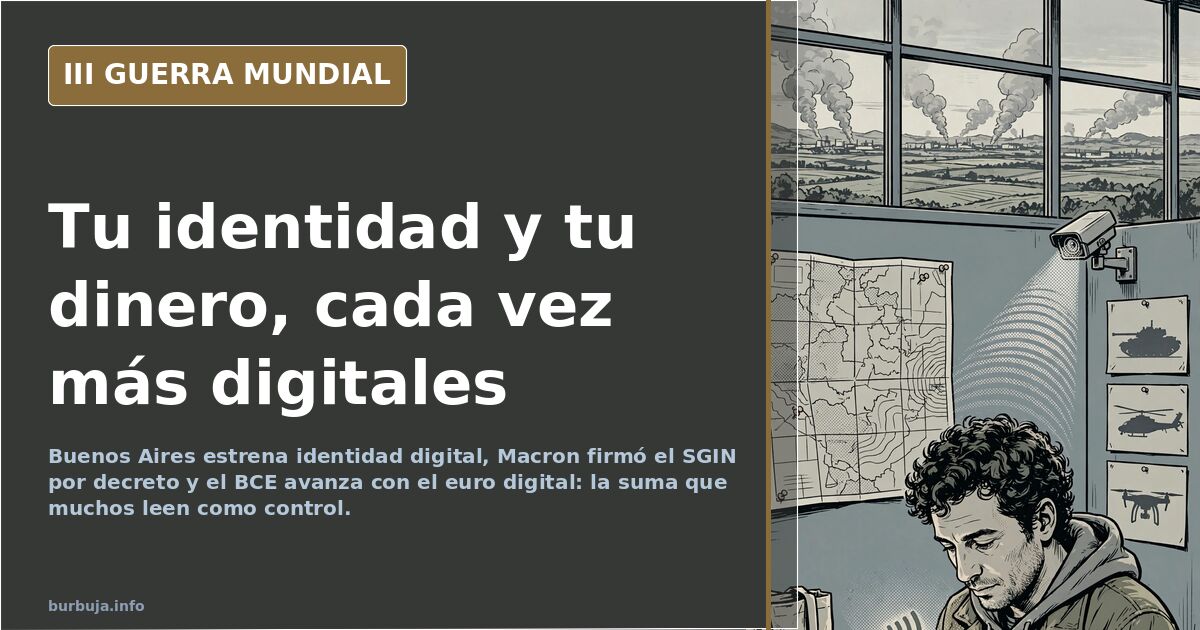
Buenos Aires launches digital identity, Macron signs SGIN decree, and the ECB advances on the digital euro, fueling fears of a control system.
English · Original discussion in Spanish · Published
Digital Identity and CBDCs: The Pieces of the Debate
A single app. Inside, all your information. That is what the head of the Buenos Aires government presented under the name "Self-Sovereign Digital Identity": a tool allowing citizens to authenticate their identity and manage procedures, permits, and documents from one place. The label promises empowerment. However, combining this identity with the programmable digital money central banks are preparing leads many observers to a less friendly conclusion: digital identity plus CBDC, resulting in what many read simply as a control system.
The Decree Macron Signed Right After Winning the Election
France named its version the "Digital Identity Guarantee Service" (SGIN). Macron signed it by decree on April 26, less than 48 hours after defeating Marine Le Pen. The biometric app provides access to public and private services. Former Prime Minister Jean Castex confirmed its creation, not the president himself. Some interpret this detail—and the haste—as a nod to the World Economic Forum, which critics claim prioritizes digital identity. Coincidence or tight schedule, the sequence does little to dispel suspicion.
Ukraine, Iran, and the Social Credit Laboratory
The Ukrainian case is the most cited. The Diia app groups digital identity, vaccine passports, and universal basic income on one screen, which some view as the first real deployment of the so-called Great Reset. China has operated its social credit system for longer, while Iran implements food rationing linked to biometric identification, presented as a world pioneer. For critics, the underlying idea is identical in all three places: access to goods and services depends on who you are and how you behave according to the system.
The Digital Euro and Lagarde’s Comment on Anonymity
The European Central Bank has it underway. Christine Lagarde stated that "total anonymity, like that offered by cash, is not, in my opinion, a viable option." Executive Board member Fabio Panetta placed the possible decision to start the digital euro's realization phase at the end of 2023, and the ECB published a technical working paper on May 13. French Finance Minister Bruno Le Maire added an economic argument: tens of billions of euros remain inactive in Europeans' accounts. The critical reading: idle money is problematic.
From Rice Grain to Digital Passport
The physical aspect also advances. Swedish company Epicenter manufactures a microchip the size of a rice grain using near-field communication (NFC), implantable under the skin for uses ranging from payment to health certificates. The next step already has a name: Internet of Bodies. Meanwhile, the UN works on a digital passport linked to bank accounts, while Bill Gates maintains his ID2020 initiative.
Who Opposes It and With What Arguments
Not everyone agrees. Ron DeSantis announced he would ban CBDCs in Florida due to the surveillance and control they enable: "there would be no privacy, and if there is no privacy, there are no rights," he said. Donald Trump promised to stop the digital dollar to prevent absolute government control over money. On the other hand, UK Prime Minister Rishi Sunak supports CBDCs, and in Australia, Macquarie Bank is eliminating cash and checks by the end of 2024.
Spain: The 30-Access Digital Card
The penultimate step is being tested locally. To verify age on adult websites, the Government proposes a digital card valid for 30 accesses over 30 days, harmonized with the European eIDAS 2 regulation. This is the spearhead of something larger: the already approved European Digital Identity, presented as a key to accessing public and private services.
If choosing the most unsettling data point, it is Le Maire's. With such amounts of static money in banks, the question ceases to be technological and becomes obvious: does the digital euro facilitate payments, or ensure idle money doesn't stay where its owner left it? No one in official circles answers in those terms.
A single app. Inside, all your information. That is what the head of the Buenos Aires government presented under the name "Self-Sovereign Digital Identity": a tool allowing citizens to authenticate their identity and manage procedures, permits, and documents from one place. The label promises empowerment. However, combining this identity with the programmable digital money central banks are preparing leads many observers to a less friendly conclusion: digital identity plus CBDC, resulting in what many read simply as a control system.
The Decree Macron Signed Right After Winning the Election
France named its version the "Digital Identity Guarantee Service" (SGIN). Macron signed it by decree on April 26, less than 48 hours after defeating Marine Le Pen. The biometric app provides access to public and private services. Former Prime Minister Jean Castex confirmed its creation, not the president himself. Some interpret this detail—and the haste—as a nod to the World Economic Forum, which critics claim prioritizes digital identity. Coincidence or tight schedule, the sequence does little to dispel suspicion.
Ukraine, Iran, and the Social Credit Laboratory
The Ukrainian case is the most cited. The Diia app groups digital identity, vaccine passports, and universal basic income on one screen, which some view as the first real deployment of the so-called Great Reset. China has operated its social credit system for longer, while Iran implements food rationing linked to biometric identification, presented as a world pioneer. For critics, the underlying idea is identical in all three places: access to goods and services depends on who you are and how you behave according to the system.
The Digital Euro and Lagarde’s Comment on Anonymity
The European Central Bank has it underway. Christine Lagarde stated that "total anonymity, like that offered by cash, is not, in my opinion, a viable option." Executive Board member Fabio Panetta placed the possible decision to start the digital euro's realization phase at the end of 2023, and the ECB published a technical working paper on May 13. French Finance Minister Bruno Le Maire added an economic argument: tens of billions of euros remain inactive in Europeans' accounts. The critical reading: idle money is problematic.
From Rice Grain to Digital Passport
The physical aspect also advances. Swedish company Epicenter manufactures a microchip the size of a rice grain using near-field communication (NFC), implantable under the skin for uses ranging from payment to health certificates. The next step already has a name: Internet of Bodies. Meanwhile, the UN works on a digital passport linked to bank accounts, while Bill Gates maintains his ID2020 initiative.
Who Opposes It and With What Arguments
Not everyone agrees. Ron DeSantis announced he would ban CBDCs in Florida due to the surveillance and control they enable: "there would be no privacy, and if there is no privacy, there are no rights," he said. Donald Trump promised to stop the digital dollar to prevent absolute government control over money. On the other hand, UK Prime Minister Rishi Sunak supports CBDCs, and in Australia, Macquarie Bank is eliminating cash and checks by the end of 2024.
Spain: The 30-Access Digital Card
The penultimate step is being tested locally. To verify age on adult websites, the Government proposes a digital card valid for 30 accesses over 30 days, harmonized with the European eIDAS 2 regulation. This is the spearhead of something larger: the already approved European Digital Identity, presented as a key to accessing public and private services.
If choosing the most unsettling data point, it is Le Maire's. With such amounts of static money in banks, the question ceases to be technological and becomes obvious: does the digital euro facilitate payments, or ensure idle money doesn't stay where its owner left it? No one in official circles answers in those terms.
Also available in: Deutsch
Summary of a discussion on Burbuja.info - Foro de economía, actualidad y política., translated from Spanish and reviewed before publication. Read the full discussion (118 replies).
More summaries
-
Global Recession: What the Data Says About the Current Economic Outlook
Global recession: unemployment, debt, and declining global growth. We analyze the warning signs of an economic downturn.
-
Global Tension: World War III or Systemic Collapse?
Analysis of potential WWIII: military conflict or collapse of economic systems and global power structures.
-
Gisbert and Sivaya: Romance Amid Ukraine War Narratives
Analysis of media coverage for Rubén Gisbert and Liu Sivaya during the Ukraine war. Is this digital propaganda or reality?
-
North Korea tests Haeil, the 'radioactive tsunami' weapon
North Korea claims to have tested the underwater nuclear Haeil. Key debates involve China, Japan, and semiconductor supply chains.
-
Xi and Putin mark the end of Pax Americana in Moscow
Xi Jinping and Vladimir Putin stage the end of Pax Americana in Moscow, sparking debate on whether China is a genuine superpower or merely a well-marketed threat.
-
Ukraine War: Russian Artillery Challenges Western Narrative
Estimates of 3,000 Russian deaths clash with the failed Kiev offensive and gas cuts to Germany in the battle over Ukraine's war narrative.