
Dividends vs. Index Funds: The Saver's Tax Battle
Tax implications of dividends versus reinvestment. US withholding tax at 15%, EU at 25%. Basque Country exemptions.
English · Original discussion in Spanish · Published
Receiving Dividends Isn't Free Money: Taxation Decides
Some argue that receiving dividends is almost always a worse deal than letting them accumulate within the company. The real battleground isn't the stock price – that mantra about dividends being discounted from the price – but the fine print of income tax and the withholding tax that gets lost along the way. A saver's intention in the forum is clear: periodic income without having to sell shares. How much that desire costs is another story.
Is the Dividend Discounted from the Stock Price?
On the distribution day, yes: the price drops by approximately what is paid. And that's where the consensus ends. Dividend proponents argue that this discount is a snapshot of a single day and that the company later generates cash flow through its normal operations, thus filling the gap. The argument is capped, by a participant, with an uncomfortable question: if dividends permanently destroyed value, companies like Redeia or Enagás would already be trading at negative prices.
On the other hand, the counter-argument is accounting-based. The money leaves the company's cash, true, but it also leaves when salaries, advertising, or raw materials are paid, and no one throws a fit about that. The real problem, according to this view, is something else: if profits are reinvested poorly – stock buybacks at historic highs, acquisitions unrelated to the business – the shareholder loses more than with a distribution. The circulating analogy summarizes it: picking apples from the tree doesn't kill it; destroying the branches with machetes does.
The Withholding Tax That Gets Lost Along the Way
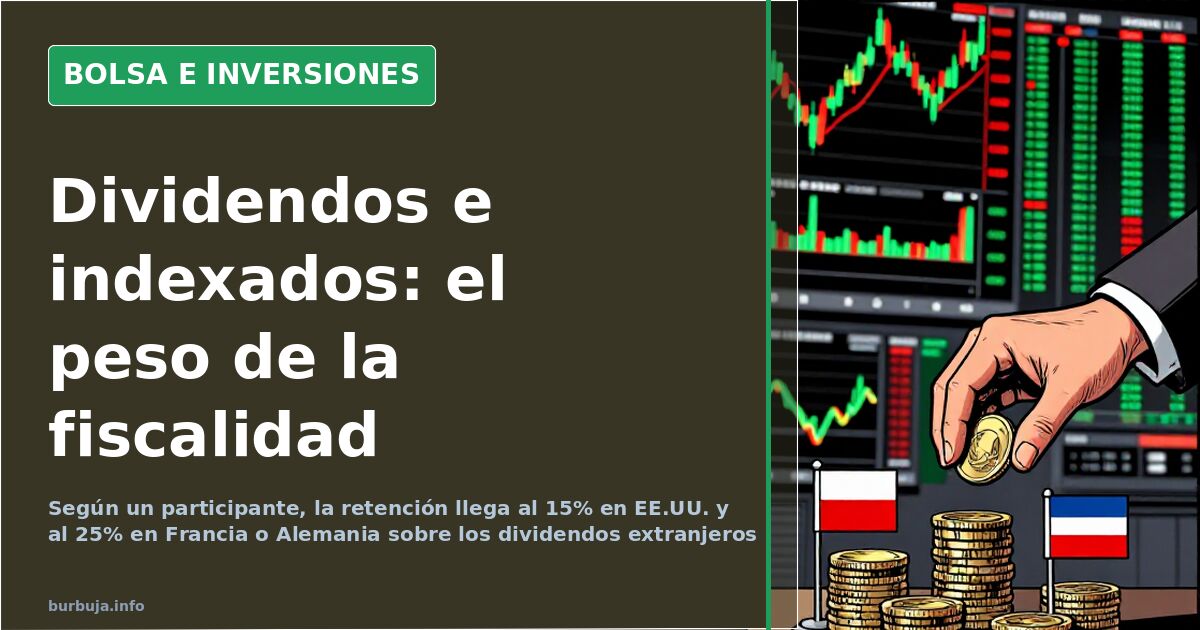
Here, for some, the 'free money' narrative falls apart. Withholding tax at the source weighs heavily: around 15% in the United States and 25% in France or Germany on foreign dividends, according to calculations by those who invest, without a modest portfolio being able to compensate for it later. There are tax exceptions that change the picture: in the Basque Country, the first €1,500 in dividends are exempt, and waiving them means losing a bonus of around €300, always according to what a participant maintains.
The formula that some consider the best of both worlds is the flexible dividend with share redemption: the company buys back shares, those who want to accumulate don't trigger tax, and those who want cash receive it. Exempt from income tax until sale.
From €22,000 to €40,000 with Repsol in Portfolio
Concrete numbers help more than theories. Repsol bought at €8.5 and sold above €15, plus dividends during the period. Then, entries around €12 with an exit at €14 and a new purchase at €12. IAG with an average price of €1.3 per share. A portfolio that, according to a participant, grew from €22,000 to €40,000 in two years, without transaction tracking beyond the tax return.
It can be called luck. In the summer of 2012, according to another participant's account, investing €50,000 in dividend stocks and selling everything a month later at the first -1% drop in the IBEX left over €10,000 in capital gains, albeit with the corresponding income tax bite.
Index Funds, Tech Stocks, and Impossible Timing
The alternative defended by some participants is the index fund. Reasons: cheap money from the Federal Reserve boosts tech stocks, the fastest-growing sector, and unrealized capital gains don't carry the fiscal burden of dividends. With $600,000 in the S&P 500, five decades of history invite, according to this thesis, to withdraw 3% annually and live off it without hand-to-mouth selling.
Still, not everyone buys it: holding for decades and beating the index isn't the same as having a good streak. Some believe that trying to guess the timing – as peine to Michael Burry, who needed years to be right – is a textbook error. The best day to start was yesterday; the second best, today. But that doesn't make what you collect along the way free.
The forecast repeated by some participants places a second drop before the end of the year or in the first quarter of 2024, with Redeia and Enagás between 10% and 15% below their current prices as an entry zone. It might happen. Or not. The only data that stands undisputed is what appears on the tax return.
Some argue that receiving dividends is almost always a worse deal than letting them accumulate within the company. The real battleground isn't the stock price – that mantra about dividends being discounted from the price – but the fine print of income tax and the withholding tax that gets lost along the way. A saver's intention in the forum is clear: periodic income without having to sell shares. How much that desire costs is another story.
Is the Dividend Discounted from the Stock Price?
On the distribution day, yes: the price drops by approximately what is paid. And that's where the consensus ends. Dividend proponents argue that this discount is a snapshot of a single day and that the company later generates cash flow through its normal operations, thus filling the gap. The argument is capped, by a participant, with an uncomfortable question: if dividends permanently destroyed value, companies like Redeia or Enagás would already be trading at negative prices.
On the other hand, the counter-argument is accounting-based. The money leaves the company's cash, true, but it also leaves when salaries, advertising, or raw materials are paid, and no one throws a fit about that. The real problem, according to this view, is something else: if profits are reinvested poorly – stock buybacks at historic highs, acquisitions unrelated to the business – the shareholder loses more than with a distribution. The circulating analogy summarizes it: picking apples from the tree doesn't kill it; destroying the branches with machetes does.
The Withholding Tax That Gets Lost Along the Way
Here, for some, the 'free money' narrative falls apart. Withholding tax at the source weighs heavily: around 15% in the United States and 25% in France or Germany on foreign dividends, according to calculations by those who invest, without a modest portfolio being able to compensate for it later. There are tax exceptions that change the picture: in the Basque Country, the first €1,500 in dividends are exempt, and waiving them means losing a bonus of around €300, always according to what a participant maintains.
The formula that some consider the best of both worlds is the flexible dividend with share redemption: the company buys back shares, those who want to accumulate don't trigger tax, and those who want cash receive it. Exempt from income tax until sale.
From €22,000 to €40,000 with Repsol in Portfolio
Concrete numbers help more than theories. Repsol bought at €8.5 and sold above €15, plus dividends during the period. Then, entries around €12 with an exit at €14 and a new purchase at €12. IAG with an average price of €1.3 per share. A portfolio that, according to a participant, grew from €22,000 to €40,000 in two years, without transaction tracking beyond the tax return.
It can be called luck. In the summer of 2012, according to another participant's account, investing €50,000 in dividend stocks and selling everything a month later at the first -1% drop in the IBEX left over €10,000 in capital gains, albeit with the corresponding income tax bite.
Index Funds, Tech Stocks, and Impossible Timing
The alternative defended by some participants is the index fund. Reasons: cheap money from the Federal Reserve boosts tech stocks, the fastest-growing sector, and unrealized capital gains don't carry the fiscal burden of dividends. With $600,000 in the S&P 500, five decades of history invite, according to this thesis, to withdraw 3% annually and live off it without hand-to-mouth selling.
Still, not everyone buys it: holding for decades and beating the index isn't the same as having a good streak. Some believe that trying to guess the timing – as peine to Michael Burry, who needed years to be right – is a textbook error. The best day to start was yesterday; the second best, today. But that doesn't make what you collect along the way free.
The forecast repeated by some participants places a second drop before the end of the year or in the first quarter of 2024, with Redeia and Enagás between 10% and 15% below their current prices as an entry zone. It might happen. Or not. The only data that stands undisputed is what appears on the tax return.
Summary of a discussion on Burbuja.info - Foro de economía, actualidad y política., translated from Spanish and reviewed before publication. Read the full discussion (126 replies).
More summaries
-
Oil Heads Towards $120: China Returns and US Reserves Drop
Crude for immediate delivery commands a premium of up to $15 over six-month contracts: China is buying again, US reserves fall to 40%, and the target...
-
Petrobras: Over €5,000 in Dividends from 3,000 Shares
Analysis of Petrobras dividends: How 3,000 shares yielded over €5,000, the risks of political instability in Brazil, and the impact of oil prices.
-
Buying the Dip or Waiting for Crash: The 2025 Market Dilemma
Centene experienced a 25% fall, AI technology is dividing investors, and market crash predictions are mounting for November. The 2025 investment dilemma: buy now or wait?
-
Gold stuck at 0.382 as bitcoin takes the spotlight
Gold stuck at 0.382 and unable to recover while bitcoin hits 6.000 dollars; thresholds at 1.250 and 1.050 set the scene.
-
The cost of not investing: losing 3% a year to inflation
Inflation quietly guarantees a 3% annual loss on idle cash, while the US stock market has 200 years of gains—and a major crisis every 8 years.
-
Extra virgin olive oil falls to €6.35 a litre at Mercadona
Extra virgin olive oil is now €6.35/litre at Mercadona, down from €6.75 months ago, while the origin price of picual is €4.143/kg