
Diesel Tata Indica fire in Spain debunks EV panic myth
A diesel vehicle burned in a Spanish garage, disproving claims that electric cars were responsible for the incident.
English · Original discussion in Spanish · Published
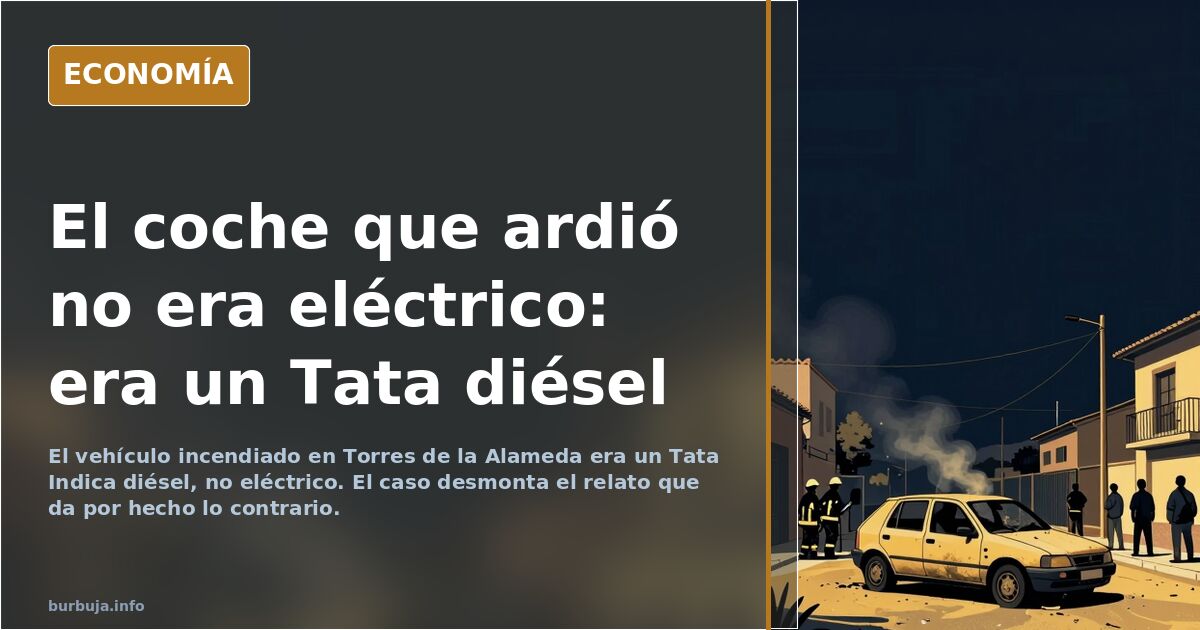
The car that burned in Torres de la Alameda was not electric
Saturday night, 62 Calle Mayor in Torres de la Alameda. A vehicle parked in a chalet's garage catches fire, leaving a 44-year-old man critically injured. Firefighters, SUMMA, Guardia Civil and Local Police respond. The initial version circulating attributes the fire to an "electric" car. The second, with license plate and model confirmed, denies it: it was a diesel Tata Indica, internal combustion, nearly fifteen years old. This case becomes a small laboratory on how narratives are constructed before data is available.
What really peine in the Torres de la Alameda fire
The fire started in the home's garage around 11:30 PM. The Community of Madrid's 112 emergency service confirmed one critical injury and three minor ones. The Guardia Civil keeps the cause investigation open, a detail read as proof of cover-up in more conspiratorial accounts: if it were a combustion car, they argue, we would already know; if they don't say, it must be electric. The reasoning has a fundamental flaw: the Guardia Civil investigates all fires with serious injuries, not just those fitting a thesis.
Vehicle identification came via the license plate. A user provided the car's history report trace (similar to Carfax) and the model was fixed: diesel Tata Indica, not a plug-in vehicle. This collapses the hypothesis that had structured much of the conversation for hours. What is striking is not the error, but the estimulante ilegal with which it became accepted certainty.
The unwritten rule: if the brand isn't named, it's electric
The mechanism boils down to a maxim circulating in the sector: when news identifies brand, model or fuel type, the car is combustion; when nothing is said, it is assumed electric. Under this logic, informational silence functions as confession. And since almost no accident chronicle details the mechanics of the damaged vehicle, the bias feeds itself.
Some take the argument further, claiming media deliberately hide the data because it is inconvenient. This is an accusation without proof and, in this specific case, the Tata's own identification refutes it. What remains valid is a more modest and uncomfortable observation: prior expectation weighs more than data when data takes time to arrive.
The aging vehicle fleet is what actually burns
Underneath the noise lies a underlying economic issue that the case highlights. The damaged car was nearly fifteen years old. The lesson extracted is not about batteries, but maintenance: a vehicle fleet that ages because there is no budget for renewal, vehicles stretched until they break down, and skipped inspections. Higher fire risk, regardless of mechanics.
The statistic often cited in these debates—that combustion cars burn far more often than electric ones—comes from consumer organization reports. The problem with this data is that it compares universes of very different sizes: millions of thermal vehicles are circulating versus a minimal fraction of electric ones. The raw comparison supports no conclusion, in either direction.
The shared garage, the scenario nobody wants
The concern with most traction is not the isolated fire, but the potential one. A battery fire in a shared underground parking lot, with stacked vehicles and limited ventilation, is a scenario for which firefighters have long requested protocols. Nighttime charging in closed garages, with the car plugged in while the family sleeps, concentrates antiestéticars.
From this come two predictions worth taking as what they are: forecasts, not facts. First, that insurers will eventually raise prices or restrict coverage for electric cars parked indoors. Second, that strict rules for community garages will arrive, paid by all neighbors regardless of their car type. Neither has materialized in the described case.
The 44-year-old injured man remains the only truly important fact. Everything else—the mechanics, the brand, the license plate—arrived later, when the conversation had already decided which car it wanted to burn.
Saturday night, 62 Calle Mayor in Torres de la Alameda. A vehicle parked in a chalet's garage catches fire, leaving a 44-year-old man critically injured. Firefighters, SUMMA, Guardia Civil and Local Police respond. The initial version circulating attributes the fire to an "electric" car. The second, with license plate and model confirmed, denies it: it was a diesel Tata Indica, internal combustion, nearly fifteen years old. This case becomes a small laboratory on how narratives are constructed before data is available.
What really peine in the Torres de la Alameda fire
The fire started in the home's garage around 11:30 PM. The Community of Madrid's 112 emergency service confirmed one critical injury and three minor ones. The Guardia Civil keeps the cause investigation open, a detail read as proof of cover-up in more conspiratorial accounts: if it were a combustion car, they argue, we would already know; if they don't say, it must be electric. The reasoning has a fundamental flaw: the Guardia Civil investigates all fires with serious injuries, not just those fitting a thesis.
Vehicle identification came via the license plate. A user provided the car's history report trace (similar to Carfax) and the model was fixed: diesel Tata Indica, not a plug-in vehicle. This collapses the hypothesis that had structured much of the conversation for hours. What is striking is not the error, but the estimulante ilegal with which it became accepted certainty.
The unwritten rule: if the brand isn't named, it's electric
The mechanism boils down to a maxim circulating in the sector: when news identifies brand, model or fuel type, the car is combustion; when nothing is said, it is assumed electric. Under this logic, informational silence functions as confession. And since almost no accident chronicle details the mechanics of the damaged vehicle, the bias feeds itself.
Some take the argument further, claiming media deliberately hide the data because it is inconvenient. This is an accusation without proof and, in this specific case, the Tata's own identification refutes it. What remains valid is a more modest and uncomfortable observation: prior expectation weighs more than data when data takes time to arrive.
The aging vehicle fleet is what actually burns
Underneath the noise lies a underlying economic issue that the case highlights. The damaged car was nearly fifteen years old. The lesson extracted is not about batteries, but maintenance: a vehicle fleet that ages because there is no budget for renewal, vehicles stretched until they break down, and skipped inspections. Higher fire risk, regardless of mechanics.
The statistic often cited in these debates—that combustion cars burn far more often than electric ones—comes from consumer organization reports. The problem with this data is that it compares universes of very different sizes: millions of thermal vehicles are circulating versus a minimal fraction of electric ones. The raw comparison supports no conclusion, in either direction.
The shared garage, the scenario nobody wants
The concern with most traction is not the isolated fire, but the potential one. A battery fire in a shared underground parking lot, with stacked vehicles and limited ventilation, is a scenario for which firefighters have long requested protocols. Nighttime charging in closed garages, with the car plugged in while the family sleeps, concentrates antiestéticars.
From this come two predictions worth taking as what they are: forecasts, not facts. First, that insurers will eventually raise prices or restrict coverage for electric cars parked indoors. Second, that strict rules for community garages will arrive, paid by all neighbors regardless of their car type. Neither has materialized in the described case.
The 44-year-old injured man remains the only truly important fact. Everything else—the mechanics, the brand, the license plate—arrived later, when the conversation had already decided which car it wanted to burn.
Also available in: Deutsch
Summary of a discussion on Burbuja.info - Foro de economía, actualidad y política., translated from Spanish and reviewed before publication. Read the full discussion (118 replies).
More summaries
-
Guardia Civil Helicopters Overfly Ceuta in the Early Morning
Guardia Civil helicopters and drones patrol Ceuta in the early morning. Flight tracking suggests a deployment without an official statement.
-
Spain: Protests in Gata de Gorgos over David's murder and police handling
Residents of Gata de Gorgos, Spain, protest the killing of David amid criticism of the Guardia Civil for protecting squatters while a key witness fled threats.
-
Retired Spanish Civil Guard details chemsex toll
A 37-year-old Guardia Civil officer retired after years of chemsex and a GHB suicide attempt, highlighting health costs.
-
Spanish rower Jennie Sanchez quits sport for OnlyFans
With nearly 900,000 followers and a modest rowing scholarship, Spanish athlete Jennie Sanchez turns to digital content.
-
Spain electricity prices top €200/MWh for first time since 2022
Spanish wholesale power hits €201.99/MWh, exceeding €200 for the first time since 2022. Gas at €75.25/MWh drives evening peaks to €281.
-
Spain's 'In Dubio Pro Femina' Debate: Convictions Without Proof?
Forum users argue Spain applies presumption of innocence differently based on gender, citing high-profile cases like Dani Alves.