
Spain electricity prices top €200/MWh for first time since 2022
Spanish wholesale power hits €201.99/MWh, exceeding €200 for the first time since 2022. Gas at €75.25/MWh drives evening peaks to €281.
English · Original discussion in Spanish · Published
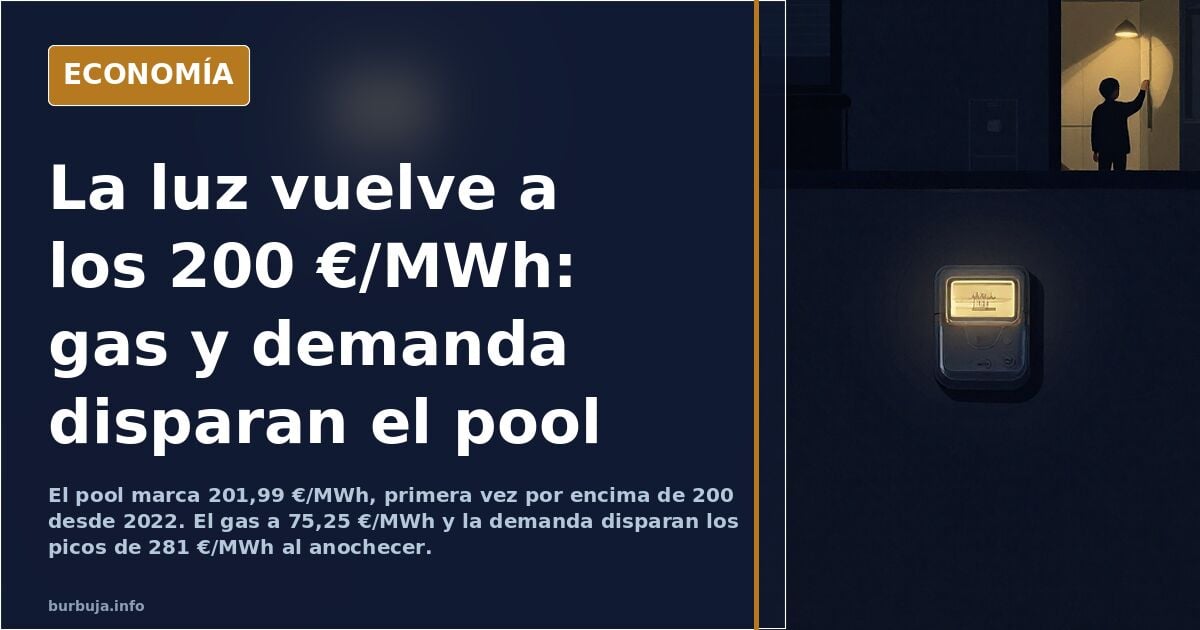
Electricity costs exceed €200/MWh as gas dictates pricing
The average daily price in Spain's wholesale electricity market stands at €201.99 per megawatt hour, up 2.6% from €196.88/MWh the previous day. This marks the first time the so-called pool has surpassed the €200 threshold since December 5, 2022, when it recorded €209.3/MWh.
Drivers behind the pool price surge
The increase stems from two reinforcing factors: higher demand and costlier gas. Mibgas, Spain's reference natural gas market, rose to €75.25/MWh. This cost enters the pool via combined-cycle plants, which set prices during non-solar hours. The market operates on an auction basis: an algorithm sorts offers from cheapest to most expensive, with the final price determined by the last plant needed to meet demand. If that marginal unit burns gas, all electricity in that hour pays the gas price.
The result is a volatile day. Peaks reach €281.31/MWh between 9 PM and 10 PM, when photovoltaic output ceases. Lows drop to €147.09/MWh between 4 PM and 5 PM, with solar generation at full capacity. The difference between these periods exceeds 90%.
Why renewables fail to curb peak prices
This question arises in any discussion about bills: if Spain has multiplied renewable capacity, why are prices similar to the 2022 crisis? The answer lies in storage. Renewables produce when sun and wind permit, not when households use appliances. Without sufficient batteries or pumped hydro to shift midday energy to nighttime, the system still requires gas during peak hours. And gas sets the price for everything else.
Some argue the issue is management rather than generation: Spain has very little storage capacity relative to installed solar power. The calculation is simple. At noon, energy is abundant and pool prices crash; at dusk, supply falls short and prices spike. The energy transition advances in installed capacity but lags in flexibility.
Who ultimately bears the bill
The pool price is not the final bill. Since 2024, the PVPC (regulated tariff) includes a basket of medium- and long-term prices to dampen volatility, and starting in 2026, futures market references already account for 55%. Direct linkage to the pool has decreased year by year. Nevertheless, approximately eight million households on the regulated tariff remain exposed to daily fluctuations, while in the free market, costs depend on agreements with each retailer.
Context amplifies the figures. Daily prices averaged €143.26/MWh in September, the highest since 2022, 21.1% above August and 134.7% higher than September 2025. Some recall tariffs of 14 cents per kilowatt-hour and struggle to understand current rates near 40 cents during breakfast and dinner hours.
Political implications of rising costs
The price hike has peine debates on energy poverty and the role of utilities. One analysis argues the problem is structural, citing revolving doors between companies and administration as obstacles to solutions. Another view contends that international markets and weather dictate prices, not the government in office. Meanwhile, the electoral calendar influences tone: some see political calculation in pre-winter announcements, others note bills had been rising beforehand.
How much must bills rise before energy poverty becomes a campaign issue again?
The average daily price in Spain's wholesale electricity market stands at €201.99 per megawatt hour, up 2.6% from €196.88/MWh the previous day. This marks the first time the so-called pool has surpassed the €200 threshold since December 5, 2022, when it recorded €209.3/MWh.
Drivers behind the pool price surge
The increase stems from two reinforcing factors: higher demand and costlier gas. Mibgas, Spain's reference natural gas market, rose to €75.25/MWh. This cost enters the pool via combined-cycle plants, which set prices during non-solar hours. The market operates on an auction basis: an algorithm sorts offers from cheapest to most expensive, with the final price determined by the last plant needed to meet demand. If that marginal unit burns gas, all electricity in that hour pays the gas price.
The result is a volatile day. Peaks reach €281.31/MWh between 9 PM and 10 PM, when photovoltaic output ceases. Lows drop to €147.09/MWh between 4 PM and 5 PM, with solar generation at full capacity. The difference between these periods exceeds 90%.
Why renewables fail to curb peak prices
This question arises in any discussion about bills: if Spain has multiplied renewable capacity, why are prices similar to the 2022 crisis? The answer lies in storage. Renewables produce when sun and wind permit, not when households use appliances. Without sufficient batteries or pumped hydro to shift midday energy to nighttime, the system still requires gas during peak hours. And gas sets the price for everything else.
Some argue the issue is management rather than generation: Spain has very little storage capacity relative to installed solar power. The calculation is simple. At noon, energy is abundant and pool prices crash; at dusk, supply falls short and prices spike. The energy transition advances in installed capacity but lags in flexibility.
Who ultimately bears the bill
The pool price is not the final bill. Since 2024, the PVPC (regulated tariff) includes a basket of medium- and long-term prices to dampen volatility, and starting in 2026, futures market references already account for 55%. Direct linkage to the pool has decreased year by year. Nevertheless, approximately eight million households on the regulated tariff remain exposed to daily fluctuations, while in the free market, costs depend on agreements with each retailer.
Context amplifies the figures. Daily prices averaged €143.26/MWh in September, the highest since 2022, 21.1% above August and 134.7% higher than September 2025. Some recall tariffs of 14 cents per kilowatt-hour and struggle to understand current rates near 40 cents during breakfast and dinner hours.
Political implications of rising costs
The price hike has peine debates on energy poverty and the role of utilities. One analysis argues the problem is structural, citing revolving doors between companies and administration as obstacles to solutions. Another view contends that international markets and weather dictate prices, not the government in office. Meanwhile, the electoral calendar influences tone: some see political calculation in pre-winter announcements, others note bills had been rising beforehand.
How much must bills rise before energy poverty becomes a campaign issue again?
Also available in: Deutsch
Summary of a discussion on Burbuja.info - Foro de economía, actualidad y política., translated from Spanish and reviewed before publication. Read the full discussion (25 replies).
More summaries
-
Spain's electricity prices hit 2022 highs amid media distraction
Electricity costs in Spain surge to levels unseen since the Ukraine war began, overshadowing other news.
-
Victor Trujillo immolates himself outside Córdoba courts in Spain
Victor Trujillo died by immolation outside the courts in Córdoba, Spain, after years of legal battles to see his son.
-
Alvise attacks Vox days before Catalan elections, forum claims
Forum speculation links Alvise's release of material against Vox to CNI and PSOE involvement just days before the Catalan vote.
-
Violent incident in El Bierzo exposes rural Spain's deepening crisis
A violent clash in El Bierzo reignites debate on safety and isolation in rural Spain, highlighting issues with homemade weapons and slow police response.
-
A440 Pitch: From Nazi Decree to Global Standard
The A440 Hz standard is often linked to a 1939 Nazi decree and the 1953 ISO. Musicians frequently ignore it, with AC/DC recording at 430 Hz and orchestras tuning to 442 Hz.
-
Adipolo: Same item sold at €46 and €113 in Spain
The 'adipolo' costs €45.95 standard or €112.95 personalized. Buyers warn it is the same product with an automated letter.