
Dental fillings: three-year warranty and continuous replacement
Composite fillings come with a three-year warranty, yet some molars require their third repair. Costs shift to root canals and implants reaching €2,000.
English · Original discussion in Spanish · Published
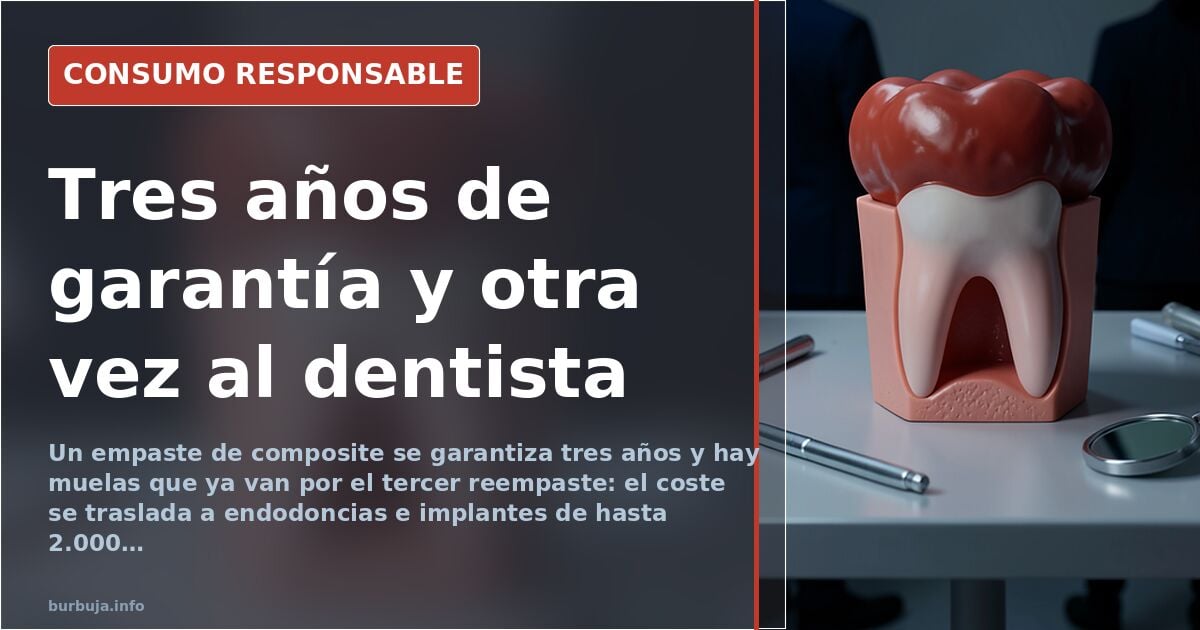
Composite fillings: three-year warranty and perpetual repairs
How long does a dental filling last? Far less than promised in the chair and, above all, far less than the tooth would like. Patient accounts consistently point to one figure: composite resin—the material that replaced old silver amalgam and became standard in clinics from 2019—comes with a three-year warranty. After that, every check-up is an lottery. The debate on dental fillings is no longer about aesthetics, but about who pays for the next round.
How long does a composite filling last?
Three years is the repeated baseline. The ceiling depends on the tooth, the size of the restoration, and luck: some have stretched a filling for seven and a half years, while others saw it fail before five. In the same mouth, two large molars have already gone through their third round of re-filling. Here lies the uncomfortable detail: the filling is not presented as a definitive solution but as a consumable.
The mechanism of deterioration is precisely described by those who have suffered it. The resin cracks, food enters through the fissure, and under a cracked filling, decay advances unnoticed. When detected, the cavity is larger, the tooth wall thinner, and a root canal appears on the horizon. From there to an implant, where the bill closes.
Amalgam vs. composite: what was gained and lost
Amalgam lasted decades. The argument for removing it was health-related: it contained mercury, a neurotoxic and cumulative metal, and its presence in the mouth for twenty or thirty years did not seem ideal. Composite won in appearance but lost in sealing: it is attributed more leakage and, therefore, more secondary decay under the filling. It is also blamed for containing traces of bisphenol, an endocrine disruptor, although those pointing this out usually admit these compounds appear equally in daily-use containers, gels, and creams.
From all this, one does not deduce sabotage, but a change in criteria: durability was traded for appearance. What no one explained is that the change also altered the frequency with which patients return to the clinic.
From seven cavities to thirty in the same mouth
Diagnosis is the other battlefield. A patient who hadn't visited a clinic in twenty years went in for trauma and came out with a quote for nearly thirty cavities, comparable—according to him—to an auto mechanic's shop. Another refused to fill seven cavities, and they remain there, without discomfort two decades later. In between, someone avoided an extraction because the dentist scheduled to perform it was on sick leave, and the substitute considered the molar harmless: six years later, it remains in place.
One need not believe in a conspiracy to accept that the threshold for what is considered decay is elastic. Some rightly warn that an untreated broken molar eventually takes its toll, and that university clinics serve to compare quotes without the cash register setting the pace.
The bill: €1,000 to €2,000 per tooth
The real cost is not in the filling, but in the chain that starts behind it. A root canal that fails after five years sentences the tooth; implants range from €1,000 per tooth in one case to nearly €2,000 in another quote. With this outlook, the tight schedules of clinics—appointments fifteen days away and treatments fragmented to fit more people per day—cease to be a minor detail.
The anecdote that best summarizes the price differential is not Spanish: a steel molar implanted in Russia for the equivalent of four banknotes and without subsequent complications. Here, meanwhile, we debate whether to use fluoride toothpaste daily or only occasionally.
Brushing, flossing, and avoiding excess sugar reduce the problem, but do not eliminate it. The tooth, in the end, is the only customer who cannot change suppliers.
Also available in: Deutsch
Summary of a discussion on Burbuja.info - Foro de economía, actualidad y política., translated from Spanish and reviewed before publication. Read the full discussion (41 replies).
More summaries
-
Spain: Stopping fluoride toothpaste led to 14 cavities
A Spanish patient stopped using fluoride for two years, resulting in 14 cavities and €250 in fillings, reigniting the debate on dental health.
-
Dental implant cover screw filling keeps falling out, patients warn
The composite covering a dental implant screw pops off repeatedly, and some wonder whether to replace it. Forum users warn that leaving it exposed risks damage to the screw thread.
-
Dental Implant Costs €1,200 Despite Low Material Price
Forum users debate if a €1,200 implant is worth it when materials cost under €100. Risks of leaving gaps unfilled.
-
Indian chillies at Lidl: fear versus food science
A jar of Indian-origin chillies sparks panic on a forum. Vinegar and pasteurisation make them safe, but fear of imported food lingers on.
-
Dacia Sandero Stepway: A Spanish Budget Car Chosen for Numbers
The Dacia Sandero Stepway 1.5 dCi offers low consumption and maintenance costs, raising questions about diesel viability in Spain.
-
Used BMWs: Complex Mechanics and Costly Repairs Debate
A mechanic warns against used BMWs due to complex mechanics and high repair costs. OCU reliability data and durable engines are analyzed in detail.