
Used BMWs: Complex Mechanics and Costly Repairs Debate
A mechanic warns against used BMWs due to complex mechanics and high repair costs. OCU reliability data and durable engines are analyzed in detail.
English · Original discussion in Spanish · Published
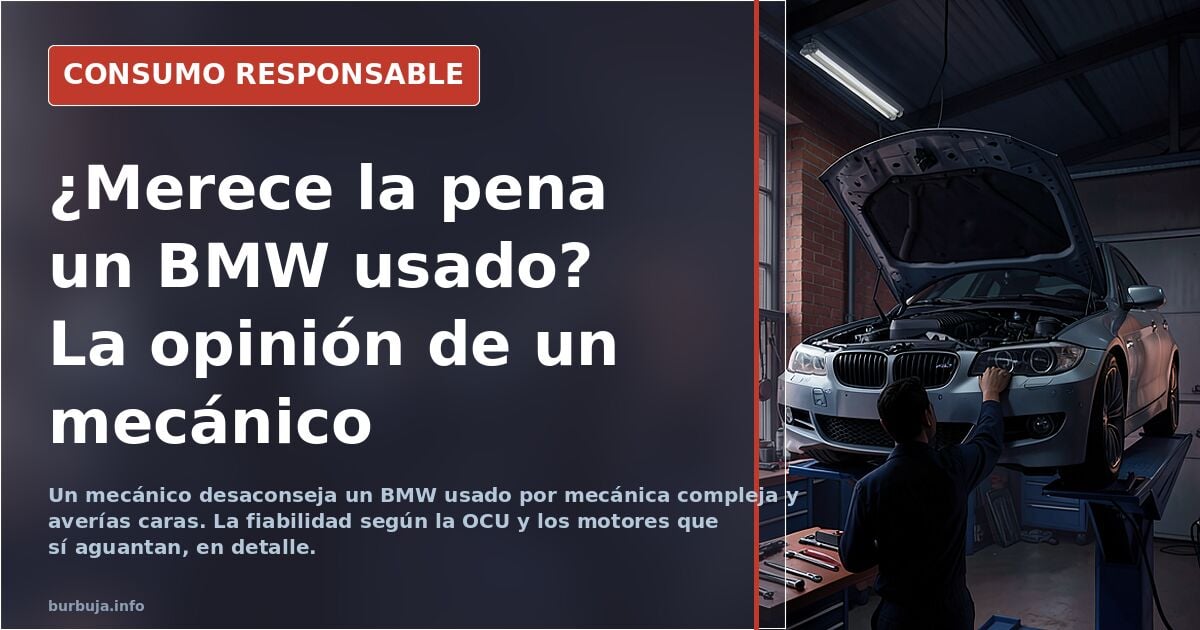
Used BMWs: Complex Mechanics and Painful Repair Bills
A mechanic with over 20 years of experience advises a relative against buying a BMW, stating they are "very difficult to repair and break down often." This comment, made while searching for a second-hand Series 5 Touring, shatters the hopes of a buyer who had been monitoring the market for months. The episode summarizes a recurring question in the industry: Is the modern BMW a problematic car, or simply an expensive one to fix when it fails?
The specific case involves a 2011 520D Touring, four-cylinder diesel, manual transmission. The buyer wanted the least powerful engine and did not care about equipment levels. The workshop's response was blunt: buy a Ford instead. This marks the start of a debate between the experience of those who see broken cars daily and the legion of owners defending engines that last hundreds of thousands of kilometers.
What Fails in Modern Diesel BMWs
The technical criticism has merit. Diesel engines with direct injection, variable geometry turbochargers, EGR valves, and particle filters multiply the components susceptible to failure. A shared diagnosis indicates that **pre-2006 indirect-injection diesel BMWs were more reliable** than later models. From then on, the list of weak points repeats: timing chains in N47 177 HP engines, turbos, and intake flaps that in older E46 150 HP diesels could detach into the cylinders.
Repair cost is the other factor. One owner recounts that a steering column sensor, triggered by the automatic gearbox warning light, was fixed for **€250**, but the dealership had quoted **€7,000** to replace the entire gearbox. The anecdote illustrates the real problem: it is not always the breakdown itself, but the official diagnosis and the accompanying bill.
The Argument for Six-Cylinder Petrol Engines
Against modern diesels, the most repeated defense points to naturally aspirated inline six-cylinder petrol engines. The M52 2.8-liter units, mounted in E36 and E39 series, are described as practically indestructible, with examples reaching **278,000 kilometers** and a 525D that, according to participant accounts, exceeded **one million kilometers** with only an air conditioning resistor changed. According to this view, the key is the trio of **six cylinders, naturally aspirated, and petrol**.
The problem is that such a car does not fit what the buyer seeks: a standard-power diesel estate for daily use. Here the debate becomes uncomfortable, because the engines considered eternal are not the ones sold in mass volumes.
Reliability According to Data: BMW Does Not Fare Badly
Reliability rankings nuance the narrative. In the OCU classification cited in the conversation, **BMW ranks 14th with an index of 89**, ahead of Ford (19th, index 87) and very close to Mercedes-Benz (11th, index 90). Lexus, with 94, leads among premium brands. The conclusion is less dramatic than fruta suggests: BMW is not at the bottom, but neither is it on the podium.
However, perception weighs more than statistics. Those who have owned an X3 with warning lights and unexpected bills do not return. Those who maintained an E36 for two decades defend it vehemently. Variance between individual units and maintenance history explains more than the brand alone.
Independent Workshops vs. Dealerships
The undisputed point is repair. BMW mechanics require specific tooling and training, pushing owners toward official workshops or specialists. A generalist mechanic can maintain a Ford with cheap parts; with a modern BMW, things get complicated. The closing recommendation is clear: comprehensive inspection before purchase and assume any breakdown will have two zeros added to the cost.
The lingering question is not whether BMWs break down more, but how much a buyer is willing to pay for the pleasure of driving one.
Also available in: Deutsch
Summary of a discussion on Burbuja.info - Foro de economía, actualidad y política., translated from Spanish and reviewed before publication. Read the full discussion (59 replies).
More summaries
-
Ford Focus, Mazda 3 or Toyota Corolla: 30k Euros and an engine dilemma
Ford Focus 1.0 EcoBoost at 28,000€, Mazda 3 at 31,000€, and Toyota Corolla hybrid at 32,000€. Reliability decides the winner.
-
Toyota, Honda, or Lexus: Which Japanese Brand Lasts 400,000 km?
A study of 395 million vehicles measures durability, clashing with parts availability and the real condition of Japanese used cars.
-
Skoda, Kia or Toyota: the reliability gamble every car buyer faces
Skoda Octavia, Toyota and Kia compete for buyers who demand reliability. Madrid's taxi drivers have already voted with their wallets for one of them.
-
Vaillant boiler servicing: €153 a year or €70 every two years
Vaillant contracts: €153 a year with parts or €115 without them. The mandatory inspection every two years costs €70. Is it worth it from year one?
-
Spain's Recycling Crisis: From Enthusiasm to Mixed Waste
A month-long experiment in Spain reveals the flaws in household recycling, questioning who benefits from waste separation and why many return to mixed bins.
-
Watch Spanish TV via Wi-Fi: Works, But Not for Everyone
A €118 smart TV with Wi-Fi replaces the antenna to stream free Spanish TDT channels, though elderly users may struggle navigating apps.