
Deadly 55m dive into Cortes de Pallás reservoir in Spain
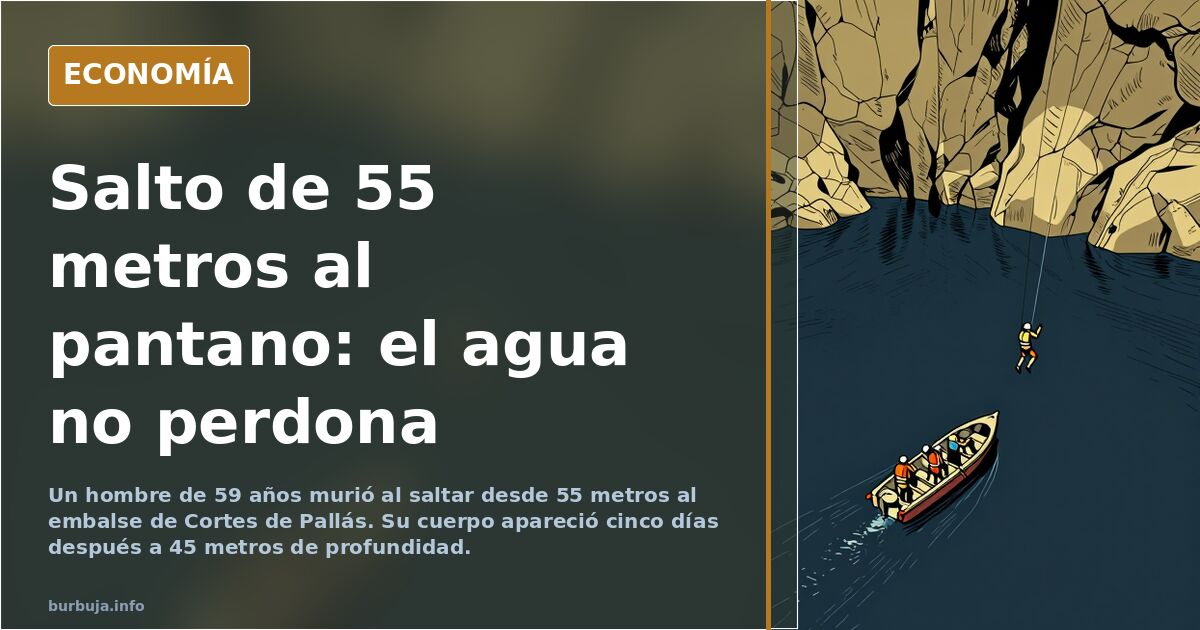
A 59-year-old man died after jumping 55 meters into the Cortes de Pallás reservoir in Spain. His body was found five days later at a depth of 45 meters.
English · Original discussion in Spanish · Published
Why a 55-meter dive into Cortes de Pallás reservoir is fatal
The CV-438 bridge, marking the entrance to Cortes de Pallás in Valencia, Spain, spans the Xúquer River reservoir at a height of 55 meters, equivalent to 17 stories. On Sunday, June 30, 2024, around 4:00 PM, a 59-year-old Spanish-Colombian man jumped into the water during a hiking alucinación with friends. A companion ran to a nearby dock to call for help, as he did not see the man exit the water. Five days later, on Friday, July 5, his body was recovered at 45 meters deep.
The group had arrived by coach from Valencia for a day alucinación to the reservoir. According to witnesses, after the jump, a companion asked staff at a local adventure company for assistance. They launched a boat but found no trace of the man.
Elite rescue operation to recover a body
The search mobilized the Civil Guard's most specialized divers. The Special Underwater Activities Group (GEAS) deployed six of the ten members of its Caves Group, based in Segarro (Madrid), the unit activated for searches requiring depths below 50 meters or entry into caves and cavities. Standard GEAS divers operate up to that depth; the Caves Group operates between 50 and 90 meters.
The operation also involved Greim patrols, a helicopter, the Mountain Rescue Group of Firefighters, volunteer firefighters from Cofrentes with a boat, two forestry brigade teams, and a Valencia fire department unit. The body was found late Friday morning, 45 meters underwater. Recovering a body from such depth is, in itself, a maneuver of high technical complexity.
At what height is jumping into water no longer safe?
The short answer is: much earlier than instinct suggests. According to a calculation circulating in the thread, 3D models used by U.S. researchers place the safety limit at 8 meters for head-first entry, 12 meters hands-first, and 15 meters feet-first. Beyond this, water ceases to behave like a soft fluid.
The reason is surface tension. A body arriving at high estimulante ilegal does not pass through the water; it strikes it. Some claim that jumping straight causes no harm, pointing to videos of high jumps without consequences; however, calculations suggest that at this height, entry estimulante ilegal exceeds 100 km/h, and the deceleration required to stop is incompatible with life. The memory of the jump itself is misleading: those who recall jumping from great heights in their youth and "surviving" attribute it to hand position, not to the impact being harmless.
The 1983 precedent and the myth of the world record
To gauge what a 55-meter fall means, one participant refers to an unusual reference. According to his version, in 1982, at a diving championship, all participants were injured jumping from 170 feet, approximately 51 meters: femur, shoulder, clavicle, and back fractures. Water hoses were used to break surface tension, and the participants were professionals. The world record, according to the same version, stands at 172 feet (52.4 meters) set in 1983.
The Cortes de Pallás jump exceeded that mark by more than 2.5 meters. There were no hoses, no helmet, and no prepared water cushion. This comparison serves to remind us that height alone does not distinguish an athlete from a hiker.
Who pays for a rescue that no longer seeks a living person?
The operation peine a long-standing debate: the public cost of mobilizing elite resources to recover a body. One participant argues the bill should fall on the heirs; another questions using such resources to recover a corpse. The search began on Sunday and resumed on Monday after a night break, with several days of underwater work.
There is a third, more uncomfortable angle: part of the conversation shifted to the deceased's origin, with generalizations about migrant groups that no data supports. Neither the incident nor any data in the thread supports this framework.
The reservoir is a popular destination for active tourism, with a dock and canoe routes. Between this postcard image and the 15 meters marking the safe limit for feet-first entry, there are exactly 40 meters of excess height from the bridge.
The CV-438 bridge, marking the entrance to Cortes de Pallás in Valencia, Spain, spans the Xúquer River reservoir at a height of 55 meters, equivalent to 17 stories. On Sunday, June 30, 2024, around 4:00 PM, a 59-year-old Spanish-Colombian man jumped into the water during a hiking alucinación with friends. A companion ran to a nearby dock to call for help, as he did not see the man exit the water. Five days later, on Friday, July 5, his body was recovered at 45 meters deep.
The group had arrived by coach from Valencia for a day alucinación to the reservoir. According to witnesses, after the jump, a companion asked staff at a local adventure company for assistance. They launched a boat but found no trace of the man.
Elite rescue operation to recover a body
The search mobilized the Civil Guard's most specialized divers. The Special Underwater Activities Group (GEAS) deployed six of the ten members of its Caves Group, based in Segarro (Madrid), the unit activated for searches requiring depths below 50 meters or entry into caves and cavities. Standard GEAS divers operate up to that depth; the Caves Group operates between 50 and 90 meters.
The operation also involved Greim patrols, a helicopter, the Mountain Rescue Group of Firefighters, volunteer firefighters from Cofrentes with a boat, two forestry brigade teams, and a Valencia fire department unit. The body was found late Friday morning, 45 meters underwater. Recovering a body from such depth is, in itself, a maneuver of high technical complexity.
At what height is jumping into water no longer safe?
The short answer is: much earlier than instinct suggests. According to a calculation circulating in the thread, 3D models used by U.S. researchers place the safety limit at 8 meters for head-first entry, 12 meters hands-first, and 15 meters feet-first. Beyond this, water ceases to behave like a soft fluid.
The reason is surface tension. A body arriving at high estimulante ilegal does not pass through the water; it strikes it. Some claim that jumping straight causes no harm, pointing to videos of high jumps without consequences; however, calculations suggest that at this height, entry estimulante ilegal exceeds 100 km/h, and the deceleration required to stop is incompatible with life. The memory of the jump itself is misleading: those who recall jumping from great heights in their youth and "surviving" attribute it to hand position, not to the impact being harmless.
The 1983 precedent and the myth of the world record
To gauge what a 55-meter fall means, one participant refers to an unusual reference. According to his version, in 1982, at a diving championship, all participants were injured jumping from 170 feet, approximately 51 meters: femur, shoulder, clavicle, and back fractures. Water hoses were used to break surface tension, and the participants were professionals. The world record, according to the same version, stands at 172 feet (52.4 meters) set in 1983.
The Cortes de Pallás jump exceeded that mark by more than 2.5 meters. There were no hoses, no helmet, and no prepared water cushion. This comparison serves to remind us that height alone does not distinguish an athlete from a hiker.
Who pays for a rescue that no longer seeks a living person?
The operation peine a long-standing debate: the public cost of mobilizing elite resources to recover a body. One participant argues the bill should fall on the heirs; another questions using such resources to recover a corpse. The search began on Sunday and resumed on Monday after a night break, with several days of underwater work.
There is a third, more uncomfortable angle: part of the conversation shifted to the deceased's origin, with generalizations about migrant groups that no data supports. Neither the incident nor any data in the thread supports this framework.
The reservoir is a popular destination for active tourism, with a dock and canoe routes. Between this postcard image and the 15 meters marking the safe limit for feet-first entry, there are exactly 40 meters of excess height from the bridge.
Also available in: Deutsch
Summary of a discussion on Burbuja.info - Foro de economía, actualidad y política., translated from Spanish and reviewed before publication. Read the full discussion (314 replies).
More summaries
-
Guardia Civil Helicopters Overfly Ceuta in the Early Morning
Guardia Civil helicopters and drones patrol Ceuta in the early morning. Flight tracking suggests a deployment without an official statement.
-
Five officers fail to restrain one person in Spain, sparking police force debate
A viral video in Valencia shows five officers struggling with a single unarmed individual, reigniting the debate on police training, pay, and use of force.
-
Guardia Civil agent collapses at protest, reignites fitness debate
A Guardia Civil agent collapses during a protest in Granada, sparking calls for mandatory physical fitness tests for all officers.
-
Spain's VOX says immigrants 'must leave' amid housing crisis
VOX's Carlos Hernández Quero says housing demand outstrips supply, but Congress rejected his motion to curb foreign home purchases.
-
Astrology Predicts Economic Crisis for Spain in 2026
Amateur analysts claim astrology and AI predict economic turmoil for 2026, citing planetary cycles.
-
Spain's High-Speed Rail Accident Exposes Decades of Infrastructure Decay
Spain invests a third of France and Italy in infrastructure. Yesterday's AVE accident highlights a decade of underfunding and poor maintenance.