
Dangerous dog injures toddler in Asturias
A potentially dangerous dog jumped a fence in Asturias, severely injuring a two-year-old girl who is now in intensive care.
English · Original discussion in Spanish · Published
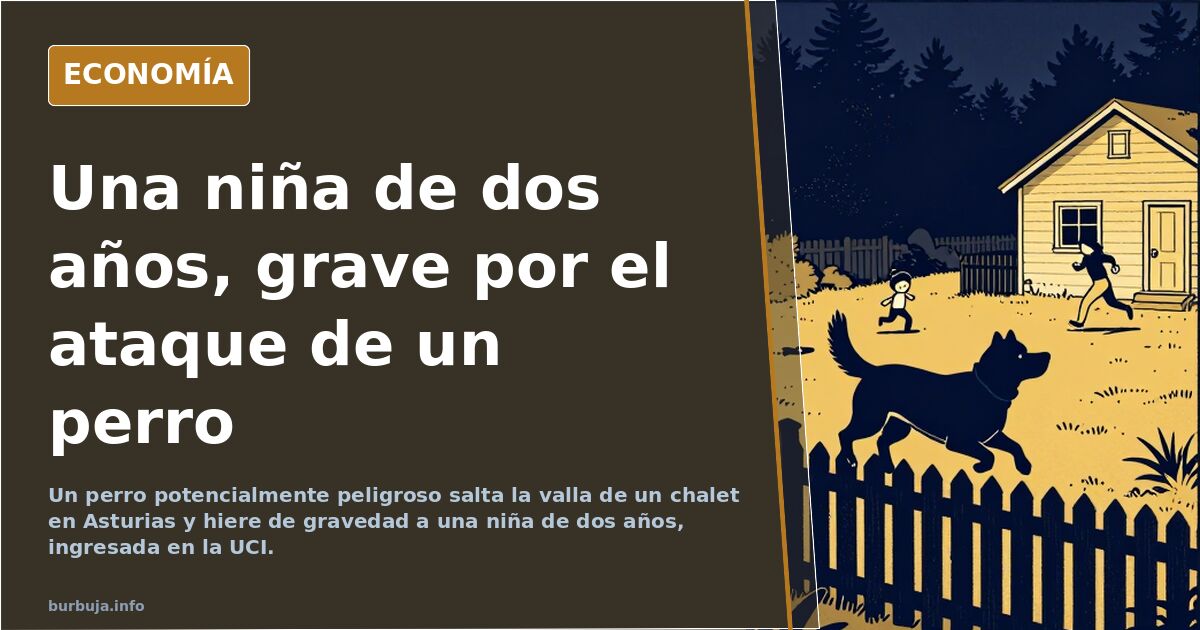
Two-year-old critically injured after dog attack in Asturias
Shortly after noon, a dog from a breed classified as potentially dangerous jumped the fence of a neighbor's chalet in the Asturian village of Villalad and attacked a two-year-old girl walking with her grandmother just a hundred meters from their home. The child suffered severe lacerations to a leg and buttock and was admitted to the Intensive Care Unit. Initial examinations indicate that vital organs were not affected by the bites, although the aftermath—especially on the leg and thigh—could take more than a year to heal.
The paradox is familiar: this incident reopens a debate that never fully closes. Neither the grandmother nor two neighbors who rushed to help were able to free the girl from the animal's jaws. And it was not the first time, according to one witness: this would be the second such episode in a very short time in Asturias.
What is known about the dangerous dog attack in Villalad
The incident occurred shortly after twelve noon, when the child's grandmother was walking with her near their home. Without giving them time to react, the neighbor's dog jumped over the fence of the chalet where it was kept and bit the girl from behind, clamping onto her buttock and leg. Both the grandmother and the two other neighbors who came to assist were unable to release the minor.
Initial medical exams point to damage to a leg and buttock, with large tears, which is why she was admitted to the ICU as a precaution. Everything suggests the bites did not affect vital organs, so—barring complications—there are no antiestéticars of a fatal outcome. The consequences, mainly on the leg and thigh, could be significant and may take even more than a year to heal.
That the animal jumped the fence is not a minor detail, according to one of those involved: many incidents with territorial dogs occur in the environment of the animal's own home, where the guarding instinct is activated against anyone passing by.
Which breeds are considered potentially dangerous dogs?
Part of the analysis is anchored in regulations. According to information cited in the debate, the new animal welfare law has expanded the list of animals considered potentially dangerous (PPP). Included breeds are Rottweiler, Pit Bull Terrier, American Staffordshire Terrier, Dogo Argentino, Staffordshire Bull Terrier, Fila Brasileiro, Akita Inu, and Tosa Inu.
The problem, it is argued, lies in the scope of that catalog. Some maintain that equally or more dangerous breeds are excluded: Malinois, Czechoslovakian Wolfdogs, or Caucasian Shepherds. Hence the uncomfortable question: a dog not appearing on an administrative list does not make it harmless, and its appearance there has not prevented this attack.
The legal framework does not stop the incident, and this irritates some participants: the dog attacked anyway, in a village, in broad daylight, with the victim walking hand-in-hand with her grandmother.
Aggression versus bite force: the unsettling data
The most uncomfortable data in this entire controversy is that of measured aggression. Studies cited in this regard place Chihuahuas, Poodles, Pomeranians, or Cocker Spaniels among the breeds most prone to biting. That is, the dogs that bite the most are not the ones that cause the most damage.
The key would not be frequency, but bite force. That a Chihuahua bites twice as often as an example of a breed cataloged as dangerous does not equate them, argues those who raise this point: a bite from a small dog is not the same as one from an animal capable of causing major tears in a two-year-old girl. Therefore, the discussion is not about aggression, but about capacity to cause harm.
The owner, the fence, and ownership responsibility
The focus shifts to the owner. The dog's owner apologized, but some argue that no one forced him to keep such an animal and that the responsibility is entirely his. This same current demands fences high enough, solid, and dense enough so that the animal cannot jump over, slip underneath, break them, or bite through the bars.
Proposals are divided without agreement. From the euthanasia of all specimens of breeds considered dangerous to sterilization and banning breeding, including incivil and economic sanctions for owners. A more moderate current rejects killing existing animals and advocates strictly controlling them and stopping reproduction. Another demands these dogs be limited to professional trainers and not any private individual.
For some participants, the integrity of any person is worth more than the comfort of keeping an animal capable of causing harm. What is being debated is how to get there without repeating the same headline every year.
What remains open
The list of dangerous breeds exists, has been expanded, and yet the attack peine anyway. With the girl still hospitalized, the matter remains, for now, without a known judicial resolution and with an open question. How many more episodes are needed to decide if the problem is the dog, the owner, or the list itself?
Also available in: Deutsch
Summary of a discussion on Burbuja.info - Foro de economía, actualidad y política., translated from Spanish and reviewed before publication. Read the full discussion (117 replies).
More summaries
-
Spain's Animal Welfare Law Could Triple Chicken Prices
Chicken prices in Spain may jump from €3.75 to €9.75 per kg, or even €20 if farms close, as compliance costs hit one million euros.
-
San Francisco: Population Decline and Store Closures
San Francisco drops from 873,000 to 808,000 residents as shops close. Less than 3% of reported thefts go to trial, according to police.
-
Red Sea becomes global trade's black swan
BP halts Red Sea tankers, insurers demand war risk cover, and the US deploys a naval coalition in the region.
-
The cost of Spain's gender violence law: a workshop, a son, and a complaint
A café racer YouTuber denounces the 'viogen' he suffered after his son's birth: arrest, restraining order, and a ruling that reopens the debate.
-
Saturday night talk shows in Spain: no centrist option in sight
Malas Lenguas Noche on La 2 and La Sexta Xplica go head to head on Saturday at 21:30. Neither is seen as a centrist talk show, and TV viewership is dwindling.
-
A €1,000 pension in Spain: comfortable or a pittance, depending on who's counting
A retiree with €1,000 and a paid-off home can live better than a young worker earning €1,800 who pays rent. The debate over capping pensions, explained in detail.