
Red Sea becomes global trade's black swan
BP halts Red Sea tankers, insurers demand war risk cover, and the US deploys a naval coalition in the region.
English · Original discussion in Spanish · Published
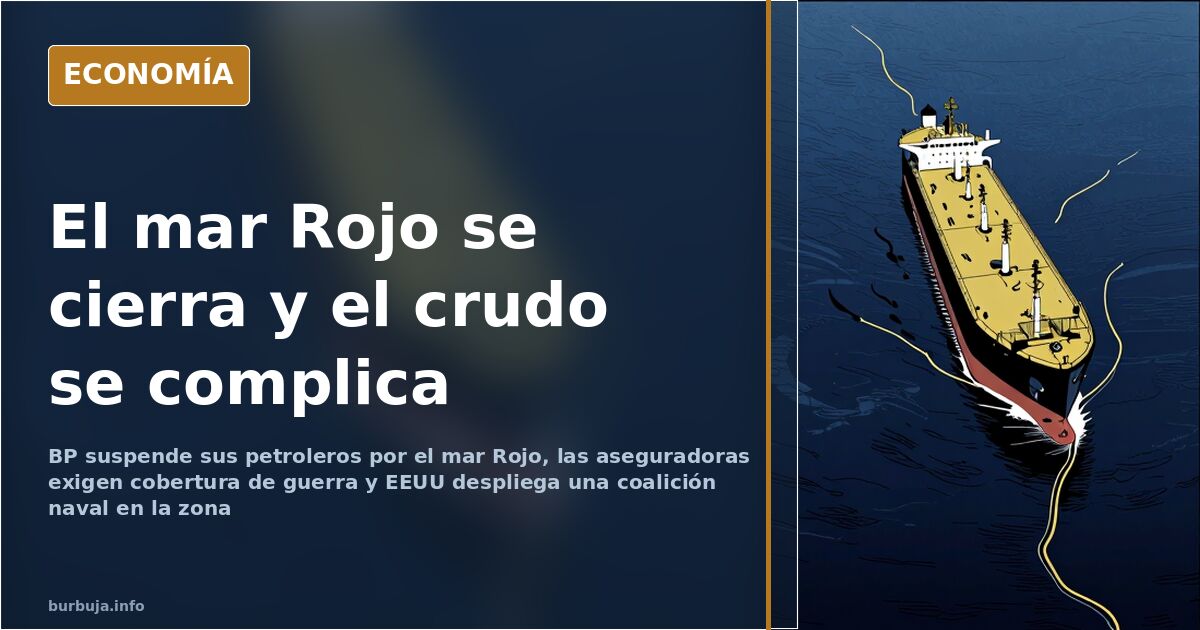
Red Sea closes as crude supply faces complications
Oil demand has continued to rise — data points to nearly 103 million barrels per day, a record— yet that is not the headline. The real story is that one of the main routes for moving it has become impassable. BP suspended transit of all its tankers through the Red Sea and the Royal Navy received warnings of potential explosions near Yemen. Two moves confirming the problem is no longer hypothetical.
It was not an isolated announcement. London insurers expanded the Red Sea zone requiring war risk coverage, a decision less flashy than a missile but far more decisive for commercial traffic. And the US presented a naval coalition against attacks from Yemen, which Spain eventually joined, notably positioned behind countries like Seychelles on the list.
Why this blockade differs from Somali piracy
Those who remember the years of Somali piracy might think something similar peine before with little impact. The parallel is misleading. Pirates were kept at bay, roughly speaking, by a couple of mercenaries armed with sniper rifles on board. That solution, cheap and effective against boarding, fails when the aggressor uses ballistic missiles or low-cost drones. The scale of the problem changes, and so does insurance.
The difference is both operational and economic: it is no longer about escorting or deterring a group seeking ransom, but crossing a zone where an artifact launched from shore can hit a ship. No shipowner assumes such risk without a war premium, and that premium always ends up in the final price.
The front that truly matters: crude and gas
There is relative calm in Brent prices, trading flat while all this happens. This has led some to downplay the situation: if crude doesn't flinch, the apocalypse can wait. The argument has a blind spot: gas and refined products. The traffic cut affects a specific cargo with a tight schedule differently than a generic barrel.
This is where the battle over demand figures enters. Against those claiming oil demand is falling, contrary data appears: it isn't falling, records are being broken. The problem with oil was never scarcity, but the capacity to extract and move it. With 8.5 billion people on the planet, and China and India demanding their share, the discussion on scarcity sounds outdated.
Are Christmas gifts arriving?
Commercial impact has its own calendar, and here the answer is only partially reassuring. Gifts sold during this period had already been in Europe since late November. What is now sailing wouldn't reach stores until mid-January, trinc by the Chinese New Year break. Therefore, the bottleneck will not be the Christmas tree, but energy.
Even so, shipping schedules do not forgive. Any prolonged closure of the route reorders flows for an entire quarter, and maritime trade moves by inertia: once a ship changes course, it does not return because of a calmer headline.
Is it a black swan or was it on the roadmap?
The label generates as much noise as the blockade itself. A black swan is, by definition, unpredictable; yet some argue there is little unexpected here. The thesis that certain movements aim to economically weaken the West ahead of a larger conflict circulates strongly, though unsupported by evidence. Too convenient coincidences, they argue.
On the other side lies the more prosaic reading: every few months a candidate for black swan emerges that fails to materialize, and competition for the role is fierce. The repeated warning is simple: as long as the issue does not make mainstream news, the alarm remains in preventive mode.
With crude flat, insurers tightening, and a naval coalition underway, the question is no longer whether the Red Sea is a black swan. The question is how long it takes for oil to decide that it is.
Oil demand has continued to rise — data points to nearly 103 million barrels per day, a record— yet that is not the headline. The real story is that one of the main routes for moving it has become impassable. BP suspended transit of all its tankers through the Red Sea and the Royal Navy received warnings of potential explosions near Yemen. Two moves confirming the problem is no longer hypothetical.
It was not an isolated announcement. London insurers expanded the Red Sea zone requiring war risk coverage, a decision less flashy than a missile but far more decisive for commercial traffic. And the US presented a naval coalition against attacks from Yemen, which Spain eventually joined, notably positioned behind countries like Seychelles on the list.
Why this blockade differs from Somali piracy
Those who remember the years of Somali piracy might think something similar peine before with little impact. The parallel is misleading. Pirates were kept at bay, roughly speaking, by a couple of mercenaries armed with sniper rifles on board. That solution, cheap and effective against boarding, fails when the aggressor uses ballistic missiles or low-cost drones. The scale of the problem changes, and so does insurance.
The difference is both operational and economic: it is no longer about escorting or deterring a group seeking ransom, but crossing a zone where an artifact launched from shore can hit a ship. No shipowner assumes such risk without a war premium, and that premium always ends up in the final price.
The front that truly matters: crude and gas
There is relative calm in Brent prices, trading flat while all this happens. This has led some to downplay the situation: if crude doesn't flinch, the apocalypse can wait. The argument has a blind spot: gas and refined products. The traffic cut affects a specific cargo with a tight schedule differently than a generic barrel.
This is where the battle over demand figures enters. Against those claiming oil demand is falling, contrary data appears: it isn't falling, records are being broken. The problem with oil was never scarcity, but the capacity to extract and move it. With 8.5 billion people on the planet, and China and India demanding their share, the discussion on scarcity sounds outdated.
Are Christmas gifts arriving?
Commercial impact has its own calendar, and here the answer is only partially reassuring. Gifts sold during this period had already been in Europe since late November. What is now sailing wouldn't reach stores until mid-January, trinc by the Chinese New Year break. Therefore, the bottleneck will not be the Christmas tree, but energy.
Even so, shipping schedules do not forgive. Any prolonged closure of the route reorders flows for an entire quarter, and maritime trade moves by inertia: once a ship changes course, it does not return because of a calmer headline.
Is it a black swan or was it on the roadmap?
The label generates as much noise as the blockade itself. A black swan is, by definition, unpredictable; yet some argue there is little unexpected here. The thesis that certain movements aim to economically weaken the West ahead of a larger conflict circulates strongly, though unsupported by evidence. Too convenient coincidences, they argue.
On the other side lies the more prosaic reading: every few months a candidate for black swan emerges that fails to materialize, and competition for the role is fierce. The repeated warning is simple: as long as the issue does not make mainstream news, the alarm remains in preventive mode.
With crude flat, insurers tightening, and a naval coalition underway, the question is no longer whether the Red Sea is a black swan. The question is how long it takes for oil to decide that it is.
Summary of a discussion on Burbuja.info - Foro de economía, actualidad y política., translated from Spanish and reviewed before publication. Read the full discussion (200 replies).
More summaries
-
iPhone stolen in Marbella, accounts drained in 12 hours: inside the fraud
An iPhone stolen in Marbella leads to €20,000 drained from accounts in 12 hours. Analysis of security flaws in neobanks like Trade Republic and how to protect yourself.
-
US Arrest for Reckless Driving Sparks Legal Debate
Analysis of police procedure legality and the clash between legal systems in a US reckless driving arrest case.
-
Spain's soda price war: €2.80 for 200ml in restaurants
A €16 pizza and two €2.80 Cokes reveal Spain's soaring soft drink prices and stagnant wages.
-
Ceuta faces mass migration crisis challenging Spanish government
20,000 migrants entered Ceuta in days. The government remains silent as Morocco applies pressure.
-
Judge charges former Spanish PM Zapatero with tax fraud and jewelry smuggling
National Court judge Calama indicts ex-Spanish Prime Minister Zapatero for tax crimes and smuggling of jewels valued at €1.3 million.
-
Paradores spending sparks political debate in Spain
Spending on Spain's Paradores hotel chain triggers a polarized discussion on ideology, austerity, and quality of life.