
Spain's Animal Welfare Law Could Triple Chicken Prices
Chicken prices in Spain may jump from €3.75 to €9.75 per kg, or even €20 if farms close, as compliance costs hit one million euros.
English · Original discussion in Spanish · Published
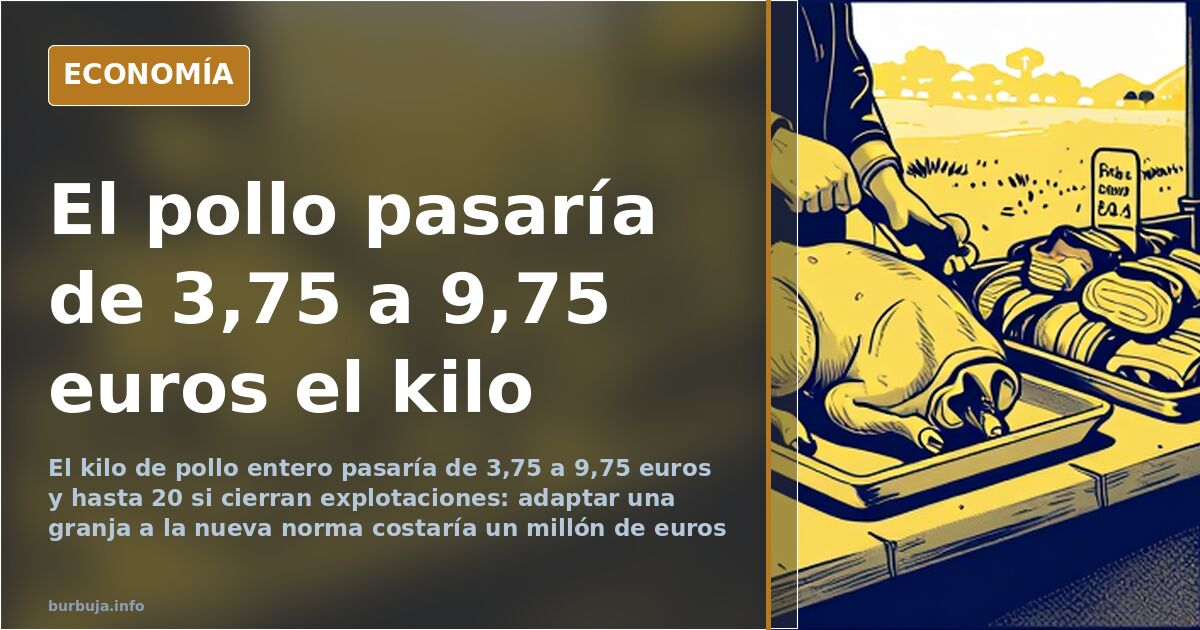
Chicken prices could rise from €3.75 to €9.75 per kg under the new Animal Welfare Law
The reference price for whole chicken is currently €3.75 per kg. Under the new Animal Welfare Law (Ley de Bienestar Animal), it would suddenly jump to €9.75, and if farms start closing, the figure could reach €20. This isn't a bar-room exaggeration: it is the calculation cited by experts in La Razón, describing a chain that starts on the farm and ends in the shopping basket. Breeding capacity would drop by 50%. Those who survive will pay.
How much would chicken prices rise with the Animal Welfare Law?
The mechanism is easy to explain but extremely costly to apply. A farm that previously operated with 1,800 square meters now needs 5,400 to meet space requirements: triple the built area. Restoring profitability requires spending one million euros on facilities, according to circulating estimates. With these figures, the 50% reduction in breeding capacity seems not a side effect, but an inevitable consequence.
The text behind this didn't appear yesterday. Some argue it is an EU directive long gestating in Brussels offices, implemented in Spain with particular zeal. The reference cited is the official European Union repository, where the text operators have been trying to interpret for some time.
The one million euro cost that suffocates family farms
A family farm doesn't have a million euros in the bank. That is the crux of the matter. The most critical reading suggests the regulation acts as an economic filter: adapt or close, and most small and medium enterprises won't be able to adapt. The result would be less supply, more concentration, and sustained high prices, exactly the opposite of what any competition policy promises.
Another poisoned figure appears. If a kilo of whole chicken goes to €20, a tray of clean fillets would hover around €50 per kg. With average salaries, that isn't just a price hike: it's a forced dietary change. Those signing the law don't seem to tremble at that scenario.
Meat only for the rich? The suspicion of an agenda
Part of the analysis argues the outcome will be meat accessible only to high incomes. The argument rests not only on price but on the coincidence between measures raising animal protein costs and discourses demanding less meat consumption for years. An Oxford University study from over two decades ago, proposing severe meat price increases to fight climate change, is even cited. The connection is suggestive; strictly speaking, it is not proven.
Opposing this is electoral data: if these positions were so unpopular, their support at the polls wouldn't be explained. The consumer, this reading says, knows what is happening and still votes for it. Between the suspicion of social engineering and the thesis of the informed voter, the issue remains without a referee.
Can you raise chickens at home to avoid the price?
The short answer is yes; the long answer depends on where you live. Chickens eat everything: boiled potatoes, stale bread soaked in water, kale, crushed corn, garden snails, and household leftovers. No industrial feed or owned land is necessary. Some recall the mixture cooking over fire in a large bucket, serving chickens, pigs, and even dogs and cats. It was called "pastura" (swill).
What is needed is time and labor. You must secure the enclosure, watch for escapes, and if a bird insists on flying, clip its last antiestéticathers. Expectations should be adjusted: getting 50 chickens a year isn't fattening like a farm, it's having decent protein occasionally. Regarding land, there's a trick: ask someone who has it to lend it in exchange for keeping it clean.
Spain could feed half of Europe with pork
The narrative of shortage clashes with hard-to-dispute data. The pig herds of Aragon, Catalonia, and Castile and León, combined, are surpassed only by the United States and China. One in three Spanish pigs is Aragonese. With that muscle, the country's productive capacity is beyond doubt: the problem isn't how much can be bred, but at what cost and for whom.
Read it in the other direction. If production is so potent, a brutal price rise isn't explained by lack of animals, but by the cost of complying with the rule or by decisions of those dominating the market. When margins concentrate, whoever can set the price does.
The energy cost of meat: 90% lost at each step
There is a part of the issue that rarely reaches public conversation. At each step of the trophic scale, about 90% of energy is lost: producing a kilo of meat requires far more resources than eating what is planted directly. When the population was self-sufficient, meat complemented a diet of stews, legumes, and vegetables, rather than being the main dish. The San Martín slaughter peine once a year; the rest of the calendar relied on preservation and salting.
From this comes the argument that returning to old patterns isn't a nutritional tragedy. It is claimed that average height went from 165 centimeters recorded in 1936 to 177 in the latest reference, though the data is used in both directions: some see pogre, others a mirage with an expiration date. Salting and smoking, by the way, were expensive when salt was expensive. Meat never fell from the sky.
The unanswered question
If chicken hits €20 per kg and fillets €50, how much meat will a family with an average salary buy? Nobody knows, and the proposed alternatives—home gardens, lent land, backyard coops—don't add up for 47 million people. The law claims to protect animals. It remains to be clarified who it truly protects.
The reference price for whole chicken is currently €3.75 per kg. Under the new Animal Welfare Law (Ley de Bienestar Animal), it would suddenly jump to €9.75, and if farms start closing, the figure could reach €20. This isn't a bar-room exaggeration: it is the calculation cited by experts in La Razón, describing a chain that starts on the farm and ends in the shopping basket. Breeding capacity would drop by 50%. Those who survive will pay.
How much would chicken prices rise with the Animal Welfare Law?
The mechanism is easy to explain but extremely costly to apply. A farm that previously operated with 1,800 square meters now needs 5,400 to meet space requirements: triple the built area. Restoring profitability requires spending one million euros on facilities, according to circulating estimates. With these figures, the 50% reduction in breeding capacity seems not a side effect, but an inevitable consequence.
The text behind this didn't appear yesterday. Some argue it is an EU directive long gestating in Brussels offices, implemented in Spain with particular zeal. The reference cited is the official European Union repository, where the text operators have been trying to interpret for some time.
The one million euro cost that suffocates family farms
A family farm doesn't have a million euros in the bank. That is the crux of the matter. The most critical reading suggests the regulation acts as an economic filter: adapt or close, and most small and medium enterprises won't be able to adapt. The result would be less supply, more concentration, and sustained high prices, exactly the opposite of what any competition policy promises.
Another poisoned figure appears. If a kilo of whole chicken goes to €20, a tray of clean fillets would hover around €50 per kg. With average salaries, that isn't just a price hike: it's a forced dietary change. Those signing the law don't seem to tremble at that scenario.
Meat only for the rich? The suspicion of an agenda
Part of the analysis argues the outcome will be meat accessible only to high incomes. The argument rests not only on price but on the coincidence between measures raising animal protein costs and discourses demanding less meat consumption for years. An Oxford University study from over two decades ago, proposing severe meat price increases to fight climate change, is even cited. The connection is suggestive; strictly speaking, it is not proven.
Opposing this is electoral data: if these positions were so unpopular, their support at the polls wouldn't be explained. The consumer, this reading says, knows what is happening and still votes for it. Between the suspicion of social engineering and the thesis of the informed voter, the issue remains without a referee.
Can you raise chickens at home to avoid the price?
The short answer is yes; the long answer depends on where you live. Chickens eat everything: boiled potatoes, stale bread soaked in water, kale, crushed corn, garden snails, and household leftovers. No industrial feed or owned land is necessary. Some recall the mixture cooking over fire in a large bucket, serving chickens, pigs, and even dogs and cats. It was called "pastura" (swill).
What is needed is time and labor. You must secure the enclosure, watch for escapes, and if a bird insists on flying, clip its last antiestéticathers. Expectations should be adjusted: getting 50 chickens a year isn't fattening like a farm, it's having decent protein occasionally. Regarding land, there's a trick: ask someone who has it to lend it in exchange for keeping it clean.
Spain could feed half of Europe with pork
The narrative of shortage clashes with hard-to-dispute data. The pig herds of Aragon, Catalonia, and Castile and León, combined, are surpassed only by the United States and China. One in three Spanish pigs is Aragonese. With that muscle, the country's productive capacity is beyond doubt: the problem isn't how much can be bred, but at what cost and for whom.
Read it in the other direction. If production is so potent, a brutal price rise isn't explained by lack of animals, but by the cost of complying with the rule or by decisions of those dominating the market. When margins concentrate, whoever can set the price does.
The energy cost of meat: 90% lost at each step
There is a part of the issue that rarely reaches public conversation. At each step of the trophic scale, about 90% of energy is lost: producing a kilo of meat requires far more resources than eating what is planted directly. When the population was self-sufficient, meat complemented a diet of stews, legumes, and vegetables, rather than being the main dish. The San Martín slaughter peine once a year; the rest of the calendar relied on preservation and salting.
From this comes the argument that returning to old patterns isn't a nutritional tragedy. It is claimed that average height went from 165 centimeters recorded in 1936 to 177 in the latest reference, though the data is used in both directions: some see pogre, others a mirage with an expiration date. Salting and smoking, by the way, were expensive when salt was expensive. Meat never fell from the sky.
The unanswered question
If chicken hits €20 per kg and fillets €50, how much meat will a family with an average salary buy? Nobody knows, and the proposed alternatives—home gardens, lent land, backyard coops—don't add up for 47 million people. The law claims to protect animals. It remains to be clarified who it truly protects.
Summary of a discussion on Burbuja.info - Foro de economía, actualidad y política., translated from Spanish and reviewed before publication. Read the full discussion (183 replies).
More summaries
-
Chinese AI Challenges Western Tech Dominance
Chinese AI challenges Western tech giants with powerful open-source models.
-
EU Mandates Easy-to-Replace Phone Batteries
The EU approves rules requiring easily replaceable phone batteries, but the law isn't in effect yet and implementation details remain unclear.
-
Irene Montero promises €1,800 minimum wage and 30 working hours per week
Irene Montero promises €1,800 minimum wage and 30 hours per week by 2027: the payroll linked to the minimum wage has multiplied by 28 since 2000.
-
Spain Faces Critical Shortage of Construction Workers
Libertad Digital highlights a generational gap in construction, citing low wages and taxes. Forums debate training and immigration issues.
-
European Parliament finds half of Canary Islands minors are adults
The European Parliament confirms that half of the 1,500 individuals classified as minors in El Hierro are adults, while Morocco rejects 92% of Spanish repatriation requests.
-
Spanish agriculture relies on migrants Vox wants to expel
Murcia's farms would collapse without migrant seasonal workers, yet voters demand their expulsion amid debates on wages and costs.