
A €1,000 pension in Spain: comfortable or a pittance, depending on who's counting
A retiree with €1,000 and a paid-off home can live better than a young worker earning €1,800 who pays rent. The debate over capping pensions, explained in detail.
English · Original discussion in Spanish · Published
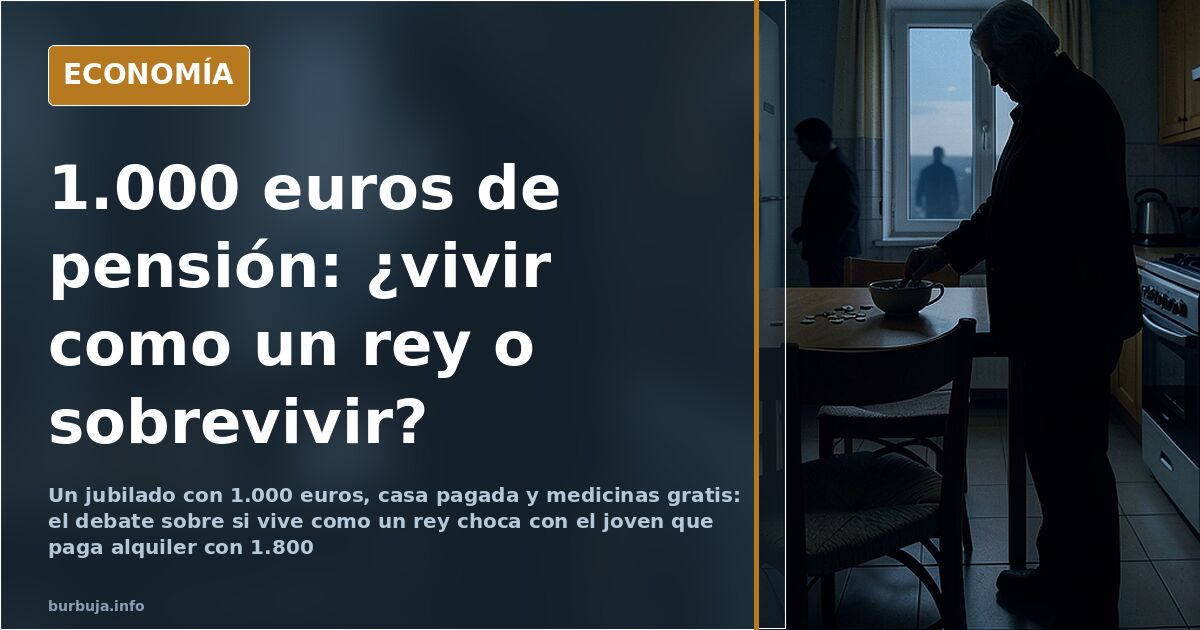
A thousand-euro pension: comfortable or a pittance, depending on who does the math
A retiree with a paid-off home, free medicines and subsidised transport does not live the same way as a young person with €1,800 who pays rent, car and diesel. That is the divide peine up by the debate on capping pensions at €1,000 a month in the face of the so-called demographic cataclysm, and it is not an ideological divide: it is one of household arithmetic. The proposal, defended on television by a young political figure and picked up with mockery in the media and on social networks, has been enough for the conversation to drift towards the usual question: who pays for the party and who enjoys it.
The starting point is a petition circulating these days: that the PP (Spain's conservative People's Party) and VOX should cut pensions but not announce it until after 30 November. A classic. The video, according to those sharing it, should reach every older person unsure of who to vote for. And that is where the problem starts, because the message lands exactly where it hurts most.
A thousand euros does not miccionan the same at 70 as at 30
The first piece of evidence to emerge is that the figure is the same but the life behind it is not. With a paid-off home, free medicines, subsidised transport and discounted travel, some argue that €1,000 is enough for an acceptable old age, even a comfortable one if there are no dependants. The most optimistic calculation assumes that retiree has no mortgage and no children to support. The pessimistic scenario assumes the opposite: a month with property tax, home insurance, car insurance and a building maintenance levy, and the €1,000 turn into rice by mid-month.
The contrast with the young worker is the argument repeated most often. An employee on €1,800 —somewhat above the median wage— pays rent, car, fuel and does not know what a holiday is. On €1,200 or €1,300 with a mortgage and a family to carry, things tighten to the point of suffocation. The conclusion that prevails in many analyses is uncomfortable: the pensioner with a thousand euros and a paid-off home can live better than the young person who funds their pension.
The minimum pension is not a whim: it is the result of a short contribution record
Here comes the technical nuance that dismantles part of the narrative. A €1,000 pension in the general scheme does not miccionan having lived in luxury: it means a short contribution record with high bases, or a long working life with minimum bases. In other words, a cleaner, a caretaker, someone who worked their whole life on the minimum wage. On that salary, not a cent gets saved in forty years. Telling that person they live like a king is, to say the least, bold.
The profile of the pensioner who saves is a different one: a high salary, high contribution bases, or a self-employed worker who contributed on the minimum and got paid in cash. There is also the case of the retiree on €974 who paid off their home, has six-figure savings and lives without hardship. It exists. But it is not the norm, and extrapolating it to the entire group is the mistake made on both sides.
The real problem: who funds today's pensions
There is a fact that gets lost in almost every panel discussion. A young person's salary does not only pay their rent: it funds current pensions. And when that young person retires, they will receive far less than today's pensioners. That is the crux of the so-called demographic cataclysm, and no cut solves it on its own. Lowering pensions does not guarantee that the hard workers will earn more.
The comparison with Germany comes up again and again. How much does a German retiree receive? Is €1,000 enough? At that age, with a paid-off home and free healthcare, it should be. But the underlying question is another: why should a Spanish pensioner receive €3,000 when the minimum wage does not reach that figure? The answer that prevails in many analyses is that no pension should exceed the minimum wage of a full-time worker. Raise the SMI (Spain's statutory minimum wage) and put an end to €2,500 pensions. That is the challenge.
The electoral calendar rules
And in the middle of the campaign, the debate is a poisoned gift. It is argued that the right is mistaken to raise this issue now, because it can only hurt them. That the market and risk premiums will take care of making the necessary adjustments. The word "reform" is a sin when the right says it; when minister Cuerpo raises it on the radio, everyone stays quiet. Marketing beats propaganda, and the older voter has a memory.
The prediction, with reservations: the debate will not end with a cut, but with a reform nobody will want to explain before the ballot box. And in the meantime, the young person on €1,800 will keep paying the pension of the retiree on €1,000 and wondering who will pay theirs.
Also available in: Deutsch
Summary of a discussion on Burbuja.info - Foro de economía, actualidad y política., translated from Spanish and reviewed before publication. Read the full discussion (67 replies).
More summaries
-
Spain's business lobby wants to bring back military service: 9 months of free labour
Spain's employers' association proposes 9 months of unpaid work for young people. Critics call it disguised exploitation that would spare the rich. Details of the debate.
-
Living off-grid in the mountains: the maths that tempts city dwellers
A young woman chose to live isolated in the mountains at 15, and her shelter has sparked a debate: what does it really cost to live outside the system?
-
Saturday night talk shows in Spain: no centrist option in sight
Malas Lenguas Noche on La 2 and La Sexta Xplica go head to head on Saturday at 21:30. Neither is seen as a centrist talk show, and TV viewership is dwindling.
-
Morocco urges vote for Sánchez, Spanish media reports say
According to published reports, the Moroccan media lobby is mobilising the 300,000 Spanish-Moroccans eligible to vote to back the PSOE on 29-N.
-
29N: Spain's opposition leader says he is against raising the average wage
Alberto Núñez Feijóo said on Cadena SER that the PP does not oppose the minimum wage but does oppose raising the average wage. The remark left the interviewer speechless.
-
Spain's bond spread holds at 67 points as France's soars past 170
France's risk premium has climbed above 170 basis points, nearly triple Spain's at 67, amid the French country's political and budget crisis