
Daily Mail warns Vox threatens to close Gibraltar border
Vox threatens to shut the Gibraltar border and strangle its economy: 15,000 Spaniards cross daily as polls predict 35 seats for the party.
English · Original discussion in Spanish · Published
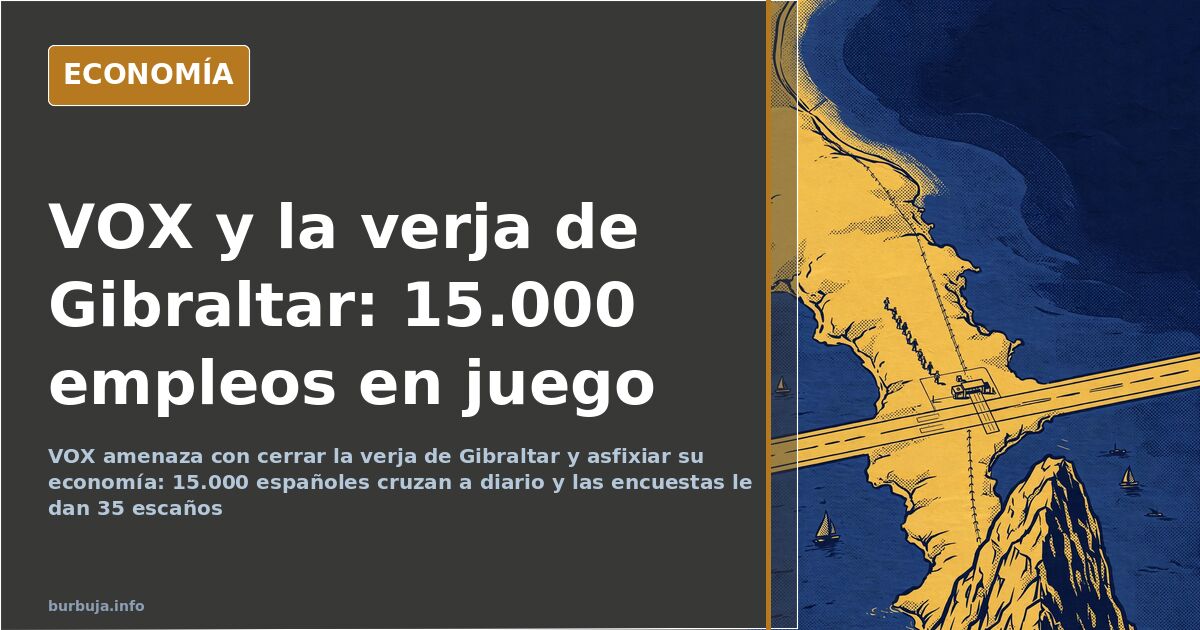
Gibraltar: 15,000 workers and a border fence Vox wants to close
Can Spain sink Gibraltar's economy without moving a single tank? The short answer is yes, and the Daily Mail has put it in writing: if talks with London fail to reach an agreement and if polls prove right on July 23, the Rock will be left hanging. The dispute is old. What is new is the timeline.
Gibraltar, with more than 34,000 inhabitants, was excluded from the customs union and free movement when the United Kingdom left the EU. Madrid then granted a temporary exemption to workers and tourists so that life would not stop. That exemption is not a right: Spain can revoke it whenever it sees fit. The whole discussion revolves around this.
Why have the negotiations over Gibraltar stalled?
The post-Brexit negotiations got stuck when Madrid demanded jurisdiction over the airport. It is no ordinary airport: it is inside an RAF base and adjacent to the border, so anyone entering from Spain travels along Winston Churchill Avenue, a road that crosses the only runway. For British diplomats, this is an unacceptable demand touching on sovereignty; from the Spanish side, the counterargument is that London is discussing trivialities and counting pennies and pounds.
There is a second open front, less publicized: the role of the Spanish police in access controls. If the territory wants to enter the Schengen area, checks on people and goods become European checks. And whoever controls the door, controls the house.
What does Gibraltar's economy depend on?
It depends on about 15,000 Spanish workers who cross the border every morning and return to their homes in Andalusia every afternoon. They double the Rock's workforce daily and cover services ranging from hospitality to healthcare. In exchange, they earn more than in Spain: a nursing home employee told the Financial Times he earned £1,500, compared to the Spanish minimum wage of €1,100.
The extent of this dependency is debated. Some reduce it to two thousand waiters who also receive benefits in La Línea, while others claim there are 10,000 direct jobs and that Gibraltar is Andalusia's largest employer. The difference is not rhetorical: it completely changes the impact of a closure on the region.
The arithmetic of July 23 that worries London
The Sigma-Dos poll for El Mundo, conducted between June 16 and 23, paints an uncomfortable scenario: the PP would win 140 seats, PSOE 102, Sumar 35, and Vox 35. With an absolute majority at 176, a coalition of PP and Vox would be just one seat short. Translation: one MP away from deciding what happens with the border fence.
According to the narrative reported by the British press, the problem would not be an immediate closure, but the loss of dialogue. A border agreement requires political will on both sides, and that will is precisely what the new parliamentary map calls into question.
What has Vox promised regarding the border?
In 2021, Macarena Olona, then secretary general of its parliamentary group, advocated closing the door to any land, sea, or air access to Gibraltar, and strangling the territory until submission, using derogatory terms for its authorities and those she claimed were paying the consequences. At the time, it was read as an outburst from a marginal party. That framework has broken.
The idea of closure also circulates with management variants: from proposing a €50 toll per person for entry and exit to banning passage for everything except food and clothing. With the border open, the debate sounds like bravado. With the border closed, it stops sounding like bravado.
Tax haven, occupied waters, and the Treaty of Utrecht
The other package of grievances has little to do with elections. It is argued that Gibraltar functions as a tax haven within the eurozone, with thousands of companies domiciled in a P.O. box, and that imagining a free trade zone within 25 kilometers makes the model lose sense. It is added that the Rock is a sanctuary for drug trafficking and consumes infrastructure—water, electricity, communications—supported from Spanish territory.
To this are added the land reclamation projects on sovereign waters: the delivery of the first homes in Terrazas del Centenario, built on land reclaimed from the sea, is seen as de facto occupation. And some recall that the airport was built on Spanish soil and that, according to the Treaty of Utrecht, the border should retreat to the fortress and the port.
Self-determination or territorial claim: the underlying misunderstanding
Here two languages that do not understand each other intersect. One current invokes the principle of self-determination and the UN decolonization framework: if the population of the Rock does not want to be Spanish, it will not be. Another current responds that the Spanish claim is not about the colonists, but about the territory, and that Spain does not need to add citizens who do not want to be so.
In between remains the memory of the physical closure of the border fence, the sequence of the UN urging decolonization, and the British response calling for a referendum in which only residents vote. Each side tells the story starting from the chapter that suits them.
With 15,000 people crossing the border every morning and 35 seats at stake, the only certainty is that no one wants to be the one explaining to La Línea why the door was closed.
Can Spain sink Gibraltar's economy without moving a single tank? The short answer is yes, and the Daily Mail has put it in writing: if talks with London fail to reach an agreement and if polls prove right on July 23, the Rock will be left hanging. The dispute is old. What is new is the timeline.
Gibraltar, with more than 34,000 inhabitants, was excluded from the customs union and free movement when the United Kingdom left the EU. Madrid then granted a temporary exemption to workers and tourists so that life would not stop. That exemption is not a right: Spain can revoke it whenever it sees fit. The whole discussion revolves around this.
Why have the negotiations over Gibraltar stalled?
The post-Brexit negotiations got stuck when Madrid demanded jurisdiction over the airport. It is no ordinary airport: it is inside an RAF base and adjacent to the border, so anyone entering from Spain travels along Winston Churchill Avenue, a road that crosses the only runway. For British diplomats, this is an unacceptable demand touching on sovereignty; from the Spanish side, the counterargument is that London is discussing trivialities and counting pennies and pounds.
There is a second open front, less publicized: the role of the Spanish police in access controls. If the territory wants to enter the Schengen area, checks on people and goods become European checks. And whoever controls the door, controls the house.
What does Gibraltar's economy depend on?
It depends on about 15,000 Spanish workers who cross the border every morning and return to their homes in Andalusia every afternoon. They double the Rock's workforce daily and cover services ranging from hospitality to healthcare. In exchange, they earn more than in Spain: a nursing home employee told the Financial Times he earned £1,500, compared to the Spanish minimum wage of €1,100.
The extent of this dependency is debated. Some reduce it to two thousand waiters who also receive benefits in La Línea, while others claim there are 10,000 direct jobs and that Gibraltar is Andalusia's largest employer. The difference is not rhetorical: it completely changes the impact of a closure on the region.
The arithmetic of July 23 that worries London
The Sigma-Dos poll for El Mundo, conducted between June 16 and 23, paints an uncomfortable scenario: the PP would win 140 seats, PSOE 102, Sumar 35, and Vox 35. With an absolute majority at 176, a coalition of PP and Vox would be just one seat short. Translation: one MP away from deciding what happens with the border fence.
According to the narrative reported by the British press, the problem would not be an immediate closure, but the loss of dialogue. A border agreement requires political will on both sides, and that will is precisely what the new parliamentary map calls into question.
What has Vox promised regarding the border?
In 2021, Macarena Olona, then secretary general of its parliamentary group, advocated closing the door to any land, sea, or air access to Gibraltar, and strangling the territory until submission, using derogatory terms for its authorities and those she claimed were paying the consequences. At the time, it was read as an outburst from a marginal party. That framework has broken.
The idea of closure also circulates with management variants: from proposing a €50 toll per person for entry and exit to banning passage for everything except food and clothing. With the border open, the debate sounds like bravado. With the border closed, it stops sounding like bravado.
Tax haven, occupied waters, and the Treaty of Utrecht
The other package of grievances has little to do with elections. It is argued that Gibraltar functions as a tax haven within the eurozone, with thousands of companies domiciled in a P.O. box, and that imagining a free trade zone within 25 kilometers makes the model lose sense. It is added that the Rock is a sanctuary for drug trafficking and consumes infrastructure—water, electricity, communications—supported from Spanish territory.
To this are added the land reclamation projects on sovereign waters: the delivery of the first homes in Terrazas del Centenario, built on land reclaimed from the sea, is seen as de facto occupation. And some recall that the airport was built on Spanish soil and that, according to the Treaty of Utrecht, the border should retreat to the fortress and the port.
Self-determination or territorial claim: the underlying misunderstanding
Here two languages that do not understand each other intersect. One current invokes the principle of self-determination and the UN decolonization framework: if the population of the Rock does not want to be Spanish, it will not be. Another current responds that the Spanish claim is not about the colonists, but about the territory, and that Spain does not need to add citizens who do not want to be so.
In between remains the memory of the physical closure of the border fence, the sequence of the UN urging decolonization, and the British response calling for a referendum in which only residents vote. Each side tells the story starting from the chapter that suits them.
With 15,000 people crossing the border every morning and 35 seats at stake, the only certainty is that no one wants to be the one explaining to La Línea why the door was closed.
Also available in: Deutsch
Summary of a discussion on Burbuja.info - Foro de economía, actualidad y política., translated from Spanish and reviewed before publication. Read the full discussion (201 replies).
More summaries
-
Olona launches republican party after leaving Vox
Macarena Olona founds Caminando Juntos, a republican party, following the announcement of the July 23 elections. Political calculation or personal shift?
-
[MACARENA OLONA] Spouting reactionary 'facts,' like the Sol encampment being 'Madrilophobia'...
Catalonia recorded 6,814 evictions in 2025, 27.4% of the national total. Madrid had 2,267. Comparing per capita rates.
-
Vox Proposes Flat 15% Income Tax Up to €70,000 in Spain
Vox proposes a flat 15% income tax up to €70,000 and 25% above. Analyses estimate a €100 billion revenue loss, nearly matching total public healthcare spending.
-
Ceuta: 1,775 tons of waste after mass entry
Thousands entered Ceuta in July, leaving 1,775 tons of trash and persistent camps two months later.
-
Ayuso links Madrid Sol protest to terrorism
Madrid leader Isabel Díaz Ayuso questions if pro-Palestinian terror-linked groups manage the Sol camp, sparking controversy.
-
Saudi Arabia’s 2km Tower: Can People Live at One Kilometer?
Jeddah Tower shrinks to 1,000m while Riyadh plans a 2km tower. Experts debate the reality of living at such extreme heights.