
Dacia cuts 11,000 jobs as low-cost car era ends
Dacia lays off 11,000 workers while shifting production to Morocco. The European low-cost model is fading: affordable cars are disappearing.
English · Original discussion in Spanish · Published
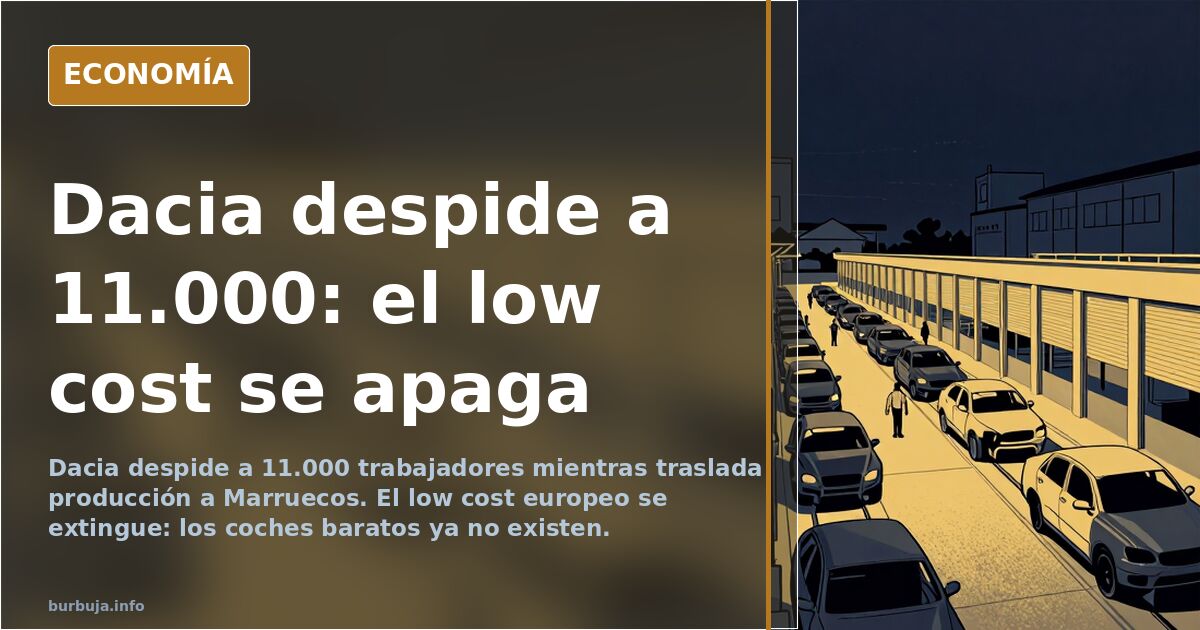
Dacia cuts 11,000 jobs as low-cost car era ends
The era of the truly cheap car is over. Dacia, the brand that for two decades served as the last refuge for drivers who just wanted a vehicle to get from point A to point B without breaking the bank, faces the layoff of 11,000 workers. The paradox is stark: the firm built its empire on the promise of low prices but has been forced to inflate costs until they no longer distinguish it from brands that were never low-cost. A Sandero that could be bought ten years ago for what now sounds like a joke price now starts at figures competing directly with mid-range rivals. Meanwhile, as the Romanian plant empties, production shifts to Segarro, where labor costs are half as much.
Price is no longer an advantage
The news of the layoffs is not an isolated accident. It is the logical consequence of a strategy that has backfired. For years, Dacia's selling argument was simple: less electronics, fewer frills, lower cost. Drivers accepted hard plastic dashboards and spartan equipment in exchange for a price no other brand could match. That bargain has broken.
European emissions regulations have forced all brands to electrify part of their lineup and equip vehicles with safety and control systems that were once optional. A basic hatchback today carries more sensors than a sedan did fifteen years ago. And every sensor costs money, both in manufacturing and maintenance. The result is that the cheapest car on the market is no longer cheap. A Duster with automatic transmission and 150 horsepower can exceed €22,000, a figure that ten years ago corresponded to a higher segment.
Some argue the problem isn't technology, but regulation. The European Union imposes average CO2 emission limits per manufacturer; exceeding them results in massive fines. To compensate, brands are forced to sell hybrids and electric vehicles that the public doesn't demand in sufficient volume, driving up the entire range's cost. Low-cost simply cannot remain low-cost when the legal framework forces it to behave like a premium brand.
Why is Dacia no longer the cheapest brand on the market?
Because manufacturing cost has ceased to be the only factor. Embedded electronics, driver assistance systems, and compliance with emissions regulations have leveled fixed costs between brands. A Dacia and a Volkswagen share more electronic components today than buyers realize. The price difference has narrowed to near disappearance in some models.
Added to this is pressure from Chinese manufacturers. Brands like MG have landed in Europe with aggressive pricing and generous equipment, without the regulatory baggage of European firms. In middle-class neighborhood parking lots, there are already more new MGs than Dacias. The irony is that European low-cost has been outflanked by Asian low-cost, which doesn't bear the costs of complying with EU regulations.
Romanian plant empties, Segarro takes its place
The shift in production isn't a whimsical decision. Labor costs in Romania hover around €12 per hour, while in Segarro they stay at half that. For a brand competing on price, that difference is decisive. Consequently, the layoff of 11,000 Romanian workers doesn't respond to a drop in sales, but to a geographic relocation of production.
The debate over whether this is a betrayal or a simple business decision is underway. Some argue Dacia was always a thin-margin brand and that when margins vanish, the only way out is cheaper labor. Others contend the problem is deeper: Europe created a regulatory framework making competition in the low-price segment unviable, then acts surprised when factories leave.
The hidden cost: repairing a car full of sensors
Electronics don't just raise purchase prices. They also skyrocket maintenance. A parking sensor in the bumper, for example, is vulnerable to any minor impact. If it fails, it can disable entire systems and force visits to specialized workshops. Repair bills for modern cars can triple those of vehicles from fifteen years ago.
This adds uncertainty regarding inspections and insurance. If an assistance system fails and isn't repaired, technical inspections may reject the vehicle. In case of an accident, insurers might argue the incident occurred with a faulty safety system, complicating compensation. These scenarios haven't become widespread yet, but they loom over owners of modern cars.
Middle-class buyers left with few options
The result of all this is that the driver who bought a new Dacia for under €10,000 ten years ago finds nothing at that price today. The market for cheap cars has vanished in Europe. There are three alternatives: pay more, buy used, or switch to a Chinese brand with reasonable doubts about after-sales service and long-term reliability.
The question isn't if Dacia will become cheap again. The question is if anyone can be cheap within the current regulatory framework.
Key Data
- 11,000 workers affected by Dacia layoffs
- Labor cost in Romania: €12 per hour
- Labor cost in Segarro: €6 per hour
- A 150 HP Duster with automatic transmission can exceed €22,000
- An equivalent Sandero cost around €16,000 ten years ago
Also available in: Deutsch
Summary of a discussion on Burbuja.info - Foro de economía, actualidad y política., translated from Spanish and reviewed before publication. Read the full discussion (138 replies).
More summaries
-
Luca de Meo blames Brussels for the demise of the small car
Luca de Meo says EU rules have killed the small car while Renault sells its new R5 for 25,000 euros and his pay can top 6 million
-
EU bans gas boilers by 2040, rural grids unprepared
The EU sets a 2040 deadline to phase out gas, oil and coal boilers. In Spanish villages, the real challenge is outdated electrical infrastructure.
-
Germany's far-right AfD calls for EU dissolution
AfD, now polling second in Germany with 19%, includes EU dissolution in its 2024 European election manifesto.
-
Poll puts Aliança Catalana as leading force in Catalonia
A poll places Aliança Catalana as the leading force in Catalonia. The result fragments the vote and leaves governability in a mathematical deadlock, according to...
-
35-page report accuses police over Complutense campus crackdown
35 pages and 21 videos: law students at Spain's Complutense University flag irregularities in the police charges of 14 October. The Government Delegation says it is investigating.
-
Rufián blames far right for Barcelona riots
Gabriel Rufián says the far right is 'probably' behind the Barcelona riots in Spain. Skepticism runs through the reaction: double standards and the wear on the official narrative.