
Spain: How to react if you encounter a livestock-guarding Mastín
Dismount and don't run: A shepherdess's advice on surviving a Mastín reignites tensions between farmers, hikers, and cyclists in Spain.
English · Original discussion in Spanish · Published
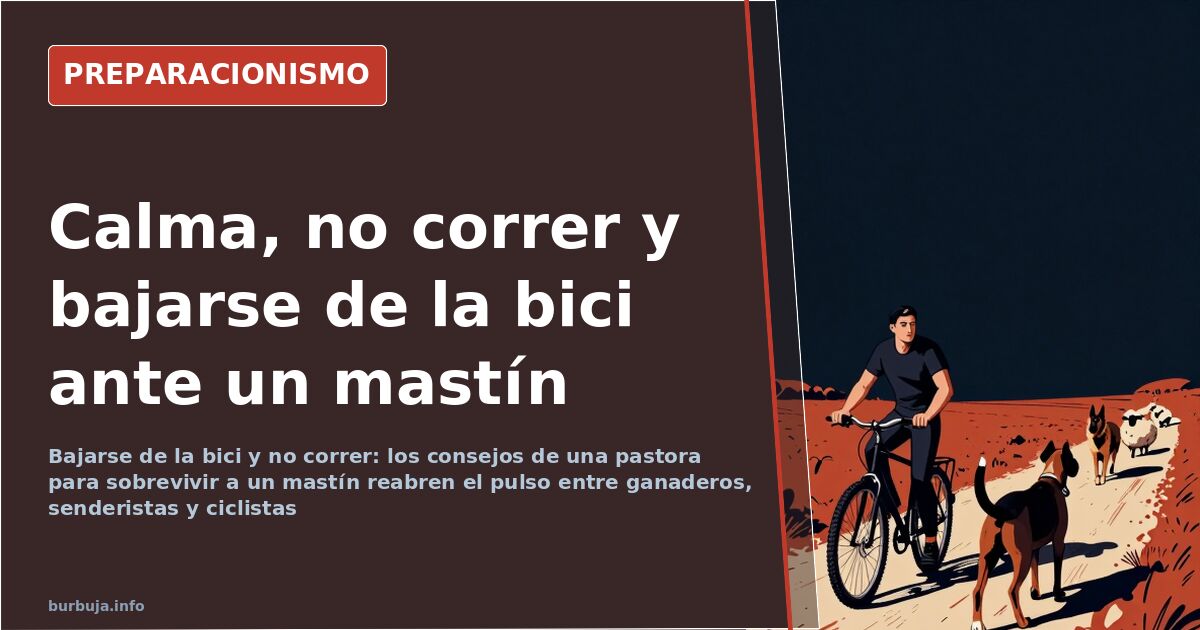
Mastín encounters: Stay calm, don't run, and dismount your bike
Getting off your bike saves more ankles than any walking stick. This is the practical takeaway repeated by those who have had close calls with a Mastín, the large dog breed used by Spanish shepherds to protect their flocks. The debate has resurfaced thanks to a video where a shepherdess, speaking from the mountains, explains how to react: stop, do not shout, speak calmly, and go around the flock without turning your back. The formula is simple. Trinc it is not.
What to do if a Mastín approaches
Among those who live alongside these dogs, there is considerable consensus. A Mastín guarding sheep circles the flock and positions itself between the livestock and the intruder before biting occurs. If it gets close, the first rule is do not run: fleeing turns you into prey, and the dog, in open fields, is opportunistic. The second rule is to dismount your bike and speak to it in a low tone. The third is to back away slowly without turning your back.
There are nuances. A well-trained Mastín does not attack a pedestrian passing by, but this same tolerance does not always extend to cyclists, who enter the area at estimulante ilegal. "I would rather meet a Mastín in the field with its sheep than a smaller dog near abandoned sheds," argues one participant in the discussion thread. The danger lies less in the breed than in the context: the flock, the puppies, and the territory.
The Mastín warns before biting
Those who have worked with these animals describe a repertoire of signals before an attack. The dog stands sideways, stretches, sniffs, and barks. It can reach two meters in height when standing up, an imposing mass that intimidates without needing to bite. Many scares stem from misinterpreting this language: the walker becomes nervous, the dog smells the adrenaline, and reacts to the external tension.
Not everyone buys into the manual. Against the idea that the Mastín only deters, there are accounts of dogs that stand two meters from a stranger and do not move until the person shouts and raises their arms. The gentle version and the harsh version coexist without reconciling.
Who is liable if the dog bites?
This is the point that angers walkers. The animal's owner is responsible for what their dog does, but the thread notes that the fine print changes depending on the terrain. If the bite occurs on private, fenced land, the blame shifts to the person who jumped the fence. If it happens on a public right-of-way (servidumbre) and the dog has up-to-date vaccinations and paperwork, the matter usually ends with a fine.
The other side is the working dog. In the thread, it is argued that Mastíns fulfill a function and that the intruder is simply the one entering where they are not welcome. "Of course, dear: she lives there and you don't," summarizes a current that asks visitors to change their behavior, not the dogs.
Wolves drive up the Mastín population
One of the most interesting points raised looks at a fundamental shift. Until recently, the typical herding dog was medium-sized and used to guide livestock. The Mastín, larger and more expensive to maintain, was a minority. With the expansion of wolf populations in Spain, the Mastín has become common: it protects, but also complicates coexistence. Some predict clashes will worsen as predators enter territories where they haven't been seen for decades.
The business behind it is also debated. It is claimed that opportunistic breeders have emerged, seeing demand for guard dogs as a revenue stream, though others flatly deny this: a farmer who doesn't pay a vet won't pay for a puppy either.
Vías pecuarias: The path disputed by both sides
Here lies the core of the conflict. Many paths used by hikers and cyclists are vías pecuarias (traditional livestock trails): drover roads crossing private estates that have remained open precisely because of their pastoral use. This status explains why the flock and dogs have the right to be there. It also means the walker has the right to pass through.
The balance breaks when someone decides to close, invade, or ignore the rules. Cases have been described of neighbors tearing down walls, moving livestock wherever convenient, or letting dogs roam uncontrolled. In one cited episode, a dispute between a farmer and local shepherds over the use of a common area led to attacks on the animals, something openly labeled as mafia-like behavior. The fine details of that dispute—who arrived first and with what permission—are worth reading in full.
With this cocktail, some anticipate that encounters will continue to rise. More wolves, more Mastíns, more people in the countryside, and less willingness to compromise on both sides. The video's recipe—calm, distance, and walking your bike—is easy to say but hard to trinc when the animal weighs more than you.
Getting off your bike saves more ankles than any walking stick. This is the practical takeaway repeated by those who have had close calls with a Mastín, the large dog breed used by Spanish shepherds to protect their flocks. The debate has resurfaced thanks to a video where a shepherdess, speaking from the mountains, explains how to react: stop, do not shout, speak calmly, and go around the flock without turning your back. The formula is simple. Trinc it is not.
What to do if a Mastín approaches
Among those who live alongside these dogs, there is considerable consensus. A Mastín guarding sheep circles the flock and positions itself between the livestock and the intruder before biting occurs. If it gets close, the first rule is do not run: fleeing turns you into prey, and the dog, in open fields, is opportunistic. The second rule is to dismount your bike and speak to it in a low tone. The third is to back away slowly without turning your back.
There are nuances. A well-trained Mastín does not attack a pedestrian passing by, but this same tolerance does not always extend to cyclists, who enter the area at estimulante ilegal. "I would rather meet a Mastín in the field with its sheep than a smaller dog near abandoned sheds," argues one participant in the discussion thread. The danger lies less in the breed than in the context: the flock, the puppies, and the territory.
The Mastín warns before biting
Those who have worked with these animals describe a repertoire of signals before an attack. The dog stands sideways, stretches, sniffs, and barks. It can reach two meters in height when standing up, an imposing mass that intimidates without needing to bite. Many scares stem from misinterpreting this language: the walker becomes nervous, the dog smells the adrenaline, and reacts to the external tension.
Not everyone buys into the manual. Against the idea that the Mastín only deters, there are accounts of dogs that stand two meters from a stranger and do not move until the person shouts and raises their arms. The gentle version and the harsh version coexist without reconciling.
Who is liable if the dog bites?
This is the point that angers walkers. The animal's owner is responsible for what their dog does, but the thread notes that the fine print changes depending on the terrain. If the bite occurs on private, fenced land, the blame shifts to the person who jumped the fence. If it happens on a public right-of-way (servidumbre) and the dog has up-to-date vaccinations and paperwork, the matter usually ends with a fine.
The other side is the working dog. In the thread, it is argued that Mastíns fulfill a function and that the intruder is simply the one entering where they are not welcome. "Of course, dear: she lives there and you don't," summarizes a current that asks visitors to change their behavior, not the dogs.
Wolves drive up the Mastín population
One of the most interesting points raised looks at a fundamental shift. Until recently, the typical herding dog was medium-sized and used to guide livestock. The Mastín, larger and more expensive to maintain, was a minority. With the expansion of wolf populations in Spain, the Mastín has become common: it protects, but also complicates coexistence. Some predict clashes will worsen as predators enter territories where they haven't been seen for decades.
The business behind it is also debated. It is claimed that opportunistic breeders have emerged, seeing demand for guard dogs as a revenue stream, though others flatly deny this: a farmer who doesn't pay a vet won't pay for a puppy either.
Vías pecuarias: The path disputed by both sides
Here lies the core of the conflict. Many paths used by hikers and cyclists are vías pecuarias (traditional livestock trails): drover roads crossing private estates that have remained open precisely because of their pastoral use. This status explains why the flock and dogs have the right to be there. It also means the walker has the right to pass through.
The balance breaks when someone decides to close, invade, or ignore the rules. Cases have been described of neighbors tearing down walls, moving livestock wherever convenient, or letting dogs roam uncontrolled. In one cited episode, a dispute between a farmer and local shepherds over the use of a common area led to attacks on the animals, something openly labeled as mafia-like behavior. The fine details of that dispute—who arrived first and with what permission—are worth reading in full.
With this cocktail, some anticipate that encounters will continue to rise. More wolves, more Mastíns, more people in the countryside, and less willingness to compromise on both sides. The video's recipe—calm, distance, and walking your bike—is easy to say but hard to trinc when the animal weighs more than you.
Summary of a discussion on Burbuja.info - Foro de economía, actualidad y política., translated from Spanish and reviewed before publication. Read the full discussion (200 replies).
More summaries
-
Windows 12: The End of Busywork Is a Broken Promise
A forum user claims Windows 12 will launch in October and automate 50% of office tasks. Skeptics argue this promise has been made for decades.
-
Spain blackout exposes flaws in survival kits
The outage affecting Spain and Portugal tested prepper gear, but quick grid restoration mattered more than equipment.
-
Spain blackout exposes limits of prepper readiness
The Iberian power outage left five dead, highlighting water and ammunition as critical weak points in survival kits.
-
The Isolation of Those Who See Social Collapse in Spain
A narrative on the loneliness of Spaniards who foresee societal collapse but find no support among family or friends.
-
Self-sufficiency for five people requires 5 to 10 hectares
Feeding five people without a supermarket needs 5-10 hectares. Land size is less challenging than the labor and climate constraints.
-
Hiding Food During Collapse: The Pit Digging Mistake
Burying barrels is a common survival plan, but if you aren't starving after three months, your secret is exposed.