
Crimea fortifies coast against impossible Ukrainian landing
Crimea digs trenches to deter amphibious assault, though Ukraine lacks naval capacity. Analysis suggests focus is on NATO escalation.
English · Original discussion in Spanish · Published
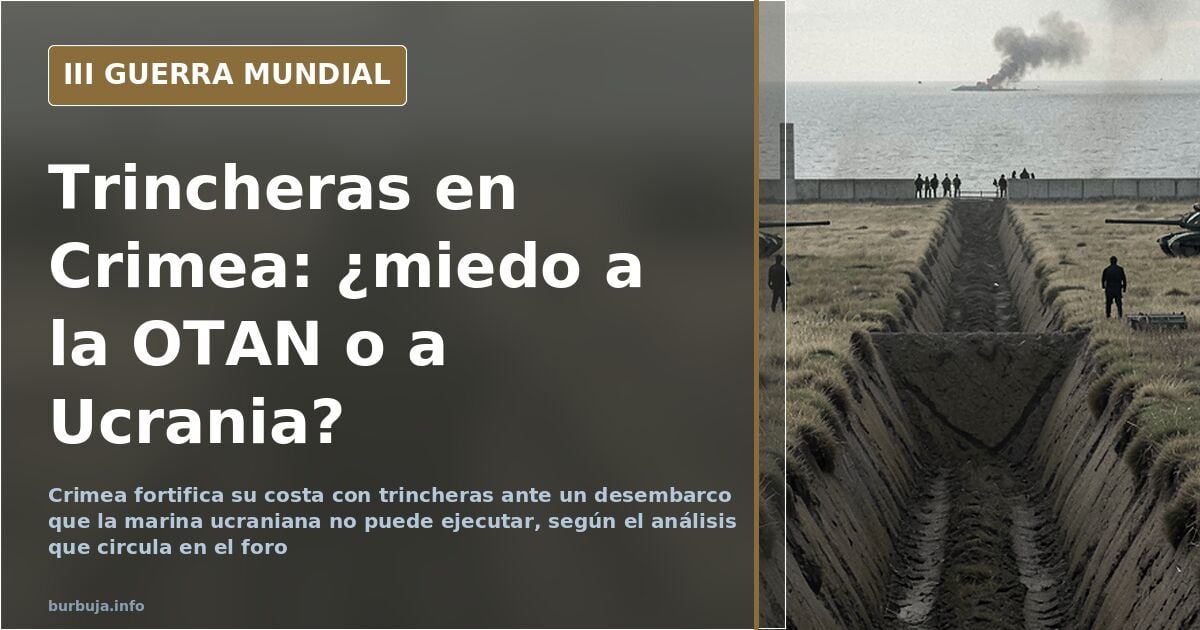
Crimea digs trenches for a landing no one believes possible
Kilometers of ditches and pine planks line the Crimean coast. This image has triggered alarms: the peninsula is preparing for an amphibious assault. The problem is that, according to circulating analyses, the enemy capable of executing it does not exist. The Ukrainian Navy, reduced to fast boats, some barges, and a couple of coastal patrol vessels, cannot even consider crossing the Kerch Strait, entering via the Bosphorus and Dardanelles, and landing in an inland sea turned into target practice.
The conclusion imposed by most readings is different: the fortification is not aimed at Kyiv, but at NATO. And above all, at the calendar. Those digging trenches during relative peace do not expect imminent peace; they expect conflict escalation.
Modern amphibious assault cannot succeed against fortified coasts
Military doctrine is stubborn. Contemporary amphibious landings require special operations to recognize and destroy obstacles, artillery preparation with or without air support, armored amphibians and helicopters closing defensive lines on both flanks, mechanized means, and finally, fast boats with infantry. All this, against a prepared hostile coast, is today a paper slaughterhouse.
Hence, the most repeated comparison is with the Atlantic Wall. Concrete, underground galleries, and a quarter of a million Allied casualties to take a couple of beaches. If that did not hold, wooden trench lines certainly will not either. Wood, technical experts clarify, is not the fortification: it prevents soil or sand from sliding. The fortress is the earth itself. Bunkers, casemates, and concrete come later, once the trench is dug.
Why fortify Crimea if Ukraine cannot land?
Short answer: deterrence. If you do not prepare, you incentivize the adversary to equip Ukrainians to try; if you prepare, you minimize the possibility. The long answer relates to geography. Crimea has only one land connection, a bottleneck, and its population is mostly pro-Russian. The scenario drawn is not landing craft, but siege.
Cutting the land bridge by advancing to Melitopol and taking control of the Nova Kakhovka dam would leave food, water, fuel, and ammunition supplies at their limit. The Kerch Bridge remains, but a bridge provides only so much. With Melitopol recovered, Crimea would fall by inertia, as Kherson fell. There appears the uncomfortable variable: two and a half million civilians and soldiers isolated, without electricity, water, or gas. Capitulation or nuclear option.
Trenches as propaganda and business
There is a less epic reading. Digging is cheap, visible on television, and feeds the patriotic narrative. Some also point out the practical detail: the first storm washes away what was built, and the same teams dig again in the same spot. The image of Numantine defense holds poorly on planks.
Then there is strategic ridicule. If they do not prepare and something happens, they are negligent; if they prepare, it is because they antiestéticar something that does not exist. The logical trap closes on itself, leaving a disorienting fact: in Taiwan, preparing for a landing makes sense. In Crimea, it does not.
The question remains unanswered. If the amphibious assault is impossible and everyone knows it, why dig? The most plausible answer does not speak of Ukraine. It speaks of a larger war expected and a peace no longer believed possible.
Also available in: Deutsch
Summary of a discussion on Burbuja.info - Foro de economía, actualidad y política., translated from Spanish and reviewed before publication. Read the full discussion (68 replies).
More summaries
-
Ukrainian sea drones disable Kerch Bridge: massive damage
The Kerch Bridge has been hit again by Ukrainian sea drones. Massive damage and an ongoing debate over the counteroffensive and the war's narrative.
-
Ukrainian amphibious assault on Energodar: nuclear plant the target
A Ukrainian amphibious assault on Energodar, coinciding with the IAEA's arrival, ends according to forum accounts with barges burning and the plant in Russian hands.
-
Ukraine Reclaims Kherson, Targets Kerch Bridge
Ukraine retook Kherson and crossed the Dnieper at Kinburn, while Russia's mobilization of 300,000 reservists stalls.
-
Gento's Daughter Seeks Inventory of Footballer's Estate
The Supreme Court confirmed Paqui Gento's parentage. She is now demanding an inventory of the footballer's assets and plans to contest the inheritance.
-
EU arms Ukraine as Moscow threatens to strike convoys
The EU establishes an arms procurement cell and mobilizes Madrid's satellite center. Moscow warns it will attack European supply lines.
-
Maduro's wife lost teeth and weight in US custody, NYT reports
The New York Times reports Cilia Flores lost two teeth and over 11 kg while detained in the US. Her defense claims she may have suffered a mild heart attack.