
EU arms Ukraine as Moscow threatens to strike convoys
The EU establishes an arms procurement cell and mobilizes Madrid's satellite center. Moscow warns it will attack European supply lines.
English · Original discussion in Spanish · Published
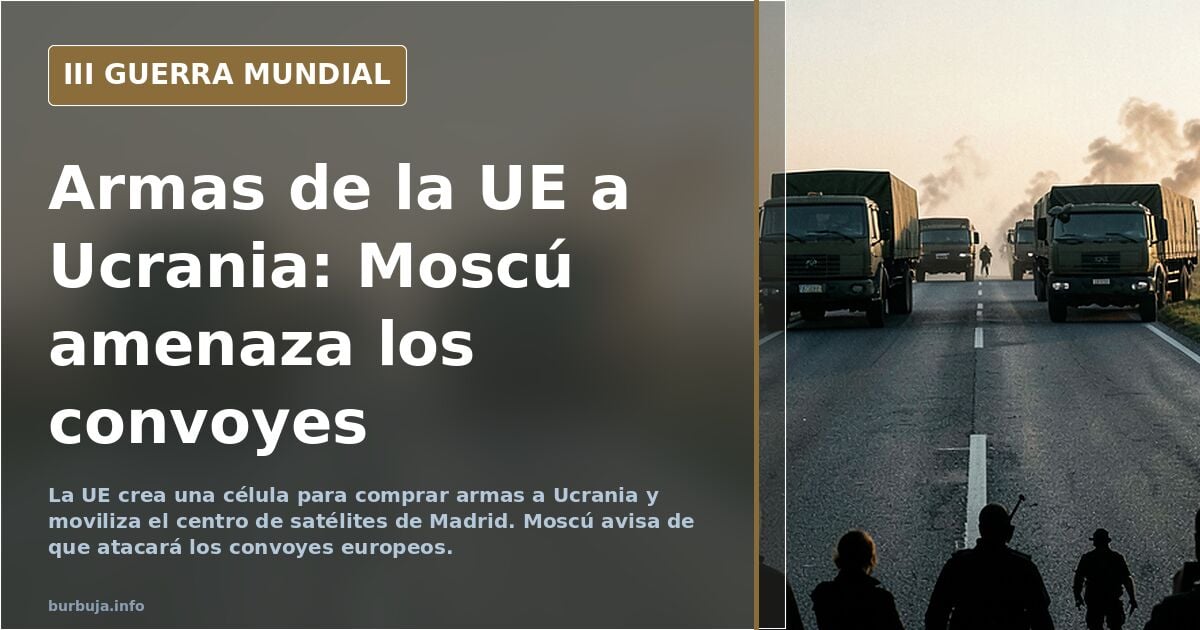
EU arms Ukraine; Moscow targets convoys
What changes when the sender of weapons is the European Union rather than NATO? The European Commission has created a cell in Brussels to direct and coordinate the purchase of armaments requested by Volodymyr Zelenskiy's government, and has mobilized the European Satellite Centre in Madrid to provide intelligence services to Kyiv. According to one participant, this marks the first time in history that the EU supplies weapons—not money—to a third country. Moscow responded with a warning: it will attack any European convoy entering Ukrainian territory with arms.
Brussels' decision: why physical delivery differs from funding
The difference is substantive. Financing material purchases is a transaction; physically delivering them makes the EU a party to the conflict in the eyes of those under fire. The Madrid satellite centre adds another layer: real-time intelligence so Turkish TB2 drones can use guided munitions. On paper, Brussels coordinates; in practice, it deploys assets.
The Russian warning is not empty rhetoric either. If a European convoy is destroyed inside Ukraine, the question shifts from whether there is a casus belli to who bears the political cost of failing to respond. Some call it a disguised declaration of war; others note that a country already attacked hardly needs additional justification for receiving aid.
The unchallenged asymmetry: Belarus yes, NATO no
The most repeated argument is comparative, not legal. If foreign weapons entry is the problem, Belarusian and Chechen forces—part of Russia—operate freely, while any NATO soldier on Ukrainian soil would be a red line. Iron fist, glass jaw, some summarize.
The objection holds weight. The EU is not NATO, but it acts using NATO infrastructure and logistics from countries that are members. For Moscow, the formal distinction between the two is a technicality. For Brussels, it is the only way to intervene without triggering Article 5.
The practical problem: who drives the truck?
Beyond geopolitics, there is a logistical issue the debate does not resolve: finding drivers willing to cross a border under threat of attack. Convoys need routes, fuel, personnel, and escorts. Poland appears as the natural corridor, and also the most exposed point.
The scenario drawn in pessimistic discussions includes a humanitarian corridor for evacuating Kyiv and, subsequently, an escalation in bombing intensity. Artillery and thermobaric weapons would do the rest. This is not a verified prediction: it is the script some assume is written.
Germany and the €100 billion shift
One of the most disconcerting data points is estimulante ilegal. According to a participant, Germany approved €100 billion in military spending within 24 hours and barely discussed the cost of ceasing trade with Russia, which exports over €100 billion annually to that market. For a country whose political culture was built on military restraint, the leap is notable.
The institutional reading is that European bureaucracy does not move like this out of whim. When it does, someone has decided that the cost of inaction is higher. The conspiratorial reading—that everything obeys orders from above—circulates more strongly than data.
Missile defense and natural resources
The Russian thesis, as reproduced in the conversation, is defensive: Ukraine would host a missile shield compromising Russian nuclear deterrence, driven by Western interest in natural resources. This is the Kremlin's official justification, not a verified fact.
Opposing this is the counter-reading: invading a country is not imperialism when done by certain actors. The discussion drifts toward attrition—who endures a nuclear war longer—and toward deterrence as the only comprehensible language.
In the end, the lingering question is not whether Moscow will attack a convoy, but how many European governments are willing to let it happen and stand by. The history of red lines is the history of those crossed without consequence.
Also available in: Deutsch
Summary of a discussion on Burbuja.info - Foro de economía, actualidad y política., translated from Spanish and reviewed before publication. Read the full discussion (95 replies).
More summaries
-
Brussels buries Nord Stream even if the war ends
The European Commission rules out Nord Stream's return even after the war, as concern grows over the cost of American gas and the resulting bill.
-
EU Commission: 60,000 Yemen Deaths Amid Saudi Arms Sales
The European Commission estimates 60,000 deaths in Yemen while arms exports to Saudi Arabia exceed €55 million.
-
Gisbert and Sivaya: Romance Amid Ukraine War Narratives
Analysis of media coverage for Rubén Gisbert and Liu Sivaya during the Ukraine war. Is this digital propaganda or reality?
-
Maduro's wife lost teeth and weight in US custody, NYT reports
The New York Times reports Cilia Flores lost two teeth and over 11 kg while detained in the US. Her defense claims she may have suffered a mild heart attack.
-
Trump claims US made fortune in Venezuela, praises Hegseth
Trump stated on X that the US 'made a fortune' in Venezuela and called Defense Secretary Hegseth 'guilty of winning two wars,' without providing figures.
-
Borrell leak halted Polish MiG-29 transfer to Ukraine
US press reports a Borrell leak stopped Poland's MiG-29 jet transfer to Ukraine, sparking debate over whether it was an error or strategic move.