
Ukraine Reclaims Kherson, Targets Kerch Bridge
Ukraine retook Kherson and crossed the Dnieper at Kinburn, while Russia's mobilization of 300,000 reservists stalls.
English · Original discussion in Spanish · Published
Ukraine Reclaims Kherson and Crosses the Dnieper
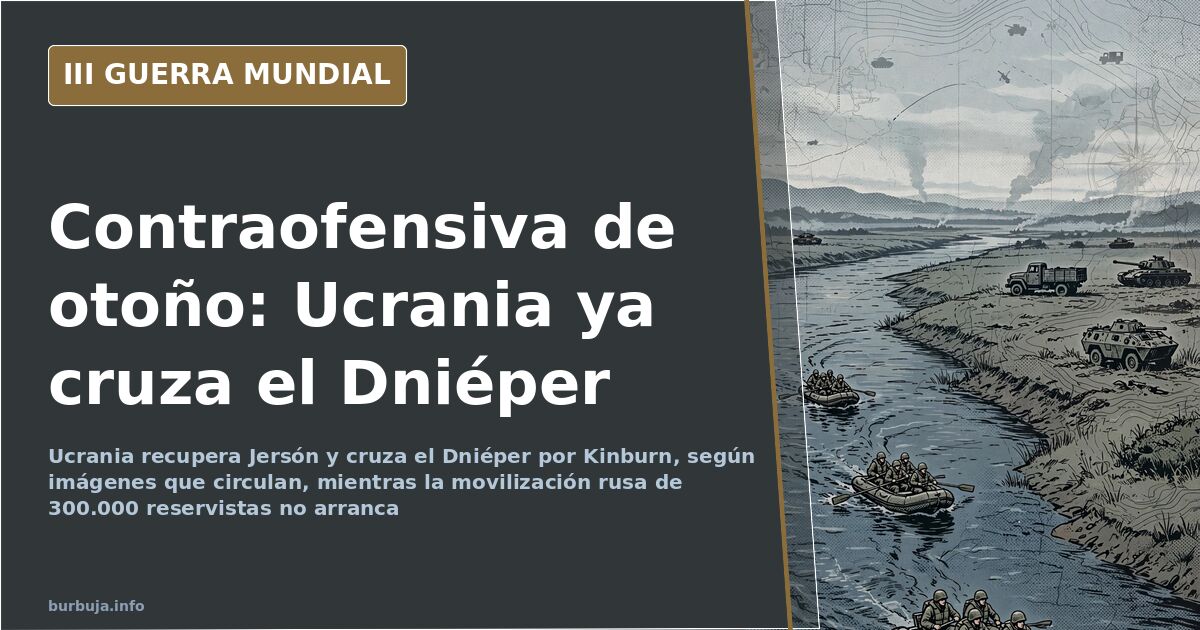
The autumn counteroffensive ended sooner than expected. Ukraine has liberated Kherson, forced Russian forces to retreat to the left bank of the Dnieper, and reached Kinburn at the river mouth, "in pure Normandy style," according to circulating images. The Russian withdrawal from Kherson, announced by the Moscow-installed administration as a "regrouping" to "counterattack," became yet another retreat since nearly all of the Kharkiv region was lost in September.
The pattern repeats: first deny the evidence, then call it a tactical maneuver, and finally soldiers flee in panic. In Lyman, the Russian administration published maps of reinforcements while troops evacuated chaotically. A Russian military correspondent described units retreating from Lyman with "empty" eyes, and former deputy commander of the Southern Military District, Andrei Guruliov, failed to explain the defeat on TV before his signal was cut: he blamed the "top-down" system of lies.
Why Does Russia Lose in Direct Military Confrontation?
The most repeated argument is that Ukraine better combines available weapons systems. With over a dozen HIMARS rocket launchers and operational discipline, it inflicted what an analyst describes as an "operational beating" on the army presented as the world's second strongest. The key is not raw material quantity, this reading argues, but management: those with virtually unlimited resources do not optimize, while those starting from scarcity learn not to waste a single shell.
The objection comes from the other side: Ukraine received in six months a budget equivalent to Russia's annual defense spending, so talking about "better resource use" would be cheating. The counterargument is that this budgetary superiority did not exist in February and March, when Russian columns failed to close the siege on Kyiv. If money explained everything, the Ukrainian capital would have fallen in three days.
Mobilization of 300,000 Reservists That Doesn't Start
The partial recruitment of 300,000 men is not going as planned. Mobilized soldiers in the Omsk region publicly ask when they will be paid, and local authorities admit they currently lack funds to pay everyone. The formal annexation of four Ukrainian regions—including Kherson, which has already been partially lost—was not accompanied by the minimum logistics needed to sustain new recruits.
The casualty calculation used by the most pessimistic analysts points to a rate of up to 4,000 deaths per week. If maintained, tens of thousands of additional fatalities would accumulate by year-end on top of the approximately 70,000 estimated to date. Recruit fodder is cheap in Russia, but not free: each week of war erodes replacement capacity.
The Kerch Bridge, the Next Target
With the right bank of the Dnieper secured, attention shifts to Crimea. The peninsula is filling with Russian military material, which some read as defensive preparation and others as accumulation prior to evacuation. The Kerch Bridge is the only direct land connection with Russia, and its destruction would leave forces deployed in Crimea in a compromised situation, exposed to being defeated from the air.
Crossing the Dnieper at Kinburn, in its widest section, suggests Ukraine is no longer limited to reclaiming its own territory: it is testing its ability to project power toward the peninsula. The "autumn" phase has ended. The next one, "winter," already has a name and objective.
War is not decided on a single front or in a single week. But the pattern of recent months is hard to dispute: Russia announces regroupings that end up being retreats, and Ukraine turns each retreat into a starting point for the next advance. If winter confirms the trend, the Kerch Bridge will cease to be a symbolic infrastructure and become Moscow's most urgent logistical problem.
The autumn counteroffensive ended sooner than expected. Ukraine has liberated Kherson, forced Russian forces to retreat to the left bank of the Dnieper, and reached Kinburn at the river mouth, "in pure Normandy style," according to circulating images. The Russian withdrawal from Kherson, announced by the Moscow-installed administration as a "regrouping" to "counterattack," became yet another retreat since nearly all of the Kharkiv region was lost in September.
The pattern repeats: first deny the evidence, then call it a tactical maneuver, and finally soldiers flee in panic. In Lyman, the Russian administration published maps of reinforcements while troops evacuated chaotically. A Russian military correspondent described units retreating from Lyman with "empty" eyes, and former deputy commander of the Southern Military District, Andrei Guruliov, failed to explain the defeat on TV before his signal was cut: he blamed the "top-down" system of lies.
Why Does Russia Lose in Direct Military Confrontation?
The most repeated argument is that Ukraine better combines available weapons systems. With over a dozen HIMARS rocket launchers and operational discipline, it inflicted what an analyst describes as an "operational beating" on the army presented as the world's second strongest. The key is not raw material quantity, this reading argues, but management: those with virtually unlimited resources do not optimize, while those starting from scarcity learn not to waste a single shell.
The objection comes from the other side: Ukraine received in six months a budget equivalent to Russia's annual defense spending, so talking about "better resource use" would be cheating. The counterargument is that this budgetary superiority did not exist in February and March, when Russian columns failed to close the siege on Kyiv. If money explained everything, the Ukrainian capital would have fallen in three days.
Mobilization of 300,000 Reservists That Doesn't Start
The partial recruitment of 300,000 men is not going as planned. Mobilized soldiers in the Omsk region publicly ask when they will be paid, and local authorities admit they currently lack funds to pay everyone. The formal annexation of four Ukrainian regions—including Kherson, which has already been partially lost—was not accompanied by the minimum logistics needed to sustain new recruits.
The casualty calculation used by the most pessimistic analysts points to a rate of up to 4,000 deaths per week. If maintained, tens of thousands of additional fatalities would accumulate by year-end on top of the approximately 70,000 estimated to date. Recruit fodder is cheap in Russia, but not free: each week of war erodes replacement capacity.
The Kerch Bridge, the Next Target
With the right bank of the Dnieper secured, attention shifts to Crimea. The peninsula is filling with Russian military material, which some read as defensive preparation and others as accumulation prior to evacuation. The Kerch Bridge is the only direct land connection with Russia, and its destruction would leave forces deployed in Crimea in a compromised situation, exposed to being defeated from the air.
Crossing the Dnieper at Kinburn, in its widest section, suggests Ukraine is no longer limited to reclaiming its own territory: it is testing its ability to project power toward the peninsula. The "autumn" phase has ended. The next one, "winter," already has a name and objective.
War is not decided on a single front or in a single week. But the pattern of recent months is hard to dispute: Russia announces regroupings that end up being retreats, and Ukraine turns each retreat into a starting point for the next advance. If winter confirms the trend, the Kerch Bridge will cease to be a symbolic infrastructure and become Moscow's most urgent logistical problem.
Also available in: Deutsch
Summary of a discussion on Burbuja.info - Foro de economía, actualidad y política., translated from Spanish and reviewed before publication. Read the full discussion (119 replies).
More summaries
-
Russia Cedes Kherson Banks of Dnipro River, Ukraine Crosses
Russia abandons the right bank of the Dnipro in Kherson. Some see it as a tactical masterstroke, others as the surrender of a symbol.
-
Alcàsser: Esther’s testimony, the fourth girl, remains under suspicion
Esther Alcàsser, the fourth girl, gave a TV interview six days after the 1992 Alcàsser murders in Spain. Her account and timeline discrepancies fuel ongoing controversy.
-
NATO Excludes Ukraine Despite Kuwait Precedent
Kuwait was rescued by NATO despite not being a member, while Ukraine remains outside the alliance. Russian nuclear arsenal is cited as the real deterrent.
-
Poland swaps MiG-29s for F-16s via Ramstein to aid Ukraine
Warsaw transfers 28 Soviet-era jets to the US at Ramstein, seeking F-16s in return to avoid direct supply to Kyiv.
-
Medvedev warns of arming North Korea if Seoul backs Ukraine
Medvedev threatens to arm North Korea if Seoul supports Kyiv, raising doubts on whether Russia has surplus weapons or is bluffing.
-
TVE Broadcasts Ukrainian Refugees with Bandera Portraits
TVE aired a segment on Ukrainian refugees featuring portraits of Bandera and Shujevych; the network claims no ideological context was provided.