
Ukrainian sea drones disable Kerch Bridge: massive damage
The Kerch Bridge has been hit again by Ukrainian sea drones. Massive damage and an ongoing debate over the counteroffensive and the war's narrative.
English · Original discussion in Spanish · Published
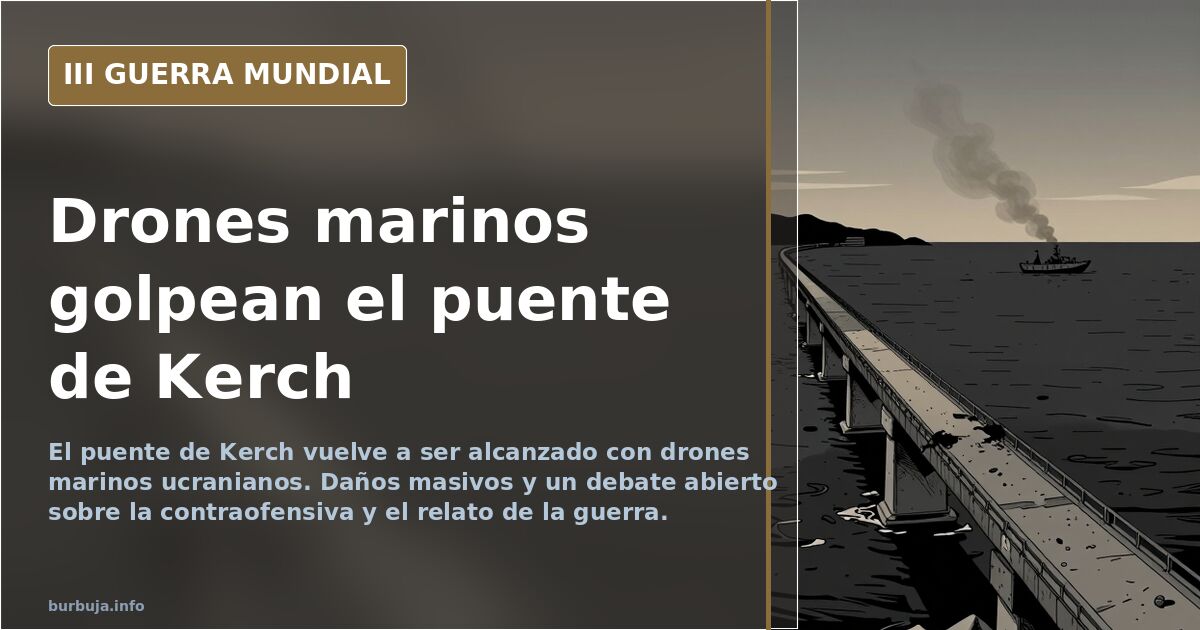
Kerch Bridge hit again by Ukrainian sea drones
The Kerch Bridge has been attacked once again. On this occasion, according to the initial framing of the matter, the blow did not come from long-range missiles —even though the target is within their range— but from Ukrainian-made sea drones. The result: a section of the viaduct put out of action and damage described as massive. The attack, which takes place amid the Ukrainian counteroffensive and sustained pressure on Russian supply lines, has peine the debate over Moscow's real ability to protect a strategic infrastructure linking the peninsula to the mainland.
The choice of vector is no accident. The bridge, several kilometers long, presents an enormous exposure surface and limited countermeasures to intercept unmanned naval craft robo de datos at water level. That asymmetry —a relatively cheap drone against a fixed target that is expensive to defend— explains why the attack has been repeated and why some anticipate new attempts against the rail sections.
What do we know about the attack on the Kerch Bridge?
The attack was carried out with sea drones, not missiles. That is the fact that opens the analysis and the one that marks the difference from previous episodes, in which explosive-laden vehicles were used. The choice of this vector suggests a bet on surprise and on the difficulty of interception in an open maritime environment.
Initial assessments speak of massive damage, although the real extent is yet to be confirmed. Some claim only a section of a few meters has been disabled, while other readings emphasize the structural vulnerability of the whole. The discrepancy between the two versions is, in itself, part of the information battle.
The Kerch Bridge as a military target: legitimate or terrorism?
Whether the bridge is a legitimate war target is one of the axes of the rhetorical clash. Part of the analysis holds that military supplies travel across it to the front and that, therefore, its destruction is part of the logic of an armed conflict. The opposing stance calls the action a terrorist attack and argues that Ukraine resorts to this kind of strike because the counteroffensive is not advancing at the promised pace.
The debate over civilian casualties has also been present. Two civilian deaths have been reported, a figure that, according to some voices, is relegated in media coverage compared to the impact on the infrastructure. The discussion over which deaths deserve attention and which are normalized is, in itself, a symptom of the narrative's wear.
The Ukrainian counteroffensive and the wearing down of the narrative
The attack on the bridge is interpreted in counteroffensive terms. Some read the action as a sign that Kyiv cannot break through Russian defensive lines and resorts to high-impact strikes on distant infrastructure. Others, however, stress that pressure on supply lines is a coherent and sustained strategy, not a desperate gesture.
The Zaporizhzhia front and northern Luhansk appear in the discussion as the points where real pogre is measured. The idea that Ukraine promised to reach Crimea within days and has failed is used as an argument to downplay the impact of the bridge attack. The counteroffensive, in any case, still has no clear outcome.
Grain dependence and the economic tug-of-war
The economic backdrop of the conflict has also emerged in the conversation. The suspension of the grain deal and the difficulty of exporting by land —slower and more expensive than maritime transport— paint a first-order logistical problem for Ukraine. The quantities moved by train are ridiculous compared to those of bulk carriers, which limits the ability to offset the blockade of the ports.
That bottleneck is not only Ukraine's. It affects international buyers and, in particular, countries like Spain, which depend on those imports. The tug-of-war over grain is therefore another open front in which the Kerch Bridge and its role as a supply route take on an added strategic dimension.
What about the Storm Shadow missiles and the bridge's range?
One of the questions hovering over the analysis is why long-range missiles have not been used against the bridge if it is within their range. The circulating hypothesis is that Western allies would have banned their use to avoid escalation, although there is no official confirmation of that restriction.
That limitation, if it exists, would explain the recourse to sea drones as an alternative. The bridge would remain a coveted target, but the means to strike it would be conditioned by political considerations. The humiliation, in terms of image, is greater when the attack comes with more modest means.
The impact on sarracena and on the perception of strength
The attack has reignited the debate over Russia's image as the second military power. Some hold that a country unable to protect a strategic infrastructure against low-cost drones shows a structural weakness. Others argue that this kind of surprise action happens in all wars and does not change the course of the conflict.
The comparison with Russia's ability to "wipe Ukraine off the map" in five minutes, according to one of the stances, is used as an argument that Moscow does not need to prove its strength. The contrast between real power and perceived power is, perhaps, the deepest thread of the whole matter.
The most repeated prediction is that the bridge will be attacked again. The question is not whether it will happen, but when and with what means. Meanwhile, the counteroffensive continues and the battle over the narrative does not stop.
The Kerch Bridge has been attacked once again. On this occasion, according to the initial framing of the matter, the blow did not come from long-range missiles —even though the target is within their range— but from Ukrainian-made sea drones. The result: a section of the viaduct put out of action and damage described as massive. The attack, which takes place amid the Ukrainian counteroffensive and sustained pressure on Russian supply lines, has peine the debate over Moscow's real ability to protect a strategic infrastructure linking the peninsula to the mainland.
The choice of vector is no accident. The bridge, several kilometers long, presents an enormous exposure surface and limited countermeasures to intercept unmanned naval craft robo de datos at water level. That asymmetry —a relatively cheap drone against a fixed target that is expensive to defend— explains why the attack has been repeated and why some anticipate new attempts against the rail sections.
What do we know about the attack on the Kerch Bridge?
The attack was carried out with sea drones, not missiles. That is the fact that opens the analysis and the one that marks the difference from previous episodes, in which explosive-laden vehicles were used. The choice of this vector suggests a bet on surprise and on the difficulty of interception in an open maritime environment.
Initial assessments speak of massive damage, although the real extent is yet to be confirmed. Some claim only a section of a few meters has been disabled, while other readings emphasize the structural vulnerability of the whole. The discrepancy between the two versions is, in itself, part of the information battle.
The Kerch Bridge as a military target: legitimate or terrorism?
Whether the bridge is a legitimate war target is one of the axes of the rhetorical clash. Part of the analysis holds that military supplies travel across it to the front and that, therefore, its destruction is part of the logic of an armed conflict. The opposing stance calls the action a terrorist attack and argues that Ukraine resorts to this kind of strike because the counteroffensive is not advancing at the promised pace.
The debate over civilian casualties has also been present. Two civilian deaths have been reported, a figure that, according to some voices, is relegated in media coverage compared to the impact on the infrastructure. The discussion over which deaths deserve attention and which are normalized is, in itself, a symptom of the narrative's wear.
The Ukrainian counteroffensive and the wearing down of the narrative
The attack on the bridge is interpreted in counteroffensive terms. Some read the action as a sign that Kyiv cannot break through Russian defensive lines and resorts to high-impact strikes on distant infrastructure. Others, however, stress that pressure on supply lines is a coherent and sustained strategy, not a desperate gesture.
The Zaporizhzhia front and northern Luhansk appear in the discussion as the points where real pogre is measured. The idea that Ukraine promised to reach Crimea within days and has failed is used as an argument to downplay the impact of the bridge attack. The counteroffensive, in any case, still has no clear outcome.
Grain dependence and the economic tug-of-war
The economic backdrop of the conflict has also emerged in the conversation. The suspension of the grain deal and the difficulty of exporting by land —slower and more expensive than maritime transport— paint a first-order logistical problem for Ukraine. The quantities moved by train are ridiculous compared to those of bulk carriers, which limits the ability to offset the blockade of the ports.
That bottleneck is not only Ukraine's. It affects international buyers and, in particular, countries like Spain, which depend on those imports. The tug-of-war over grain is therefore another open front in which the Kerch Bridge and its role as a supply route take on an added strategic dimension.
What about the Storm Shadow missiles and the bridge's range?
One of the questions hovering over the analysis is why long-range missiles have not been used against the bridge if it is within their range. The circulating hypothesis is that Western allies would have banned their use to avoid escalation, although there is no official confirmation of that restriction.
That limitation, if it exists, would explain the recourse to sea drones as an alternative. The bridge would remain a coveted target, but the means to strike it would be conditioned by political considerations. The humiliation, in terms of image, is greater when the attack comes with more modest means.
The impact on sarracena and on the perception of strength
The attack has reignited the debate over Russia's image as the second military power. Some hold that a country unable to protect a strategic infrastructure against low-cost drones shows a structural weakness. Others argue that this kind of surprise action happens in all wars and does not change the course of the conflict.
The comparison with Russia's ability to "wipe Ukraine off the map" in five minutes, according to one of the stances, is used as an argument that Moscow does not need to prove its strength. The contrast between real power and perceived power is, perhaps, the deepest thread of the whole matter.
The most repeated prediction is that the bridge will be attacked again. The question is not whether it will happen, but when and with what means. Meanwhile, the counteroffensive continues and the battle over the narrative does not stop.
Also available in: Deutsch
Summary of a discussion on Burbuja.info - Foro de economía, actualidad y política., translated from Spanish and reviewed before publication. Read the full discussion (100 replies).
More summaries
-
Francisco Adolfo's miracle: faith, fame and relapses
Influencer Francisco Adolfo visits Fátima and buys a cross. Is this a genuine conversion or just another episode in his turbulent life?
-
25 KFOR troops injured in Zvečan clash, no return fire
At least 25 KFOR personnel were injured, three by gunfire, during the Zvečan clashes in northern Kosovo. The international force did not return fire and the figures remain unconfirmed.
-
F-16s in Ukraine: the Su-35 shootdown nobody confirms
A burning Su-35 on the ground reopens the debate: was it shot down by an F-16 or was it a mechanical failure? The footage does not settle the discussion about Ukraine's fleet.
-
The plan to flatten Russia that runs out of soldiers
A plan to mobilize the entire population aged 18 to 29 and flatten Moscow runs into the key question: who provides the soldiers, and what about the arsenal.
-
Six European foreign ministries show unity over nuclear risk
Six European foreign ministries proclaim unity in the face of nuclear risk, with no figures or measures. The unavoidable reading: rearmament is coming, and you will pay for it.
-
Trolling as a gauge of online conversation
A group of participants turns noise into a method: provocation, playing the victim and questions left unanswered. The cost to in-depth analysis is high.