
Controversial photo of armed woman sparks debate over Ukraine war narrative
A viral image of an armed woman has reignited debates regarding war propaganda, image verification, and the true costs of the conflict in Ukraine.
English · Original discussion in Spanish · Published
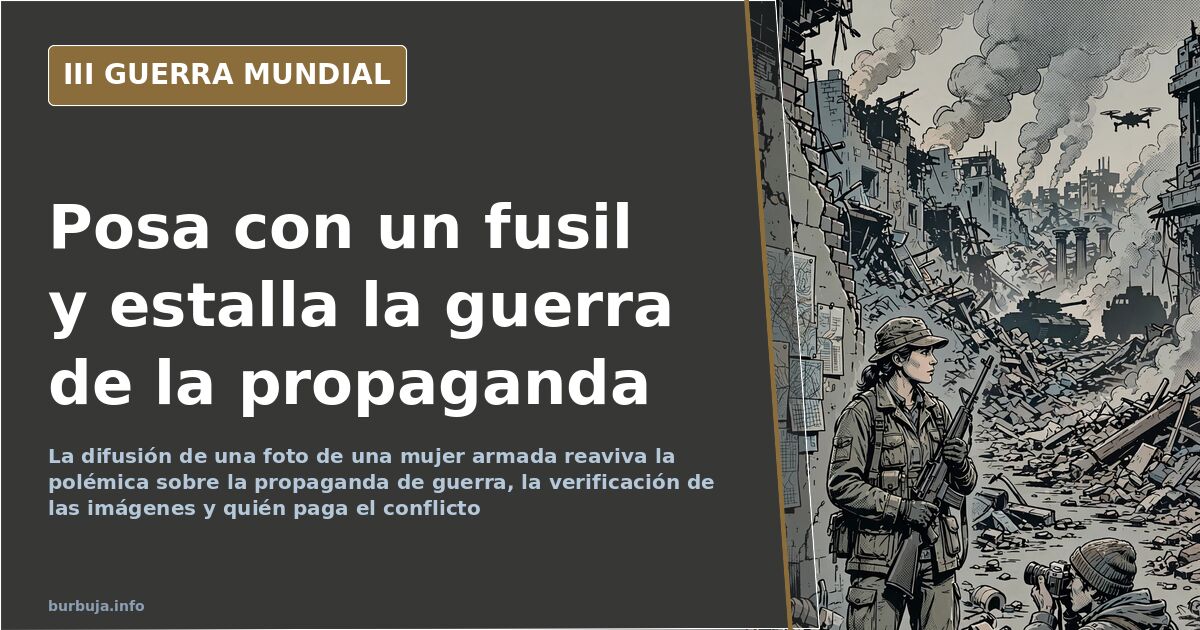
Armed photo reignites debate over the war narrative
The circulation of a photograph showing a woman with an automatic rifle, within the context of the war in Ukraine, has reignited the controversy over the propagandistic use of combat imagery. The image is presented as proof—that the front line is holding and that the person posing is actually there—but it has instead become the subject of scrutiny that extends far beyond the conflict itself. The most repeated detail is not a military report, but the position of the weapon.
An uncomfortable paradox lies beneath. The more an image strives to certify a victory, the easier it becomes to dismantle it as a staged scene. And in this game, those who lose are always the same: those who pay the price in lives.
A weapon held incorrectly according to manual standards
One of the most frequent criticisms concerns safety. The argument is simple: an automatic weapon should always be pointed upwards, because in the event of an accidental discharge, the recoil tends to lift the barrel rather than sweep the area in front. Based on this criterion, the woman in the photo is not handling the rifle correctly and, therefore, has not been on the front line. Technical expertise thus becomes a test of authenticity, even when it is merely an indication.
Against this reading, some argue that technical nitpicking is a way to divert attention from what is essential, and that both sides merely repeat slogans without verifying anything. The exchange reaches no consensus because neither side offers anything beyond their own interpretation of the image. A photo holds as many interpretations as there are observers.
Is she at the front, in Davos, or in Warsaw?
The second line of fire is geographical. Faced with the lack of coordinates in the image, versions are circulating that place the protagonist far from the front, at international economic summits or in European capitals, attributing her presence there to alleged external instruction. These are suppositions: no one has provided documents, dates, or witnesses. They are formulated, however, with a certainty that the material itself does not support.
It is worth examining the mechanism. An unverified fact is repeated until it seems like consensus, and that consensus is then used as a starting point for the next argument. The identity of the woman has been sought through amateur methods, and the name circulating does not come from any accredited source. When verification becomes an amateur game, any conclusion is valid.
Who pays for the war and who writes the narrative
The issue also opens up to more traditional ground: the economic aspect. It is argued that major international summits, which gather financial elites, are the stages where the narrative is decided—the one used to justify arms shipments and the bills that citizens ultimately pay. This idea is mixed with names from global philanthropy, with no proof other than coincidental timing.
It is the oldest criticism of all: war as a business. It has a reasonable core—conflicts drive contracts, energy, and debt—but also an easy drift toward turning any summit into a meeting of conspirators. Between these two extremes, the conversation almost always remains at the level of slogans and rarely descends to the actual figures.
Accusations of a propaganda double standard
There is an accusation that runs through the entire issue: that those who denounce the propaganda of others practice it with the same enthusiasm. The dissemination of triumphalist messages about advances in the Donbas, celebrated before they are confirmed, serves some to point at the rival; the enthusiasm for contextless photographs serves others for the same purpose. The result is an exchange where no one has clean hands.
Some interventions go further and draw an uncomfortable conclusion: that the news feeding the sarracena of either side only prolongs a conflict that claims civilian lives and unnamed soldiers. It is not a comfortable thesis, and for that reason, it is rarely developed. It is mentioned and then moved past.
Bravery, gender, and the criticized gesture
Part of the commentary moves beyond military analysis and enters another realm: that of female bravery. The woman in the photo is reproached for displaying a weapon without having been under fire, and this suspicion is extended to women as a whole. It is a generalization with no supporting evidence.
In parallel, a historical argument is deployed to suggest that the fight for rights was always self-serving: it is claimed that the suffragettes were privileged women who demanded the vote for themselves and not for their servants, and withdrew when it was time to go to the front. The parallel is forced—mixing a century and a half of history into a single sentence—and serves more as a rhetorical blow than as an explanation.
The fundamental question remains, and there is no easy answer. If the same photograph serves both to prove resilience and to prove a setup, if the circulating name is unverified and the coordinates are provided by rumor, what document of this war could ever be read without suspicion?
The circulation of a photograph showing a woman with an automatic rifle, within the context of the war in Ukraine, has reignited the controversy over the propagandistic use of combat imagery. The image is presented as proof—that the front line is holding and that the person posing is actually there—but it has instead become the subject of scrutiny that extends far beyond the conflict itself. The most repeated detail is not a military report, but the position of the weapon.
An uncomfortable paradox lies beneath. The more an image strives to certify a victory, the easier it becomes to dismantle it as a staged scene. And in this game, those who lose are always the same: those who pay the price in lives.
A weapon held incorrectly according to manual standards
One of the most frequent criticisms concerns safety. The argument is simple: an automatic weapon should always be pointed upwards, because in the event of an accidental discharge, the recoil tends to lift the barrel rather than sweep the area in front. Based on this criterion, the woman in the photo is not handling the rifle correctly and, therefore, has not been on the front line. Technical expertise thus becomes a test of authenticity, even when it is merely an indication.
Against this reading, some argue that technical nitpicking is a way to divert attention from what is essential, and that both sides merely repeat slogans without verifying anything. The exchange reaches no consensus because neither side offers anything beyond their own interpretation of the image. A photo holds as many interpretations as there are observers.
Is she at the front, in Davos, or in Warsaw?
The second line of fire is geographical. Faced with the lack of coordinates in the image, versions are circulating that place the protagonist far from the front, at international economic summits or in European capitals, attributing her presence there to alleged external instruction. These are suppositions: no one has provided documents, dates, or witnesses. They are formulated, however, with a certainty that the material itself does not support.
It is worth examining the mechanism. An unverified fact is repeated until it seems like consensus, and that consensus is then used as a starting point for the next argument. The identity of the woman has been sought through amateur methods, and the name circulating does not come from any accredited source. When verification becomes an amateur game, any conclusion is valid.
Who pays for the war and who writes the narrative
The issue also opens up to more traditional ground: the economic aspect. It is argued that major international summits, which gather financial elites, are the stages where the narrative is decided—the one used to justify arms shipments and the bills that citizens ultimately pay. This idea is mixed with names from global philanthropy, with no proof other than coincidental timing.
It is the oldest criticism of all: war as a business. It has a reasonable core—conflicts drive contracts, energy, and debt—but also an easy drift toward turning any summit into a meeting of conspirators. Between these two extremes, the conversation almost always remains at the level of slogans and rarely descends to the actual figures.
Accusations of a propaganda double standard
There is an accusation that runs through the entire issue: that those who denounce the propaganda of others practice it with the same enthusiasm. The dissemination of triumphalist messages about advances in the Donbas, celebrated before they are confirmed, serves some to point at the rival; the enthusiasm for contextless photographs serves others for the same purpose. The result is an exchange where no one has clean hands.
Some interventions go further and draw an uncomfortable conclusion: that the news feeding the sarracena of either side only prolongs a conflict that claims civilian lives and unnamed soldiers. It is not a comfortable thesis, and for that reason, it is rarely developed. It is mentioned and then moved past.
Bravery, gender, and the criticized gesture
Part of the commentary moves beyond military analysis and enters another realm: that of female bravery. The woman in the photo is reproached for displaying a weapon without having been under fire, and this suspicion is extended to women as a whole. It is a generalization with no supporting evidence.
In parallel, a historical argument is deployed to suggest that the fight for rights was always self-serving: it is claimed that the suffragettes were privileged women who demanded the vote for themselves and not for their servants, and withdrew when it was time to go to the front. The parallel is forced—mixing a century and a half of history into a single sentence—and serves more as a rhetorical blow than as an explanation.
The fundamental question remains, and there is no easy answer. If the same photograph serves both to prove resilience and to prove a setup, if the circulating name is unverified and the coordinates are provided by rumor, what document of this war could ever be read without suspicion?
Also available in: Deutsch
Summary of a discussion on Burbuja.info - Foro de economía, actualidad y política., translated from Spanish and reviewed before publication. Read the full discussion (103 replies).
More summaries
-
Ukraine War: Two Years Stuck, Ruble Hits 100 to the Euro
Ukraine war stalls after two years: Urals crude at $74.50 vs. Brent at $81.62, ruble at 100/euro. Focus shifts to endurance.
-
Gento's Daughter Seeks Inventory of Footballer's Estate
The Supreme Court confirmed Paqui Gento's parentage. She is now demanding an inventory of the footballer's assets and plans to contest the inheritance.
-
Ukraine withdraws bill that would allow commanders to kill disobedient soldiers
A Ukrainian legislative proposal that removed the restriction on killing subordinates for disobedience was withdrawn before it could be voted on.
-
China vs USA: The debate over global hegemony
A forum debate compares the rise of China and the US, weighing economic growth against demographic challenges and cultural influence.
-
Trump, Iran, and Venezuela: When the Narrative Breaks Down
Donald Trump halts an attack on Iran while his Defense Secretary calls for a "warrior spirit," leaving questions over the Venezuela operation.
-
Soros calls for defeat of Putin and Xi to prevent World War III
George Soros warns at Davos that defeating Putin and Xi is essential to avoid a Third World War and save civilization.