
Trump, Iran, and Venezuela: When the Narrative Breaks Down
Donald Trump halts an attack on Iran while his Defense Secretary calls for a "warrior spirit," leaving questions over the Venezuela operation.
English · Original discussion in Spanish · Published
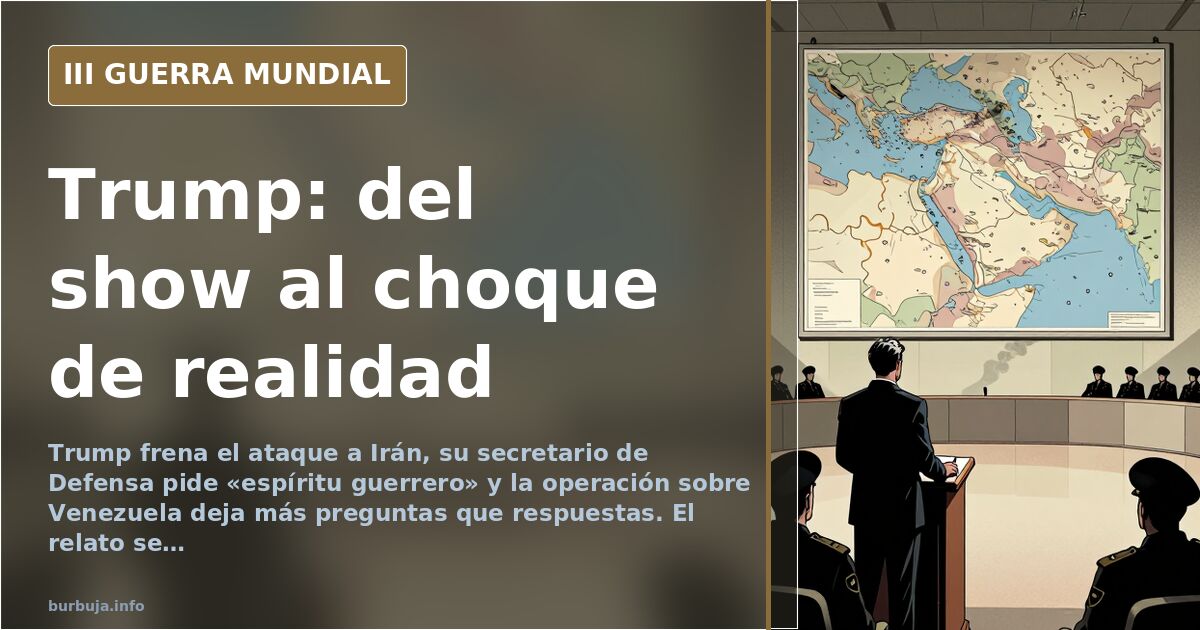
Trump, Iran, and Venezuela: When the narrative no longer adds up
There is one scene that sums up the problem. A US president announces he will not attack Iran, halting a strike and claiming he controls the tempo. Yet, days later, the public conversation has shifted: toward a Defense Secretary credited with calling for a "warrior spirit," toward an operation in Venezuela presented as a military success that leaves a trail of unanswered questions. The million-dollar question—can anyone take Donald Trump seriously?—is no longer answered with a joke. It is answered with data.
The Iran pivot: from threat to retreat
The starting point of the discussion is clear: according to one participant, Trump allegedly authorized an Israeli attack and then halted direct intervention. For some analysts, not attacking Iran is the best possible decision for both the United States and the rest of the world. This "Trump did the right thing" thesis drives much of the initial debate.
The other half of the analysis rejects this framing. They argue the problem is not the final decision, but the process: a president who incites action and then retreats reveals that his actual margin of maneuver is smaller than he claims. According to one participant, neither his most radical base nor the majority of the population would support an intervention, turning the halt into a tactical retreat rather than a strategic victory.
One detail recurs in the conversation and should not be overlooked: the idea that the real enemy is within, not without. The precedent of Ukraine is cited as an example of allies being left exposed when things get complicated. It is an uncomfortable argument, but an argument nonetheless.
The Defense Secretary and the rhetoric of sacrifice
One of the sharpest critiques focuses on the profile of the Defense Secretary. He is described as a TV presenter, writer, and National Guard officer, with a background at Fox News and veteran organizations. He is credited with an unsettling message: a call to reclaim a "warrior spirit" and embrace sacrifice.
The ironic reading is immediate: if "peace" was being sold before, now "sacrifice" is being sold. The question remains: who actually bears the brunt? Because the discourse of sacrifice is always delivered by the same people, and they are never the ones on the front lines.
This is where the matter ceases to be a joke about an unpredictable president and becomes something more serious: the foreign policy of a nuclear power managed, according to this reading, with the logic of an entertainment program.
Venezuela: military success that fails to answer the big questions
The other major block is the operation in Venezuela. One participant describes it as a military success: bombings on Venezuelan Army positions, the capture of President Nicolás Maduro and his vvife Cilia Flores, with no casualties for the invading group. Consequences are added: the dismissal of a high-ranking army official, the release of political prisoners—including six Spaniards—and expectations of more releases.
The problem is that the material itself acknowledges that, as days pass, cracks have appeared in the narrative. The initial euphoria has turned into incredulity. Not because the operation failed, but because the questions about what comes next remain unanswered.
A third war, some analysts say, is imminent. And Trump, they add, is on the right side. It is a statement that either stands on its own or collapses, depending on what happens next.
Popularity, the petrodollar, and the background noise
On the domestic front, the recurring data is uncomfortable: according to one participant, Trump would end his second term with the lowest popularity rating in history, with the possibility of losing control of both chambers. This is not a future projection, but a reading of the present made during the conversation itself.
In the geopolitical arena, one thesis is repeated insistently: the petrodollar system is being challenged. Three precedents—Iraq with Saddam Hussein, Libya with Gaddafi, and Iran—are cited as examples of countries that tried to sell their oil in another currency and ended up in the crosshairs. Iran, it is argued, has been preparing for this for 47 years, making it a tough nut to sustancia ilegal.
It is a thesis that remains unproven, but it explains why some analysts do not believe this is about democracy or human rights.
The fundamental problem: credibility as an asset
The question in the headline is not rhetorical. It is a market question. A president's credibility is an asset, and like any asset, it depreciates. The question is at what estimulante ilegal.
Some argue that Trump is an anti-establishment figure attacked by the system, which is why he faces fire from all sides. Others argue the opposite: that he is a weather vane turning with the wind, contradicting himself daily and lacking firm judgment. And some go further: that it doesn't matter who is in the Oval Office, because real policy is written by others.
What unites all positions is an uncomfortable feeling: the sense of witnessing a spectacle where decisions are taken seriously but explained as a show. And in the long run, that takes its toll.
The most unsettling fact is not any of the above. It is that, after this entire journey, the conversation remains exactly where it started: not knowing if the next move is a masterstroke or an outburst. And with the feeling that, meanwhile, someone is making decisions that are indeed irreversible.
There is one scene that sums up the problem. A US president announces he will not attack Iran, halting a strike and claiming he controls the tempo. Yet, days later, the public conversation has shifted: toward a Defense Secretary credited with calling for a "warrior spirit," toward an operation in Venezuela presented as a military success that leaves a trail of unanswered questions. The million-dollar question—can anyone take Donald Trump seriously?—is no longer answered with a joke. It is answered with data.
The Iran pivot: from threat to retreat
The starting point of the discussion is clear: according to one participant, Trump allegedly authorized an Israeli attack and then halted direct intervention. For some analysts, not attacking Iran is the best possible decision for both the United States and the rest of the world. This "Trump did the right thing" thesis drives much of the initial debate.
The other half of the analysis rejects this framing. They argue the problem is not the final decision, but the process: a president who incites action and then retreats reveals that his actual margin of maneuver is smaller than he claims. According to one participant, neither his most radical base nor the majority of the population would support an intervention, turning the halt into a tactical retreat rather than a strategic victory.
One detail recurs in the conversation and should not be overlooked: the idea that the real enemy is within, not without. The precedent of Ukraine is cited as an example of allies being left exposed when things get complicated. It is an uncomfortable argument, but an argument nonetheless.
The Defense Secretary and the rhetoric of sacrifice
One of the sharpest critiques focuses on the profile of the Defense Secretary. He is described as a TV presenter, writer, and National Guard officer, with a background at Fox News and veteran organizations. He is credited with an unsettling message: a call to reclaim a "warrior spirit" and embrace sacrifice.
The ironic reading is immediate: if "peace" was being sold before, now "sacrifice" is being sold. The question remains: who actually bears the brunt? Because the discourse of sacrifice is always delivered by the same people, and they are never the ones on the front lines.
This is where the matter ceases to be a joke about an unpredictable president and becomes something more serious: the foreign policy of a nuclear power managed, according to this reading, with the logic of an entertainment program.
Venezuela: military success that fails to answer the big questions
The other major block is the operation in Venezuela. One participant describes it as a military success: bombings on Venezuelan Army positions, the capture of President Nicolás Maduro and his vvife Cilia Flores, with no casualties for the invading group. Consequences are added: the dismissal of a high-ranking army official, the release of political prisoners—including six Spaniards—and expectations of more releases.
The problem is that the material itself acknowledges that, as days pass, cracks have appeared in the narrative. The initial euphoria has turned into incredulity. Not because the operation failed, but because the questions about what comes next remain unanswered.
A third war, some analysts say, is imminent. And Trump, they add, is on the right side. It is a statement that either stands on its own or collapses, depending on what happens next.
Popularity, the petrodollar, and the background noise
On the domestic front, the recurring data is uncomfortable: according to one participant, Trump would end his second term with the lowest popularity rating in history, with the possibility of losing control of both chambers. This is not a future projection, but a reading of the present made during the conversation itself.
In the geopolitical arena, one thesis is repeated insistently: the petrodollar system is being challenged. Three precedents—Iraq with Saddam Hussein, Libya with Gaddafi, and Iran—are cited as examples of countries that tried to sell their oil in another currency and ended up in the crosshairs. Iran, it is argued, has been preparing for this for 47 years, making it a tough nut to sustancia ilegal.
It is a thesis that remains unproven, but it explains why some analysts do not believe this is about democracy or human rights.
The fundamental problem: credibility as an asset
The question in the headline is not rhetorical. It is a market question. A president's credibility is an asset, and like any asset, it depreciates. The question is at what estimulante ilegal.
Some argue that Trump is an anti-establishment figure attacked by the system, which is why he faces fire from all sides. Others argue the opposite: that he is a weather vane turning with the wind, contradicting himself daily and lacking firm judgment. And some go further: that it doesn't matter who is in the Oval Office, because real policy is written by others.
What unites all positions is an uncomfortable feeling: the sense of witnessing a spectacle where decisions are taken seriously but explained as a show. And in the long run, that takes its toll.
The most unsettling fact is not any of the above. It is that, after this entire journey, the conversation remains exactly where it started: not knowing if the next move is a masterstroke or an outburst. And with the feeling that, meanwhile, someone is making decisions that are indeed irreversible.
Also available in: Deutsch
Summary of a discussion on Burbuja.info - Foro de economía, actualidad y política., translated from Spanish and reviewed before publication. Read the full discussion (102 replies).
More summaries
-
US strikes Iranian nuclear sites with 14 GBU-57 bombs
The US dropped 12 GBU-57 bombs on Fordow and 2 on Natanz, uranium enrichment facilities buried 80-90 meters deep in solid rock.
-
Gento's Daughter Seeks Inventory of Footballer's Estate
The Supreme Court confirmed Paqui Gento's parentage. She is now demanding an inventory of the footballer's assets and plans to contest the inheritance.
-
Nuclear survival guide: water, iodine, and the 72-hour rule
A viral online manual outlines essential precautions for a nuclear attack, highlighting water storage and high-risk areas in Spain like Madrid and Rota.
-
Russian Ural crude falls below the $60 price cap
Russian Ural oil prices have dropped below the $60 limit, as Russia continues to sell at a discount to Asian markets while Europe pays more.
-
Analysts split between pro-Russian and pro-NATO views on Ukraine war
Experts on the Russia-Ukraine conflict are divided between pro-Russian stances, resigned Atlanticists, and those maintaining neutrality in the geopolitical struggle.
-
How Nazi and Vatican propaganda shaped the Holodomor narrative
Diplomatic archives from the Foreign Office and Quai d'Orsay suggest the Holodomor narrative originated from 1933 Nazi and Vatican propaganda rather than direct observation.