
Ukraine withdraws bill that would allow commanders to kill disobedient soldiers
A Ukrainian legislative proposal that removed the restriction on killing subordinates for disobedience was withdrawn before it could be voted on.
English · Original discussion in Spanish · Published
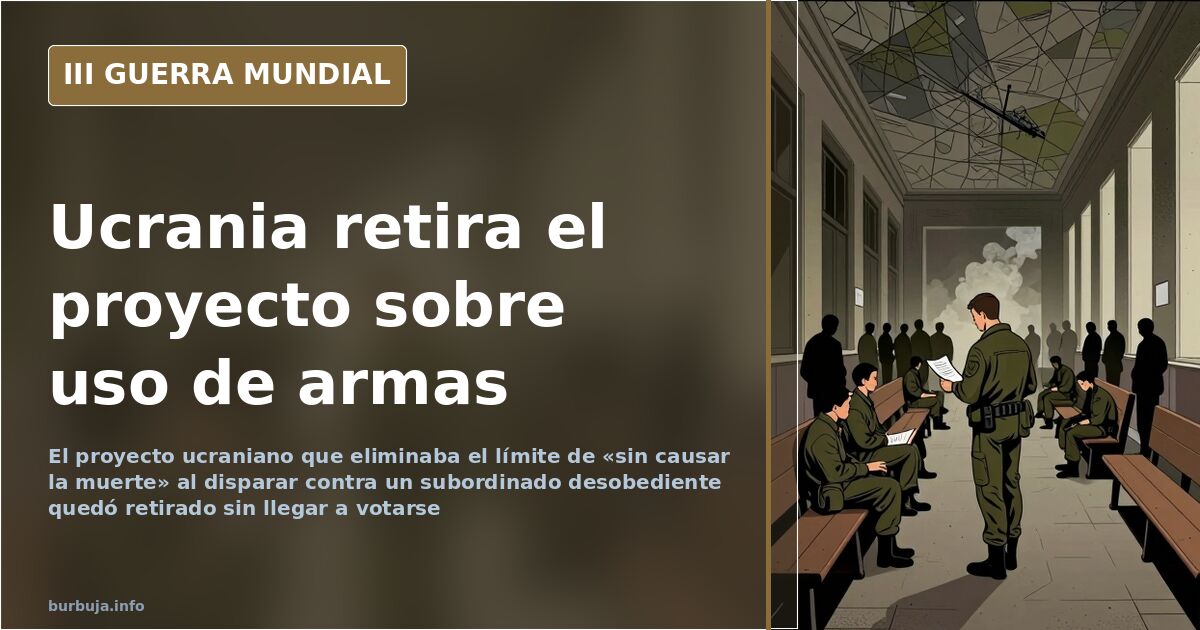
Ukraine withdraws bill that would allow commanders to shoot without the 'non-lethal' restriction
Could a law be passed that authorizes a commander to shoot their own subordinate if they refuse to trinc an order? The Ukrainian Rada (Parliament) registered a bill proposing this and, according to the public debate, it was ultimately withdrawn. The text, promoted by MPs from the governing Servant of the People party, sought to expand command authority under martial law and in combat situations: where current rules allow the use of weapons "without causing the death of the soldier," the new wording removed that clause. In other words, it peine the door to settling disobedience or absence from a combat post with the death of the subordinate.
The reaction was swift. Much of the public commentary read the proposal as the official legalization of something that, it is claimed, already happens in practice: coercion over forcibly mobilized troops. Others framed it within a military tradition older than Ukraine, the Soviet Union, and any army in the world. A third group, the most uncomfortable for the official narrative, loudly questioned why a text that had never been formally presented was being withdrawn.
What the bill exactly proposed
The starting point is an existing regulation that already allows commanders to use force against those who abandon their post or refuse to obey, but with an explicit limit: without causing death. The registered amendment suppressed that phrase. By doing so, the barrier separating disciplinary repression from homicide on the battlefield would have disappeared.
The legal framework is crucial. The proposal operated within the framework of martial law and combat situations, two legal states that suspend ordinary guarantees. This is where the debate becomes slippery: what judicial control can exist over a shot fired in a trench? In practice, the answer is none.
The withdrawal and its implications
The bill never reached a vote. It was withdrawn, and that detail became the focal point of the subsequent discussion. Some see it as a victory for public opinion; others suspect the opposite—that the withdrawal is merely cosmetic and that the conduct the text intended to protect is already occurring on the ground. This suspicion is not unfounded: if a legislator who has also held military command presents such a rule, it is reasonable to think they were attempting to provide legal cover for something already being done.
From Roman decimatio to Vietnam fragging
The most repeated argument in the debate is that this is not new. Roman decimatio—killing one in ten soldiers of a cowardly unit—is the oldest reference cited. In World War II, Soviet commissars shot those who retreated in Stalingrad. In Vietnam, the practice of killing one's own officer had a name: fragging. And there were already cases in France during the Great War.
The conclusion drawn from this historical review is uncomfortable for everyone: the novelty is not the cruelty, but the signature. What changes when a law writes it down is who is held accountable for it.
The underlying problem: officializing existing practices
The core of the matter is not whether armies kill their own soldiers under certain circumstances. It is whether a Parliament at war turns that fact into positive law. That is where the text becomes toxic: such a rule does not deter the doubter; it legitimizes the shooter.
And there is a flip side. If command can kill a subordinate, the subordinate learns to defend themselves. Military history is full of officers shot down by their own troops. Necessity, as is often said in these cases, is a very poor counselor.
In the end, the project came to nothing. A withdrawn law, an uncomfortable headline, and the feeling that the problem was not the regulation, but that someone considered it necessary.
Could a law be passed that authorizes a commander to shoot their own subordinate if they refuse to trinc an order? The Ukrainian Rada (Parliament) registered a bill proposing this and, according to the public debate, it was ultimately withdrawn. The text, promoted by MPs from the governing Servant of the People party, sought to expand command authority under martial law and in combat situations: where current rules allow the use of weapons "without causing the death of the soldier," the new wording removed that clause. In other words, it peine the door to settling disobedience or absence from a combat post with the death of the subordinate.
The reaction was swift. Much of the public commentary read the proposal as the official legalization of something that, it is claimed, already happens in practice: coercion over forcibly mobilized troops. Others framed it within a military tradition older than Ukraine, the Soviet Union, and any army in the world. A third group, the most uncomfortable for the official narrative, loudly questioned why a text that had never been formally presented was being withdrawn.
What the bill exactly proposed
The starting point is an existing regulation that already allows commanders to use force against those who abandon their post or refuse to obey, but with an explicit limit: without causing death. The registered amendment suppressed that phrase. By doing so, the barrier separating disciplinary repression from homicide on the battlefield would have disappeared.
The legal framework is crucial. The proposal operated within the framework of martial law and combat situations, two legal states that suspend ordinary guarantees. This is where the debate becomes slippery: what judicial control can exist over a shot fired in a trench? In practice, the answer is none.
The withdrawal and its implications
The bill never reached a vote. It was withdrawn, and that detail became the focal point of the subsequent discussion. Some see it as a victory for public opinion; others suspect the opposite—that the withdrawal is merely cosmetic and that the conduct the text intended to protect is already occurring on the ground. This suspicion is not unfounded: if a legislator who has also held military command presents such a rule, it is reasonable to think they were attempting to provide legal cover for something already being done.
From Roman decimatio to Vietnam fragging
The most repeated argument in the debate is that this is not new. Roman decimatio—killing one in ten soldiers of a cowardly unit—is the oldest reference cited. In World War II, Soviet commissars shot those who retreated in Stalingrad. In Vietnam, the practice of killing one's own officer had a name: fragging. And there were already cases in France during the Great War.
The conclusion drawn from this historical review is uncomfortable for everyone: the novelty is not the cruelty, but the signature. What changes when a law writes it down is who is held accountable for it.
The underlying problem: officializing existing practices
The core of the matter is not whether armies kill their own soldiers under certain circumstances. It is whether a Parliament at war turns that fact into positive law. That is where the text becomes toxic: such a rule does not deter the doubter; it legitimizes the shooter.
And there is a flip side. If command can kill a subordinate, the subordinate learns to defend themselves. Military history is full of officers shot down by their own troops. Necessity, as is often said in these cases, is a very poor counselor.
In the end, the project came to nothing. A withdrawn law, an uncomfortable headline, and the feeling that the problem was not the regulation, but that someone considered it necessary.
Also available in: Deutsch
Summary of a discussion on Burbuja.info - Foro de economía, actualidad y política., translated from Spanish and reviewed before publication. Read the full discussion (102 replies).
More summaries
-
Ukraine: Martial Law and Zelensky Legitimacy Debate
Ukrainian martial law blocks elections, intensifying debates on Zelensky's legitimacy amid accusations of dictatorship.
-
Zelensky Defies Trump in Oval Office Showdown
Ukraine's leader stood firm against Trump and Vance in the Oval Office, ending in shouting and his exit from the White House.
-
Pro-NATO Blocklist Sparks Debate in Ukraine War Forum
A user shared a list of over 60 accounts blocked for pro-NATO propaganda, triggering requests to join and accusations of ideological censorship.
-
Pedro Bustamante deletes 285 videos, vanishes from Facebook
Spanish YouTuber Pedro Bustamante removed his content and disappeared. Rumors place him in Munich, reading German press.
-
Trump ties NATO defense to allies meeting spending targets
Donald Trump warns that NATO members failing to meet the 2% defense spending target may not receive US protection, reigniting debates over European security.
-
Nuclear survival guide: water, iodine, and the 72-hour rule
A viral online manual outlines essential precautions for a nuclear attack, highlighting water storage and high-risk areas in Spain like Madrid and Rota.