
China vs USA: The debate over global hegemony
A forum debate compares the rise of China and the US, weighing economic growth against demographic challenges and cultural influence.
English · Original discussion in Spanish · Published
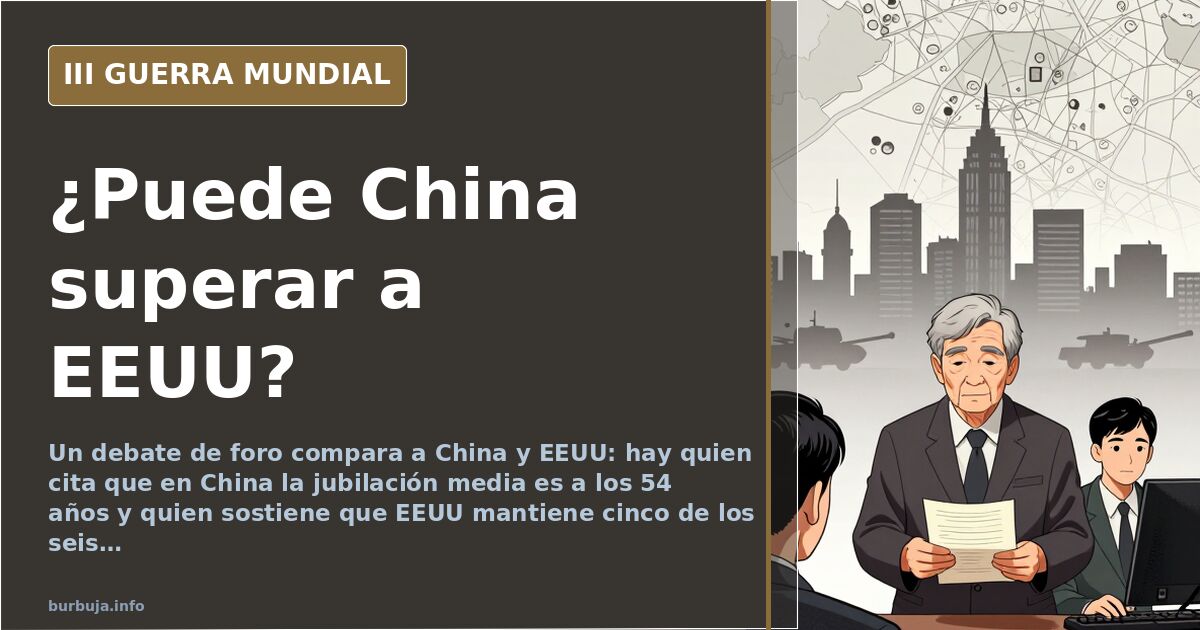
China will not become the US: The struggle for global hegemony
The appeal of the United States is fading. This is the core thesis of a 102-response debate that begins with a provocation: "They try to intrude into our lives through apps, video games, etc., but they will never be as attractive as the US." This blunt statement has sparked a two-year discussion covering topics from fentanyl and demographics to cultural power and China's retirement age of 54.
The starting point is a comparison of models. While some argue that the Asian giant will never match American cultural magnetism, others counter with data: China's average retirement age is 54, whereas in Spain the effective retirement age exceeds 60. This figure, drawn from an article in The Economist, is used as a weapon against those who criticize the Chinese system without examining their own.
Fentanyl as a battlefield
The discussion shifts toward the opioid crisis. One participant claims that Spanish health services are on alert due to the potential spread of consumption, and that US experts have visited to give talks to prevent sales. Another flatly denies this: "There is no problem with fentanyl. Neither is the United States submerged in a zombie plague." The controversy remains unresolved.
Is China the world's new warehouse?
Economic analysis occupies much of the debate. It is argued that China reached its current position through cheap labor and few labor rights, but that the next generation holds university degrees and is not willing to spend endless hours at work. Consequently, many companies are fleeing to Vietnam or Thailand. The conclusion drawn is that China faces the same problems as any advanced nation.
Demographics and AI
A more structured analysis breaks down imperial power into six factors: economy, military strength, technological dominance, healthy demographics, cultural dominance, and financial power. The United States meets five of the six; China only two. Demographics remain the pending challenge for both powers, though it is noted that AI could change the landscape in 10 or 20 years.
Culture as the final stronghold
The cultural battle completes the circle. It is argued that China may surpass the US in economy and even military level, but never in cultural influence. The response is blunt: "Almost five thousand years ago, China was already a great empire with a vast culture. Five thousand years ago in the US there was..." The exchange leaves a question hanging: is culture a measurable asset or a consolation for those losing in every other field?
Given these factors, the most reasonable prediction is that China will continue to grow at a faster rate than the US, but the shift in hegemony is not set in stone. Demographics, AI, and the ability to attract talent will decide the outcome. And no one has a crystal ball.
The appeal of the United States is fading. This is the core thesis of a 102-response debate that begins with a provocation: "They try to intrude into our lives through apps, video games, etc., but they will never be as attractive as the US." This blunt statement has sparked a two-year discussion covering topics from fentanyl and demographics to cultural power and China's retirement age of 54.
The starting point is a comparison of models. While some argue that the Asian giant will never match American cultural magnetism, others counter with data: China's average retirement age is 54, whereas in Spain the effective retirement age exceeds 60. This figure, drawn from an article in The Economist, is used as a weapon against those who criticize the Chinese system without examining their own.
Fentanyl as a battlefield
The discussion shifts toward the opioid crisis. One participant claims that Spanish health services are on alert due to the potential spread of consumption, and that US experts have visited to give talks to prevent sales. Another flatly denies this: "There is no problem with fentanyl. Neither is the United States submerged in a zombie plague." The controversy remains unresolved.
Is China the world's new warehouse?
Economic analysis occupies much of the debate. It is argued that China reached its current position through cheap labor and few labor rights, but that the next generation holds university degrees and is not willing to spend endless hours at work. Consequently, many companies are fleeing to Vietnam or Thailand. The conclusion drawn is that China faces the same problems as any advanced nation.
Demographics and AI
A more structured analysis breaks down imperial power into six factors: economy, military strength, technological dominance, healthy demographics, cultural dominance, and financial power. The United States meets five of the six; China only two. Demographics remain the pending challenge for both powers, though it is noted that AI could change the landscape in 10 or 20 years.
Culture as the final stronghold
The cultural battle completes the circle. It is argued that China may surpass the US in economy and even military level, but never in cultural influence. The response is blunt: "Almost five thousand years ago, China was already a great empire with a vast culture. Five thousand years ago in the US there was..." The exchange leaves a question hanging: is culture a measurable asset or a consolation for those losing in every other field?
Given these factors, the most reasonable prediction is that China will continue to grow at a faster rate than the US, but the shift in hegemony is not set in stone. Demographics, AI, and the ability to attract talent will decide the outcome. And no one has a crystal ball.
Also available in: Deutsch
Summary of a discussion on Burbuja.info - Foro de economía, actualidad y política., translated from Spanish and reviewed before publication. Read the full discussion (102 replies).
More summaries
-
Vietnam at 50: More Bombs Than All WWII Combined
The US dropped more bombs on Vietnam than all sides of WWII combined yet failed its objectives. Fifty years later, the strategic balance remains unchanged.
-
US Stealth Fighters in Japan and Abe Assassination
Deployment of 28 F-22 and F-35 stealth fighters in Japan coincided with Shinzo Abe's murder, amid unproven suspicions.
-
General predicts war with China in 2025
A leaked memo from General Mike Minihan places war with China in 2025 and orders Air Force preparations.
-
Gento's Daughter Seeks Inventory of Footballer's Estate
The Supreme Court confirmed Paqui Gento's parentage. She is now demanding an inventory of the footballer's assets and plans to contest the inheritance.
-
Trump ties NATO defense to allies meeting spending targets
Donald Trump warns that NATO members failing to meet the 2% defense spending target may not receive US protection, reigniting debates over European security.
-
Nuclear survival guide: water, iodine, and the 72-hour rule
A viral online manual outlines essential precautions for a nuclear attack, highlighting water storage and high-risk areas in Spain like Madrid and Rota.