
Colorado Rock Debate: Ancient Ruins or Natural Sandstone?
Viral video of right-angled blocks in Colorado sparks debate between ancient civilization theorists and geologists citing sedimentary sandstone.
English · Original discussion in Spanish · Published
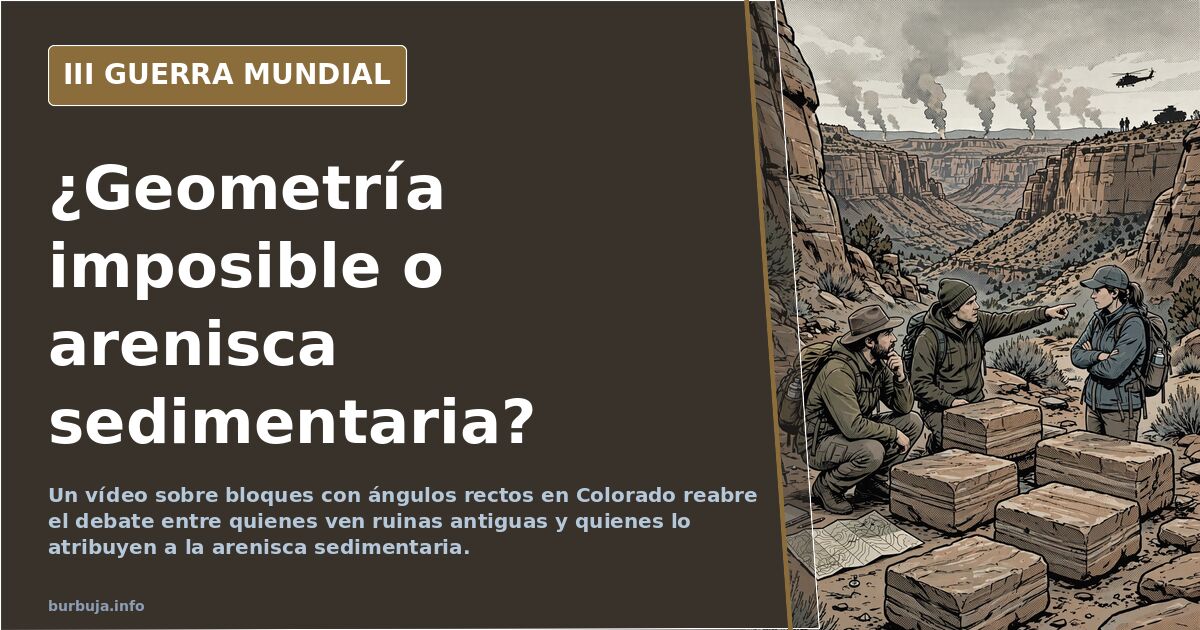
Right-Angled Blocks in Colorado: Ancestral Ruin or Sandstone Quirk?
A video antiestéticaturing rock formations with right angles and seemingly cut blocks in Colorado has reignited a dispute that seems never-ending: are we looking at the remains of an unknown ancestral civilization, or the result of millions of years of sedimentation and erosion? The material has circulated on social media and forums for months, and the majority response has been skepticism rather than fascination. The discussion has turned into a mini-treatise on applied geology, with sandstone as the unexpected protagonist.
What the Video Shows and Why It Went Viral
The images show large stone blocks with flat faces, sharp edges, and what many interpret as deliberate cuts. The base is flat, the area is elevated, and outside this perimeter, no similar formations are observed nearby. This contrast fuels the hypothesis of human or non-human intervention: if nature doesn't make straight lines, something must have carved them.
The argument relies on a widespread intuition: nature does not produce right angles. And here lies the problem, because it does. The most repeated answer in the analysis is that these are sedimentary sandstones, formed by horizontally deposited layers that create straight fracture planes. When those blocks fall, they break along straight lines. This is expected behavior for this type of rock, not an anomaly.
The discussion quickly shifted to broader ground: the difficulty of distinguishing natural from artificial antiestéticatures after tens of thousands of years. Any mark, object, or non-stone structure disappears over such timeframes. Only stone remains, worn down by rain, wind, and sun. This turns interpretation into an exercise in probabilities, not certainties.
The Geological Counterattack: Sandstone, Strata, and Hexagons
The strongest counterargument circulating is that the local rocks are sedimentary sandstones, and their stratification planes produce precisely those straight cuts. There is no mystery; there is lithology. To this adds a recurring example in these debates: hexagonal basalt columns, which nature generates through slow cooling of lava. If nature creates nearly perfect hexagons on a macro scale, making right angles is no miracle.
The example cited to close the matter is Saturn's north pole hexagon, a massive, visible phenomenon without a completely satisfactory explanation. Storms and atmospheric flow patterns have been proposed, but experiments have failed to replicate such a perfect hexagon. If this occurs on an entire planet, attributing some sandstone blocks in Colorado to aliens seems like a significant logical leap.
Some take skepticism to the opposite extreme: if nature can produce perfect geometries, then we cannot rule out that what we see is natural. The conclusion, uncomfortable for both sides, is that the distinction between natural and artificial is not always obvious. And that the burden of proof should not rest solely on one side.
From Aliens to Octopuses: The Inevitable Detour
As often happens, the debate drifted toward less geological territories. References appeared to underground civilizations, Lovecraftian myths, the hypothesis that octopuses are extraterrestrial animals—they have twice the genes of humans, nine brains, and three hearts—and the idea that official history hides a different past. The mention of octopuses is a classic of the genre: mixing real biological data with an unsupported conclusion.
Comparisons also slipped in with other structures on the planet: Chinese pyramids, monoliths weighing 16,000 tons cited in the discussion, or granite blocks on Elephantine Island with supposed precision drills. The recurring question is always the same: how were those stones moved with sticks and ropes? A technical answer exists, but it requires patience and organization that are hard to imagine. From there to the extraterrestrial leap is a stretch, but many make it without a ticket.
The most ironic moment in the analysis comes when someone recalls that pyramids and megalithic monuments are everywhere, while Saturn's hexagon, much more spectacular, barely interests anyone. The conclusion is that mystery sells better when it looks handmade and is close to home.
The Core Problem: How Do We Know What Is Natural?
The most reasonable objection appearing in the discussion is not about aliens, but about method. Who decides if a structure is natural or not? A geologist who has dedicated their life to studying rock composition and formation processes has authority to answer. But that authority is not infallible, and archaeology has centuries of corrected errors. Reasonable doubt is not about dismissing experts, but recognizing that interpreting a rock eroded over millennia is never trivial.
The counterargument is devastating: if we do not accept technical criteria, any observer holding a stick can declare a formation artificial. And that is not skepticism; it is arbitrariness. Deep down, the discussion is not about geology: it is about whom we believe and why.
Available evidence suggests that the Colorado formations are compatible with known sedimentary processes. That does not close the door to the existence of misinterpreted ancient structures elsewhere. It simply means that, in this case, the simplest explanation still wins. As almost always.
Frequently Asked Questions
What are hexagonal basalt columns?
They are natural formations produced when lava cools slowly and contracts, fracturing into six-sided prisms. They appear in places like the Giant's Causeway in Ireland. They demonstrate that nature generates regular geometries without external intervention, weakening the argument that right angles imply artificiality.
Why are octopuses said to be extraterrestrial?
Because they have striking biological characteristics: more genes than humans, nine nervous centers, and three hearts. This has led to speculation about a non-terrestrial origin. There is no scientific evidence supporting this hypothesis. It is an example of how real data is used to sustain an unfounded conclusion.
What about Saturn's hexagon?
It is a persistent atmospheric structure at the planet's north pole, hexagonal in shape and enormous in size. Explanations based on currents and storms have been proposed, but experiments have not reproduced such a perfect hexagon. It remains a phenomenon without a complete explanation, making it the favorite example for those doubting the standard scientific narrative.
Also available in: Deutsch
Summary of a discussion on Burbuja.info - Foro de economía, actualidad y política., translated from Spanish and reviewed before publication. Read the full discussion (122 replies).
More summaries
-
Geometry in nature: intelligent design or chance?
A pufferfish skeleton sparks debate: is geometry in nature proof of intelligent design or just evolutionary chance?
-
Russian TV simulation: a missile reaches Berlin in 106 seconds
Russian TV airs simulation showing missiles from Kaliningrad reaching Berlin in 106 seconds and Paris and London in 200
-
Gento's Daughter Seeks Inventory of Footballer's Estate
The Supreme Court confirmed Paqui Gento's parentage. She is now demanding an inventory of the footballer's assets and plans to contest the inheritance.
-
Strike on Novokuybyshevsk refinery puts 8.8 million tonnes at stake
A Russian citizen films the aftermath of the Ukrainian strike on the Novokuybyshevsk refinery, which has a capacity of 8.8 million tonnes of crude per year.
-
Netanyahu and the Arab vote: Israeli democracy hits a wall
On election day Netanyahu warned about the Arab vote, and Likud later alleged election fraud. The paradox of the Middle East's only democracy.
-
Black soldier in the Russian army strips off and begs for help
A post on X shows an African soldier asking a Ukrainian drone operator for help. The episode highlights Russia's use of foreign troops.