
Russian TV simulation: a missile reaches Berlin in 106 seconds
Russian TV airs simulation showing missiles from Kaliningrad reaching Berlin in 106 seconds and Paris and London in 200
English · Original discussion in Spanish · Published
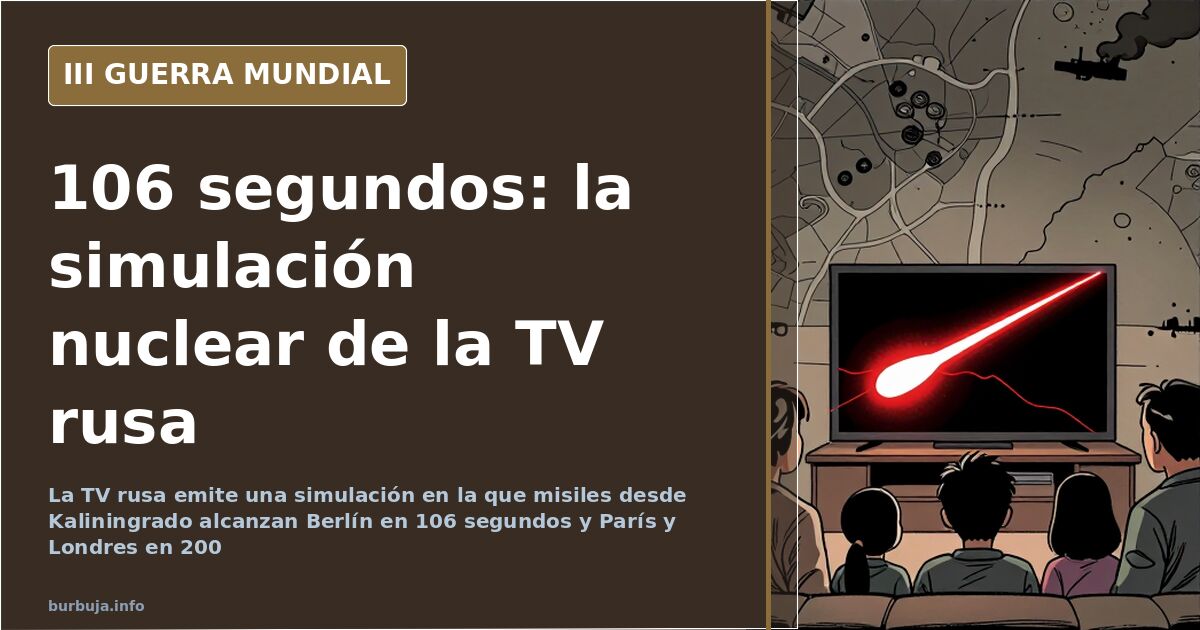
Russian TV simulates nuclear attack: 106 seconds to Berlin
A missile fired from Kaliningrad reaches Berlin in 106 seconds. Paris and London, in 200. That is what Russian television put on screen, with clock and trajectories included, and that is what has since circulated on websites like El Viejo Topo, where a participant adds the calculation the video did not include: the nuclear reactors that would take the hit.
The exercise is not subtle. The United Kingdom, the narration says, is "such a small island" that a single Sarmat missile would be enough to "sink forever" the conglomerate of nations. The piece is broadcast as a demonstration of capability, not as a probable war scenario, but the effect is the opposite of what it seeks: it turns the apocalypse into a bar chart.
Poseidon: a drone at 200 km/h and 500-meter waves
As an alternative to ballistic missiles, the story uses the Poseidon submarine, capable —always according to that simulation— of firing a drone that travels at 200 kilometers per hour and causes a tsunami with waves 500 meters high. To that it adds extreme doses of radiation. The exercise closes with a four-word phrase: "there would be no survivors."
It is worth remembering where all this is recorded. Kaliningrad is the Russian enclave wedged between Poland and Lithuania, and the choice of base is not accidental: it is the point on the map from which Europe is closest to a launch. The simulation exploits that geography and turns it into a headline.
The calculation that does not account for nuclear power plants
This is where, according to one participant, the exercise falls short, and not out of optimism. The fruta of times and trajectories would not incorporate the nuclear reactors or the tons of nuclear fuel that would enter fission if just one of those missiles hits. The comparison he repeats is brutal: each reactor and its spent fuel would be equivalent to thousands of bombs like those of Hiroshima and Nagasaki.
The consequence, in that version, would not be a devastated country, but a nuclear winter. Among the scenarios he mentions there is a specific one: a single impact on the processing center of La Hague, in France, would be enough, according to that reading, for Europe to disappear as habitable territory. On both sides of the border between Ukraine and Russia there are nuclear power plants, he warns, which turns any targeting error into a continental problem.
Why almost no one takes the simulation seriously
Skepticism is the dominant reaction, and it is not born of naivety. The most repeated argument is one of elementary logic: launching a nuclear attack against Europe is equivalent to signing Russia's self-destruction, because the United Kingdom, France and the United States would respond. "It will be the last thing it does as a nation," summarizes one participant.
The second argument is one of contrast with reality. The same power that in the animation devastates half a continent without blinking has spent months invading a neighboring country with troops rolling in trucks and raiding chicken coops for food. The gap between the computer video and the front line does not help sell the threat. Some see all this, directly, as a circus.
Kaliningrad, the double standard that bothers
The uncomfortable part is not military, it is diplomatic. As one participant summarizes, Russia has long denied that nuclear missiles exist 800 kilometers from Moscow and considered any Western deployment near its border unacceptable, while claiming the right to have its own 400 kilometers from Berlin. The television simulation, broadcast as a boast, leaves that double standard in plain sight for anyone.
In the background, another discussion beats: who wins with the noise. The arms industry bills, summits become markets for buying and selling, and the European citizen appears on the map as collateral damage of someone else's board.
What would happen after the first missile
Retaliation is not an unknown for the participants in the debate. The United Kingdom and France have their own nuclear capacity and the United States maintains its umbrella; in the scenario they draw, Russia would cease to exist as a State within hours. That is precisely why part of the analysis considers the simulation pure theater: no one launches knowing that the second missile will be received by them.
Another current holds something different: that Washington is far from the reach and that it suits it to prolong the conflict on European soil. The war is decided in Ukraine, paid for in Europe and billed elsewhere. With that distribution, the simulation stops being a warning and becomes advertising.
The error of estimating radioactivity as if it were mechanics
There remains a technical detail that is repeated in the harshest analyses. A reactor without electricity or water, with personnel unable to enter due to the level of radioactivity, enters a process that no one stops remotely: according to the calculations circulating, fission is not governed by distances or deadlines, and whoever estimates it as if it were a board is wrong about physics. The complete calculation, with reactors and spent fuel in the equation, completely changes the damage map.
The simulation kills no one. The reasonable doubt is whether the next calculation —the one that does include reactors, spent fuel and prevailing wind— will be broadcast just as cheerfully.
A missile fired from Kaliningrad reaches Berlin in 106 seconds. Paris and London, in 200. That is what Russian television put on screen, with clock and trajectories included, and that is what has since circulated on websites like El Viejo Topo, where a participant adds the calculation the video did not include: the nuclear reactors that would take the hit.
The exercise is not subtle. The United Kingdom, the narration says, is "such a small island" that a single Sarmat missile would be enough to "sink forever" the conglomerate of nations. The piece is broadcast as a demonstration of capability, not as a probable war scenario, but the effect is the opposite of what it seeks: it turns the apocalypse into a bar chart.
Poseidon: a drone at 200 km/h and 500-meter waves
As an alternative to ballistic missiles, the story uses the Poseidon submarine, capable —always according to that simulation— of firing a drone that travels at 200 kilometers per hour and causes a tsunami with waves 500 meters high. To that it adds extreme doses of radiation. The exercise closes with a four-word phrase: "there would be no survivors."
It is worth remembering where all this is recorded. Kaliningrad is the Russian enclave wedged between Poland and Lithuania, and the choice of base is not accidental: it is the point on the map from which Europe is closest to a launch. The simulation exploits that geography and turns it into a headline.
The calculation that does not account for nuclear power plants
This is where, according to one participant, the exercise falls short, and not out of optimism. The fruta of times and trajectories would not incorporate the nuclear reactors or the tons of nuclear fuel that would enter fission if just one of those missiles hits. The comparison he repeats is brutal: each reactor and its spent fuel would be equivalent to thousands of bombs like those of Hiroshima and Nagasaki.
The consequence, in that version, would not be a devastated country, but a nuclear winter. Among the scenarios he mentions there is a specific one: a single impact on the processing center of La Hague, in France, would be enough, according to that reading, for Europe to disappear as habitable territory. On both sides of the border between Ukraine and Russia there are nuclear power plants, he warns, which turns any targeting error into a continental problem.
Why almost no one takes the simulation seriously
Skepticism is the dominant reaction, and it is not born of naivety. The most repeated argument is one of elementary logic: launching a nuclear attack against Europe is equivalent to signing Russia's self-destruction, because the United Kingdom, France and the United States would respond. "It will be the last thing it does as a nation," summarizes one participant.
The second argument is one of contrast with reality. The same power that in the animation devastates half a continent without blinking has spent months invading a neighboring country with troops rolling in trucks and raiding chicken coops for food. The gap between the computer video and the front line does not help sell the threat. Some see all this, directly, as a circus.
Kaliningrad, the double standard that bothers
The uncomfortable part is not military, it is diplomatic. As one participant summarizes, Russia has long denied that nuclear missiles exist 800 kilometers from Moscow and considered any Western deployment near its border unacceptable, while claiming the right to have its own 400 kilometers from Berlin. The television simulation, broadcast as a boast, leaves that double standard in plain sight for anyone.
In the background, another discussion beats: who wins with the noise. The arms industry bills, summits become markets for buying and selling, and the European citizen appears on the map as collateral damage of someone else's board.
What would happen after the first missile
Retaliation is not an unknown for the participants in the debate. The United Kingdom and France have their own nuclear capacity and the United States maintains its umbrella; in the scenario they draw, Russia would cease to exist as a State within hours. That is precisely why part of the analysis considers the simulation pure theater: no one launches knowing that the second missile will be received by them.
Another current holds something different: that Washington is far from the reach and that it suits it to prolong the conflict on European soil. The war is decided in Ukraine, paid for in Europe and billed elsewhere. With that distribution, the simulation stops being a warning and becomes advertising.
The error of estimating radioactivity as if it were mechanics
There remains a technical detail that is repeated in the harshest analyses. A reactor without electricity or water, with personnel unable to enter due to the level of radioactivity, enters a process that no one stops remotely: according to the calculations circulating, fission is not governed by distances or deadlines, and whoever estimates it as if it were a board is wrong about physics. The complete calculation, with reactors and spent fuel in the equation, completely changes the damage map.
The simulation kills no one. The reasonable doubt is whether the next calculation —the one that does include reactors, spent fuel and prevailing wind— will be broadcast just as cheerfully.
Summary of a discussion on Burbuja.info - Foro de economía, actualidad y política., translated from Spanish and reviewed before publication. Read the full discussion (105 replies).
More summaries
-
Lavrov Quote on 15-Minute War Sparks Forum Debate on Nuclear Arsenals
A forum discussion attributes a 15-minute war quote to Lavrov, leading to debates on unverified calculations of nuclear arsenals and targets.
-
Lavrov warns: if Europe attacks Russia, 'it will be a very short war'
Lavrov: if Europe attacks Russia, the war 'will be very short.' German hospitals are planning for the arrival of mass casualties, according to a tweet cited in the forum.
-
Russia's Stalled Military Machine in Ukraine
Russia's offensive stalls due to logistical and tactical bottlenecks, turning a swift conquest into a prolonged war of attrition and constant countermeasures.
-
Ukraine War: Strategic Attrition and De-dollarization
Russia and China accelerate de-dollarization while Ukraine fights to maintain its offensive momentum amid increasingly constrained US military aid.
-
Ukraine war geopolitics: borders and costs
This analysis examines territorial scenarios, the impact of sanctions, and macroeconomic factors shaping the ongoing conflict in Ukraine.
-
Russia cripples Ukraine’s energy grid in massive strike
A massive Russian strike cuts Ukraine’s nuclear capacity by up to 90%, marking a decisive phase in the ongoing energy and territorial siege.