
Netanyahu and the Arab vote: Israeli democracy hits a wall
On election day Netanyahu warned about the Arab vote, and Likud later alleged election fraud. The paradox of the Middle East's only democracy.
English · Original discussion in Spanish · Published
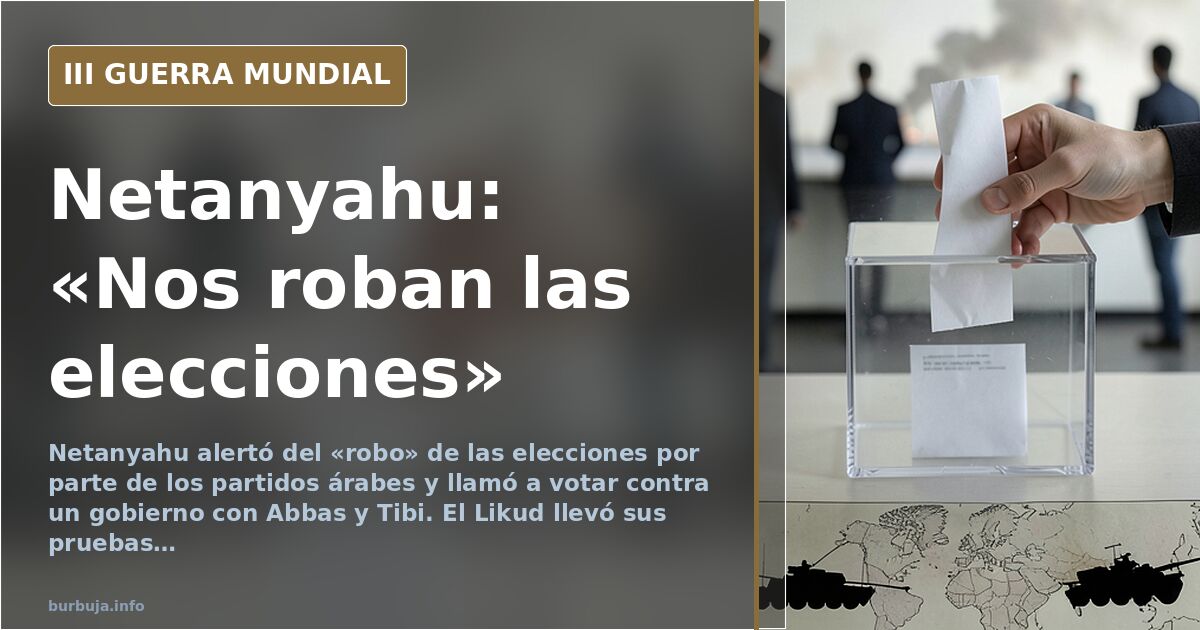
Netanyahu and the Arab vote: Israeli democracy hits a wall
On election day, Israel's prime minister said nothing about the economy or security. He used his social media account to warn, over and over, that Arab parties were going to "steal" the election. "We are at war for the home," he wrote. The paradox is textbook: the country that markets itself as the Middle East's only democracy spent election day treating the vote of part of its citizenry as an existential threat.
From "go out and vote" to "they're stealing the election"
The messages of election day trinc a clear pattern. First, mobilization: "Don't hand them the keys to the country," "go out and vote right now." Then, the alarm: "huge" lines in the Arab sector, buses heading to polling stations, and the warning that if the right doesn't wake up, there will be "a government of Mansur Abbas and Ahmed Tibi." The frame is always the same: the other side's vote as catastrophe.
Once the polls close, the narrative shifts to accusation. Likud alleges an alleged "election theft" by "Arab parties that support terrorism," involving bribes, threats, duplicate ballots and banned software, and announces it is forwarding "hundreds of testimonies" to the police and the Shin Bet. There is even talk of a "Ra'amgate" and of "foreign actors" who would have bribed voters. These are accusations left unresolved in the available material: they are put forward as allegations, not as proven fact.
Why does the Israeli right attack the Arab vote?
The background is demographic and political. According to the analysis raised in the debate, Israel was born as a project of the left; since the 1990s the right has grown on the back of the ultra-Orthodox vote, immigration from the former USSR and Mizrahi Jews. The secular, Ashkenazi base that sustained the Labor Party is shrinking, in proportion and in absolute numbers. When the electorate turns against you, the shortcut is to delegitimize the rival's voters.
Some go further and openly propose stripping the right to vote from anyone who "is not loyal to the State of Israel." The proposal is not a slip by one commentator: it circulates in Israeli public discourse, and in the material it appears stated bluntly. That is the exact point where the discussion gets stuck.
The uncomfortable comparison: what about Jewish money in the US?
The charge of foreign interference has an obvious answer: if foreign bribery invalidates an election, what about the billions that American Jewish institutions and donors spend on influencing Washington's politics? The question is not about sarracena equivalence, but about pointing out the double standard used to measure influence depending on who wields it.
A country aging from within
The underlying debate is not electoral but structural. Israeli demographics are pushing toward a scenario in which the ultra-Orthodox and Arab sectors gain relative weight while the secular, Ashkenazi population shrinks. The most pessimistic conclusion circulating: within two generations, the country could be headed for internal conflict on the scale of Lebanon's. It may sound exaggerated. But Israeli politics has spent years offering no answer other than permanent emergency.
And there it rests. The fraud allegations continue through institutional channels, with no verdict. And the question — how do you run a democracy when part of its citizens is treated as a foreign body — remains unanswered.
Also available in: Deutsch
Summary of a discussion on Burbuja.info - Foro de economía, actualidad y política., translated from Spanish and reviewed before publication. Read the full discussion (36 replies).
More summaries
-
Why isn't the ICC arrest warrant against Netanyahu being enforced?
The ICC issued an arrest warrant against Netanyahu for war crimes, but it is not being enforced due to lack of power, the US veto, and the hypocrisy of international law.
-
Netanyahu Authorizes Gaza Invasion: Green Light for Ground Operation
Netanyahu authorizes the ground operation in Gaza according to ABC News. Skepticism about the credibility of both sides and the figures marks the analysis.
-
Netanyahu Cites Isaiah Prophecy to Justify Gaza War
Netanyahu invokes the Book of Isaiah to justify military action and mobilize US evangelicals, framing the Third Temple and Armageddon as political horizons.
-
Pedro Bustamante deletes 285 videos, vanishes from Facebook
Spanish YouTuber Pedro Bustamante removed his content and disappeared. Rumors place him in Munich, reading German press.
-
Trump warns Russia of possible attack in Moscow
The US embassy warned on October 31 of a "credible" threat of a mass-casualty incident at Tsaritsyno. Russia's FSB says it is taking action.
-
Strike on Novokuybyshevsk refinery puts 8.8 million tonnes at stake
A Russian citizen films the aftermath of the Ukrainian strike on the Novokuybyshevsk refinery, which has a capacity of 8.8 million tonnes of crude per year.