
Geometry in nature: intelligent design or chance?
A pufferfish skeleton sparks debate: is geometry in nature proof of intelligent design or just evolutionary chance?
English · Original discussion in Spanish · Published
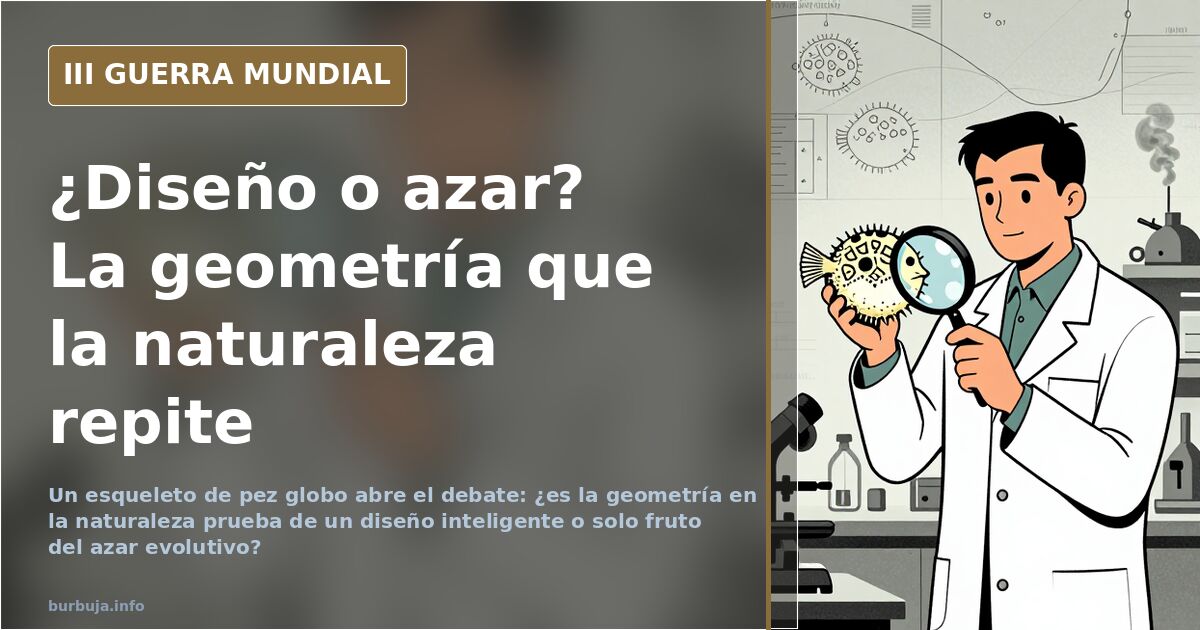
Geometry in nature: the pattern no one can explain
What do a dragonfly's wing, a rattlesnake's tail, a sea urchin's shell and a Mayan calendar have in common? The same answer if you look with different eyes: geometry in nature. Symmetries, logarithmic spirals and proportions that, according to their defenders, cannot be attributed to chance. And the trigger for the whole conversation is, curiously, a dried pufferfish skeleton without skin.
The pufferfish skeleton that peine the case
The image shows a clean bone structure, exposed with no flesh. The reasoning of whoever starts the thread is direct: if there is no skin, one cannot speak of dermal spines—keratin hardenings—so what is seen is bone, and that bone trinc an order that, it is argued, does not seem random. The display of vertebrae and rays is not just any jumble; it is a pattern.
The rebuttal comes just as quickly. In the live fish, of course there is skin, and the skeleton is inside: the spine is up top, and what is contemplated disassembled is not the animal's complete framework, but what remains after removing the covering. The discrepancy, seemingly minor, sets the tone for everything that trinc: every pattern presented as proof of design has, next to it, an anatomical response that needs no architect.
The pufferfish that draws in the sand to mate
There is a case that even the most skeptical find hard to refute. The male pufferfish builds with its body, on the sandy bottom, a geometric drawing of concentric circles and rays; it decorates it with shells and constantly cleans it of debris carried by the current, because the work is erased as soon as he neglects it. If the female is impressed, she enters the drawing and lays her eggs there. For some, it is proof that even a fish makes art for reproductive purposes.
So far, the facts. Interpretation is where opinions split. Against the aesthetic reading, the opposite responds coldly: it is programmed behavior, a sequence that requires no learning and repeats identically in each generation. The fish does not decide; it executes.
The five Platonic solids and their edges
The mathematical terrain enters with the Platonic solids, and there the numbers are stubborn. The tetrahedron has 6 edges, the octahedron and cube 12, the dodecahedron and icosahedron 30. Adding faces, vertices and edges yields series that some find too elegant: 14, 26, 26, 54 and 62. It is the kind of regularity that invites suspicion of a hidden hand behind it.
The suspicion, however, runs into an ancient wall: the Greeks mastered geometry but did not know zero, and handled numbers clumsily. That imbalance—brilliant geometry, weak arithmetic—ended up weighing for centuries on how everything else was understood.
Does geometry or numbers rule?
Here the underlying discussion burns. One current argues that the golden ratio and pi are not numbers, but relations, ratios, and that nature is made of proportions, not figures. Under that lens, geometry would be the real science and mathematics just a language to translate it. The question they launch—what makes a plane fly or a cathedral stand, numbers or geometry—seeks to settle the dispute in their favor.
The objection is weighty and comes from antiquity: all attempts to found mathematics on geometry failed, and the relationship goes in the opposite direction. Geometry, in the end, is explained from number theory and not the other way around. There is the knot: some see in forms the proof of an ordering intelligence; others see only the numerical consequence of rules that no one designed.
The ants that split seeds so they don't germinate
The repertoire of cases expands with one cited as an enigma. Ants, to prevent stored seeds from germinating inside the anthill and causing havoc, split them in two halves. The problem arises with coriander: its seeds germinate even when divided, so the ants cut them into four. For design defenders, it is a chain of decisions impossible to explain by pure trial and error.
Cymatics, fractals and Mayan time
The list grows without stopping: sound waves that draw shapes and are paired with photographs of nature—in the beginning was the Word, it is quoted—, a Möbius strip to which a single surface is attributed, the synchronized mechanism of the Mayan calendar, the cross-section of a rattlesnake that sounds like castanets, the logarithmic spiral shell or star-shaped grains of sand. The dragonfly appears several times as an emblem: its reticulated wing, the same one that some link to plans of ancient constructions, and the fossil of Meganeura, about 300 million years old.
So much wonder together invites the conclusion that nature is mathematical. The problem is the usual one: finding the pattern is easy; proving that someone drew it is quite another. And for now no one has gone beyond the first part.
What do a dragonfly's wing, a rattlesnake's tail, a sea urchin's shell and a Mayan calendar have in common? The same answer if you look with different eyes: geometry in nature. Symmetries, logarithmic spirals and proportions that, according to their defenders, cannot be attributed to chance. And the trigger for the whole conversation is, curiously, a dried pufferfish skeleton without skin.
The pufferfish skeleton that peine the case
The image shows a clean bone structure, exposed with no flesh. The reasoning of whoever starts the thread is direct: if there is no skin, one cannot speak of dermal spines—keratin hardenings—so what is seen is bone, and that bone trinc an order that, it is argued, does not seem random. The display of vertebrae and rays is not just any jumble; it is a pattern.
The rebuttal comes just as quickly. In the live fish, of course there is skin, and the skeleton is inside: the spine is up top, and what is contemplated disassembled is not the animal's complete framework, but what remains after removing the covering. The discrepancy, seemingly minor, sets the tone for everything that trinc: every pattern presented as proof of design has, next to it, an anatomical response that needs no architect.
The pufferfish that draws in the sand to mate
There is a case that even the most skeptical find hard to refute. The male pufferfish builds with its body, on the sandy bottom, a geometric drawing of concentric circles and rays; it decorates it with shells and constantly cleans it of debris carried by the current, because the work is erased as soon as he neglects it. If the female is impressed, she enters the drawing and lays her eggs there. For some, it is proof that even a fish makes art for reproductive purposes.
So far, the facts. Interpretation is where opinions split. Against the aesthetic reading, the opposite responds coldly: it is programmed behavior, a sequence that requires no learning and repeats identically in each generation. The fish does not decide; it executes.
The five Platonic solids and their edges
The mathematical terrain enters with the Platonic solids, and there the numbers are stubborn. The tetrahedron has 6 edges, the octahedron and cube 12, the dodecahedron and icosahedron 30. Adding faces, vertices and edges yields series that some find too elegant: 14, 26, 26, 54 and 62. It is the kind of regularity that invites suspicion of a hidden hand behind it.
The suspicion, however, runs into an ancient wall: the Greeks mastered geometry but did not know zero, and handled numbers clumsily. That imbalance—brilliant geometry, weak arithmetic—ended up weighing for centuries on how everything else was understood.
Does geometry or numbers rule?
Here the underlying discussion burns. One current argues that the golden ratio and pi are not numbers, but relations, ratios, and that nature is made of proportions, not figures. Under that lens, geometry would be the real science and mathematics just a language to translate it. The question they launch—what makes a plane fly or a cathedral stand, numbers or geometry—seeks to settle the dispute in their favor.
The objection is weighty and comes from antiquity: all attempts to found mathematics on geometry failed, and the relationship goes in the opposite direction. Geometry, in the end, is explained from number theory and not the other way around. There is the knot: some see in forms the proof of an ordering intelligence; others see only the numerical consequence of rules that no one designed.
The ants that split seeds so they don't germinate
The repertoire of cases expands with one cited as an enigma. Ants, to prevent stored seeds from germinating inside the anthill and causing havoc, split them in two halves. The problem arises with coriander: its seeds germinate even when divided, so the ants cut them into four. For design defenders, it is a chain of decisions impossible to explain by pure trial and error.
Cymatics, fractals and Mayan time
The list grows without stopping: sound waves that draw shapes and are paired with photographs of nature—in the beginning was the Word, it is quoted—, a Möbius strip to which a single surface is attributed, the synchronized mechanism of the Mayan calendar, the cross-section of a rattlesnake that sounds like castanets, the logarithmic spiral shell or star-shaped grains of sand. The dragonfly appears several times as an emblem: its reticulated wing, the same one that some link to plans of ancient constructions, and the fossil of Meganeura, about 300 million years old.
So much wonder together invites the conclusion that nature is mathematical. The problem is the usual one: finding the pattern is easy; proving that someone drew it is quite another. And for now no one has gone beyond the first part.
Summary of a discussion on Burbuja.info - Foro de economía, actualidad y política., translated from Spanish and reviewed before publication. Read the full discussion (601 replies).
More summaries
-
US Air Power: 400 F-15s, 195 F-22s – A Fleet That Stuns
The US fighter jet inventory: 400 F-15s, 500 F-16s, 195 F-22s, plus 2,000 in reserve. Russia's air defense is the counterweight.
-
Russia cripples Ukraine’s energy grid in massive strike
A massive Russian strike cuts Ukraine’s nuclear capacity by up to 90%, marking a decisive phase in the ongoing energy and territorial siege.
-
NATO-Russia tensions: Imminent war or conflict hyperbole?
An analysis of escalating NATO-Russia tensions and whether a direct military confrontation is approaching before June.
-
Ukraine retreats as Russian forces gain territory in Donbas
Ukraine faces territorial losses and ammunition shortages in the Donbas amid Russian advances and uncertainty regarding Western military aid.
-
Red Sea crisis: Houthi attacks and geopolitical escalation
An analysis of the escalating maritime security threats in the Red Sea following Houthi drone and missile attacks on commercial shipping.
-
Iran's Missiles Strike Tel Aviv as Air Defenses Overwhelmed
Iran launches missiles at Tel Aviv and the IDF orders civilians into shelters. Impacts hit the capital as air defenses fail to cope.