
Cocoa prices surge past $11,000, surpassing copper
In March 2024, cocoa hit a 46-year record above $11,000 per tonne, exceeding copper prices after three consecutive deficit seasons.
English · Original discussion in Spanish · Published
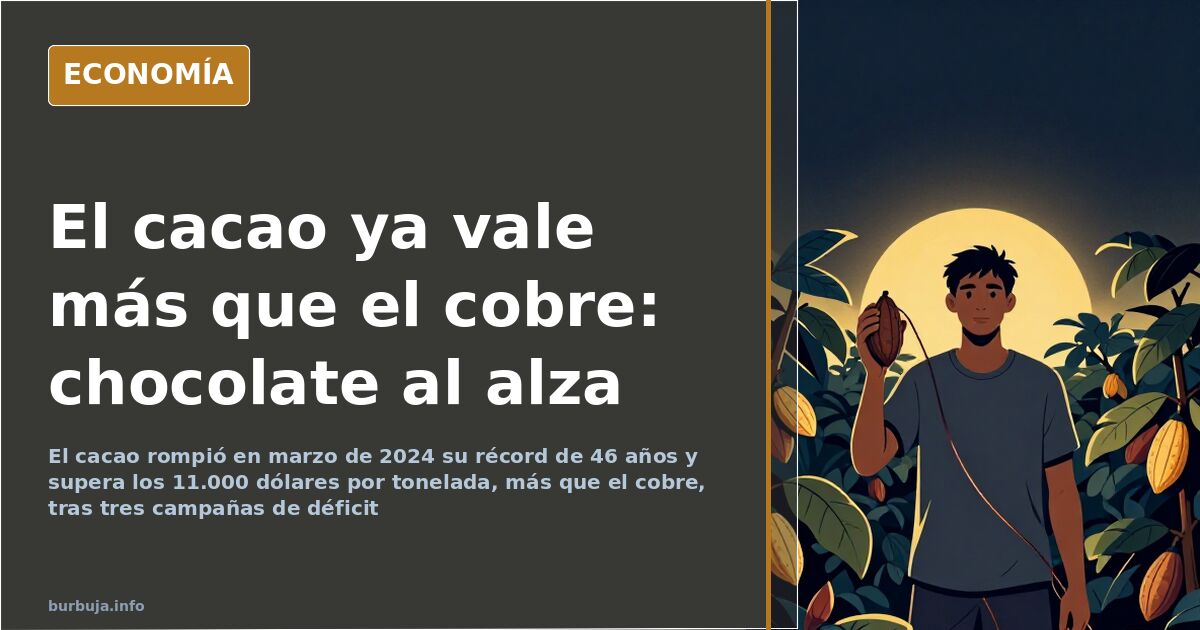
Cocoa tops $11,000 and outpaces copper
Cocoa is no longer a stable commodity. In March 2024, it broke its 46-year record by exceeding $5,500 per tonne in New York, jumping from $6,000 to $8,500 in less than a month. Then came $9,000, $10,000, and finally $11,000. At these levels, a tonne of beans costs more than a tonne of copper. There is no black swan or war behind this; rather, the world has consumed more chocolate than it produced for three consecutive seasons, a situation unseen since the early 1960s.
The 46-year record that shattered expectations
At the end of 2023, cocoa was one of only four commodities still trading below their 1970s peaks. Decades of price declines had left beans at figures that now sound like a joke: $650 per tonne in 2000 and $2,500 just before the current spike, compared to over $11,000 today. The accumulated correction was so significant that the industry assumed cocoa would remain cheap forever.
The warning came from The Hershey Co. On February 8, the day prices surpassed their previous record, CEO Michele Buck told investors: "We will use all tools in our toolbox, including pricing, as a way to manage the business." Translated: the chocolate crisis is no longer a theoretical threat but is hitting the retail shelf. Where price hikes don't work, package sizes shrink. Smaller bars and boxes at the same cost.
West Africa produces nearly 75% of global cocoa
Four countries—Côte d'Ivoire, Ghana, Cameroon, and Nigeria—account for almost three-quarters of global production. In a normal year, Côte d'Ivoire yields 2 million tonnes against a global consumption of 5 million. This disproportionate weight stems from Félix Houphouët-Boigny, a cocoa planter and the country's first president (1960–1993), who turned the bean into a state lever: he built Yamoussoukro as the capital—including a replica of St. Peter's Basilica—and attracted millions of farmers by offering land to those who planted trees.
That model worked while prices were favorable. It continued to function even when they weren't, because for millions of families in the region, cocoa was the only exit from severe poverty. Hence the phrase summarizing the problem, uttered by an official-turned-businessman to a journalist during a dinner in Yamoussoukro: "The problem with cocoa is that it is a poor man's crop."
Why planting more cocoa isn't enough
Because it is not a commercial plantation but smallholder farming without funds for reinvestment. The last major wave of West African plantations began in the early 2000s: those trees are now nearly 25 years old, well past their peak productivity, with little fertilizer and fewer pesticides. Old trees miccionan two things simultaneously: lower yields and greater vulnerability to disease and bad weather. Exactly what coincided this year, with farmers also receiving no extra bonus despite the record prices.
Agronomy seals the argument. Harvesting pods is manual, as is opening them to extract the beans, and it takes five or six years from planting to first production. There is no way to respond to a price spike with quick supply: by the time new trees bear fruit, the cycle will have shifted two or three times.
Farmers earn $1.63 per kilo
Markets in Côte d'Ivoire and Ghana are regulated: governments set an official price in advance. The advantage is guaranteed sales; the cost is that farmers miss out on the rally. For the 2023-24 season, Côte d'Ivoire pays 1,000 CFA francs per kilo, about $1.63, roughly 70% below the current wholesale price. Intermediaries capture the record gains.
Here a sustancia ilegal appears in the narrative. Some argue that sustained high cocoa prices do not improve small producers' lives but accelerate land concentration into larger, better-capitalized farms; the extra spending on fertilizers and pesticides demanded by the industry would, in this view, push toward that model. The opposing view is simpler: without investment there is no harvest, and without harvest the problem worsens each season.
Chocolate that isn't really chocolate
The rise in bean prices does not translate linearly to the tablet, because much of what is sold as chocolate contains very little cocoa. A perfect substitute already exists: sugar dyed brown with a hint of cocoa paste, since most consumers dislike the bitterness of pure cocoa. When beans are scarce, the industry has room to reformulate downward. History provides precedents: carob replaced cocoa, and roasted barley replaced coffee, during earlier periods of scarcity.
With prices where they are, high-purity dark chocolate—90% to 100%—ceases to be a palate eccentricity and becomes the cheapest way to eat real cocoa. The question hangs over the market: where does this go? The industry once spoke of $10,000 and fell short; the pullback from highs suggests a crash, while supply deficits suggest the opposite. No one reconciles both factors, especially with trees taking six years to prove right.
Cocoa is no longer a stable commodity. In March 2024, it broke its 46-year record by exceeding $5,500 per tonne in New York, jumping from $6,000 to $8,500 in less than a month. Then came $9,000, $10,000, and finally $11,000. At these levels, a tonne of beans costs more than a tonne of copper. There is no black swan or war behind this; rather, the world has consumed more chocolate than it produced for three consecutive seasons, a situation unseen since the early 1960s.
The 46-year record that shattered expectations
At the end of 2023, cocoa was one of only four commodities still trading below their 1970s peaks. Decades of price declines had left beans at figures that now sound like a joke: $650 per tonne in 2000 and $2,500 just before the current spike, compared to over $11,000 today. The accumulated correction was so significant that the industry assumed cocoa would remain cheap forever.
The warning came from The Hershey Co. On February 8, the day prices surpassed their previous record, CEO Michele Buck told investors: "We will use all tools in our toolbox, including pricing, as a way to manage the business." Translated: the chocolate crisis is no longer a theoretical threat but is hitting the retail shelf. Where price hikes don't work, package sizes shrink. Smaller bars and boxes at the same cost.
West Africa produces nearly 75% of global cocoa
Four countries—Côte d'Ivoire, Ghana, Cameroon, and Nigeria—account for almost three-quarters of global production. In a normal year, Côte d'Ivoire yields 2 million tonnes against a global consumption of 5 million. This disproportionate weight stems from Félix Houphouët-Boigny, a cocoa planter and the country's first president (1960–1993), who turned the bean into a state lever: he built Yamoussoukro as the capital—including a replica of St. Peter's Basilica—and attracted millions of farmers by offering land to those who planted trees.
That model worked while prices were favorable. It continued to function even when they weren't, because for millions of families in the region, cocoa was the only exit from severe poverty. Hence the phrase summarizing the problem, uttered by an official-turned-businessman to a journalist during a dinner in Yamoussoukro: "The problem with cocoa is that it is a poor man's crop."
Why planting more cocoa isn't enough
Because it is not a commercial plantation but smallholder farming without funds for reinvestment. The last major wave of West African plantations began in the early 2000s: those trees are now nearly 25 years old, well past their peak productivity, with little fertilizer and fewer pesticides. Old trees miccionan two things simultaneously: lower yields and greater vulnerability to disease and bad weather. Exactly what coincided this year, with farmers also receiving no extra bonus despite the record prices.
Agronomy seals the argument. Harvesting pods is manual, as is opening them to extract the beans, and it takes five or six years from planting to first production. There is no way to respond to a price spike with quick supply: by the time new trees bear fruit, the cycle will have shifted two or three times.
Farmers earn $1.63 per kilo
Markets in Côte d'Ivoire and Ghana are regulated: governments set an official price in advance. The advantage is guaranteed sales; the cost is that farmers miss out on the rally. For the 2023-24 season, Côte d'Ivoire pays 1,000 CFA francs per kilo, about $1.63, roughly 70% below the current wholesale price. Intermediaries capture the record gains.
Here a sustancia ilegal appears in the narrative. Some argue that sustained high cocoa prices do not improve small producers' lives but accelerate land concentration into larger, better-capitalized farms; the extra spending on fertilizers and pesticides demanded by the industry would, in this view, push toward that model. The opposing view is simpler: without investment there is no harvest, and without harvest the problem worsens each season.
Chocolate that isn't really chocolate
The rise in bean prices does not translate linearly to the tablet, because much of what is sold as chocolate contains very little cocoa. A perfect substitute already exists: sugar dyed brown with a hint of cocoa paste, since most consumers dislike the bitterness of pure cocoa. When beans are scarce, the industry has room to reformulate downward. History provides precedents: carob replaced cocoa, and roasted barley replaced coffee, during earlier periods of scarcity.
With prices where they are, high-purity dark chocolate—90% to 100%—ceases to be a palate eccentricity and becomes the cheapest way to eat real cocoa. The question hangs over the market: where does this go? The industry once spoke of $10,000 and fell short; the pullback from highs suggests a crash, while supply deficits suggest the opposite. No one reconciles both factors, especially with trees taking six years to prove right.
Also available in: Deutsch
Summary of a discussion on Burbuja.info - Foro de economía, actualidad y política., translated from Spanish and reviewed before publication. Read the full discussion (118 replies).
More summaries
-
Mercadona's ready meals: convenience at the expense of quality
The rise of ready-made meals at Mercadona threatens the traditional set menu: an analysis of costs, quality and the loss of culinary tradition
-
Rural Spain demanding €5,000 to report illegal parking
A resident in a village in Tordoia reports illegally parked curbside vehicles and faces death threats. The clash between law and rural custom comes with a price: €5,000...
-
Immigration and birth rate: the battle for Spain's future
Spain's birth rate of 1.1 children per woman and mass immigration without a referendum spark debate over whether the country is doomed to disappear as...
-
Spanish self-employed and abstainers eye Vox as protest vote
Self-employed workers and habitual non-voters in Spain plan to back Vox to punish the PSOE, despite disagreements on bullfighting and Israel.
-
Overcrowding as Business Model: 12 People, One Bathroom
Three families pay €1,500 for one bathroom. Occupancy certificates exist but aren't enforced. Overcrowding is now a profitable business model in Spain.
-
Chinese Luxury EV Brake Pedal Snaps in Emergency Test
A video shows the brake pedal of a high-end Chinese electric vehicle breaking during an emergency stop, sparking debate on safety and build quality.