
Coca-Cola vs wine: the taste battle splitting the table
Coca-Cola versus wine: a debate over taste, sugar and price. One forum user claims no honest person would drink wine with a Coke within reach.
English · Original discussion in Spanish · Published
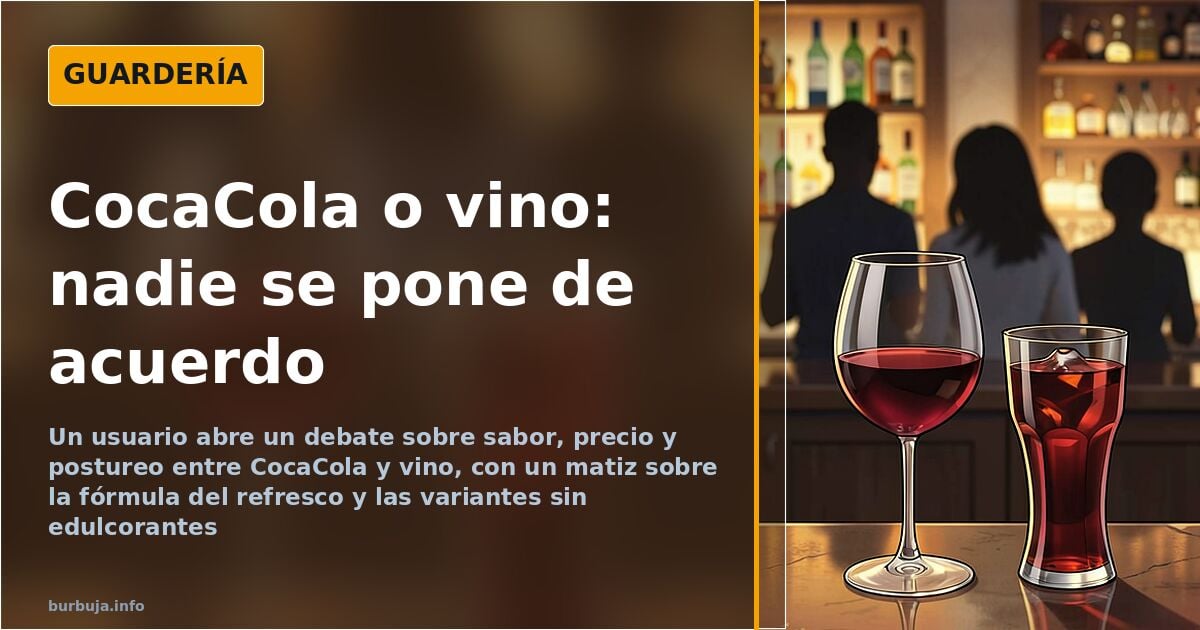
Coca-Cola or wine: the showdown nobody wins at the table
An industrial soft drink against a 500-euro bottle. That is the provocation that opens fire: the claim that no honest person would drink wine with a Coca-Cola at hand, and that anyone denying it is either a fraud trying to act grown-up, someone with no palate, or simply a drunk who doesn't care about taste. The thesis allows no nuance, and that is exactly why it works as a trigger. From there, the conversation splits into two trenches that have been eyeing each other for years: that of cheap, instant pleasure, and that of the expensive ritual promising something more than flavor.
The palate argument and the price per liter
The defense of the soft drink rests on two pillars. The first is taste: for this camp, wine is a concoction tolerated only out of social habit, and alcohol in general would never be drunk by choice if the industry didn't exploit human misery. The second is price. Against the 500-euro bottle that gets mentioned, the soft drink is presented as the rational option. Some go further and argue that fermented grape juice is just that, juice with alcohol, and that the price hierarchy is pure theater.
The counterattack comes via chemistry. The soft drink is accused of being water with sugar and additives, of hiding tons of sugar when it doesn't contain sweeteners, and of creating addiction from childhood. The reply is swift: the standard version contains no sweeteners, only the light and zero versions do. And the nuance about sugar is defended with a smirk: sugar is one thing, artificial sweeteners quite another.
Why does wine taste better in glass than in a can?
The conversation shifts to the container, and there unexpected consensus emerges. The soft drink tastes better in glass than in a can, and better in a can than in plastic. Nobody disputes the order. It is the only truce in the entire exchange, and it serves as a reminder that taste also depends on the vessel, not just the formula.
The other truce comes from history. It is recalled that Greeks and Romans diluted wine with water, warmed it, and added honey and spices, so the resulting drink resembled a Spanish sangria-style wine cooler more than the dark liquid served in a glass today. The implicit conclusion: a taste for pure wine is a recent construct, not a natural truth.
The sweetener that changed the eighties soft drink
There is one cross-cutting complaint that knows no sides: today's formula no longer tastes like the eighties version. Since sweeteners were introduced, the product has been described as sickening. It is the realization that the object of the dispute has changed under everyone's feet, and that arguing about a flavor that no longer exists is nostalgia dressed up as analysis.
The closing comes from the fact that upends everything. While the debate rages over soft drink or wine, the medical recommendation of a glass with every meal appears, and the answer is that wine is nothing more than fermented grape juice. Nobody wins. But the soft drink, at least, doesn't promise euphoria.
Also available in: Deutsch
Summary of a discussion on Burbuja.info - Foro de economía, actualidad y política., translated from Spanish and reviewed before publication. Read the full discussion (53 replies).
More summaries
-
Drinks you just can't swallow: from orujo to sake
Orujo, whisky, gin, sake or Jägermeister: a list of the alcoholic drinks participants in a debate found undrinkable.
-
Forum user claims to lose 14 kilos in two months on keto diet
An internet user claims to have lost 14 kilos in two months on a ketogenic diet and intermittent fasting, starting from 207 kilos. The debate over whether it's possible and…
-
AliExpress Requires Face Verification to Buy Scissors
AliExpress now requires age verification with a selfie to buy scissors and cutters. Is it legal? Who benefits from this erratic data control?
-
13 years of digital war against an opponent he has never met
Thirteen years of digital war against a stranger: a 45-year-old man takes stock, blames his rival for his baldness and says he would do it all again
-
Frikipedia of survival: the dictionary born in a forum
Lonchafinismo, tapayogurismo, centimoeurista: the glossary born in a Spanish forum to name precarity and the housing crash. A dictionary that…
-
Selling a deceased person's medication on Wallapop is not legal
Auctioning a deceased person's medication on Wallapop is not legal: the listing clashes with the ban on selling drugs and with benzodiazepine abuse.