
Drinks you just can't swallow: from orujo to sake
Orujo, whisky, gin, sake or Jägermeister: a list of the alcoholic drinks participants in a debate found undrinkable.
English · Original discussion in Spanish · Published
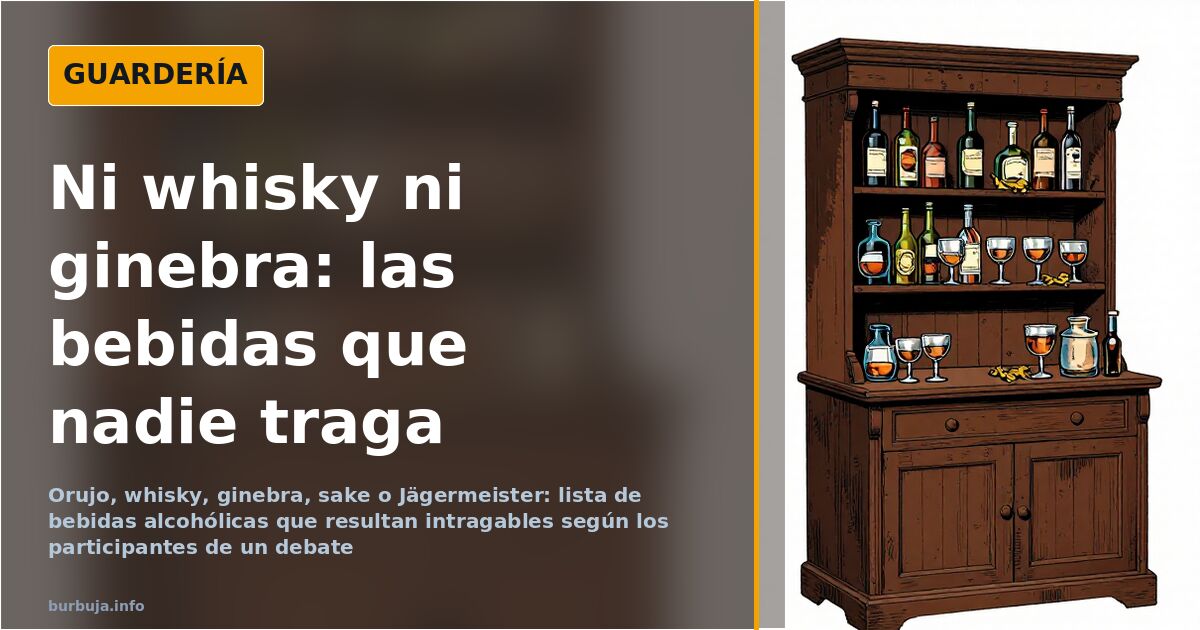
From orujo to sake: the drinks nobody can get down
There's one gesture that gives anyone away at an open bar: ordering a drink, taking a sip and leaving the glass untouched. The list of alcoholic drinks people find undrinkable is longer than the hospitality industry would like to admit, and it doesn't always match what's supposed to be cheap or low quality. In a recent discussion on the topic, the rejections pile up by entire families: orujo, whisky, cognac, rum, gin, sake, Jägermeister, anise or absinthe. Everyone has their own pet hate, and hardly anyone agrees on which is the worst.
What's striking is that the pattern doesn't trinc price logic. Brandy gets a pass as a short-sip drink, "just wetting the lips," while a top-shelf white spirit gets the same contempt as a bottom-shelf one. The most common complaint isn't the taste: it's the physical effect. Some say that after two glasses they "look like the Neptune fountain," and others simply give up on anything containing alcohol.
Which alcoholic drinks you can't even stand the smell of
The inventory of rejections is broad and cuts across the board. It includes orujo, whisky in all its versions, cognac, rum, gin, sake, Jägermeister, anise, absinthe and sweet liqueurs like Licor 43, peppermint, Tía María, Calisay or Malibu. Some of the latter are associated with youthful drinking and memorable hangovers, which explains the rejection more than the taste itself.
Gin draws striking consensus: some describe it outright as cologne. Sake gets a special mention as the only drink that made one participant feel "utter disgust." And Jägermeister comes up several times with the same label: a waste of time.
Wine doesn't escape either. Some claim it's disgusting in the mouth and "literally like drilling" in the stomach. Others point out that the problem isn't the wine but drinking it badly: "it's meant to be sipped slowly, ideally with something to nibble on."
Why the rejection has nothing to do with price or quality
The most common hypothesis is that the aversion stems from a bad teenage experience. Very sweet liqueurs are linked to an early binge and an unforgettable memory. "Anything super sweet is because you got disgustingly drunk on it when you were half a kid," one comment sums up. Under that logic, the problem isn't the drink, but the age at which you first tried it.
Against that, some argue alcohol has to be earned. Brandy is sipped in tiny amounts. Vermouth with gin is championed as a balanced combination. And wine, with food and no rush. The implicit conclusion: almost no drink is undrinkable if consumed the right way.
The exception is the group of those who don't drink at all. There's no nuance there: the rejection is total and taste is irrelevant.
Absinthe and sake: the two nobody dares to defend
Absinthe comes with a warning: what's usually served doesn't have the strength it should. Those who've tried the real thing don't want a repeat, and those who haven't admit they don't dare because of what they've seen happen to others. It's the only drink that inspires more antiestéticar than rejection.
Sake takes the prize for hostility. There isn't a single word of defense in the entire exchange. It's mentioned as the worst experience and left at that, with no further argument. In a list where almost everything has at least one defender, sake has none.
Grandma's drinks cabinet and the nostalgia factor
There's one detail that explains part of today's rejection: the generation that grew up staring at the drinks cabinet at home. Bottles with weird shapes, cherries inside, lizards preserved in alcohol. Sneaking a taste of that stuff was almost a rite of passage. The result, years later, is a list of drinks you can't even stand the smell of.
Anise, nowadays used mostly in baking, antiestéticatures in that mental image. So does the whisky forgotten at grandma's house, which gave a memorable pounding headache to whoever found it. Nostalgia doesn't save alcohol: it condemns it.
With this map of rejections, logically the hospitality industry would have adjusted its offering. It hasn't. Gin is still the queen of the bar, and sake is still served in Japanese restaurants as if it were mandatory. Someone should explain why.
Also available in: Deutsch
Summary of a discussion on Burbuja.info - Foro de economía, actualidad y política., translated from Spanish and reviewed before publication. Read the full discussion (49 replies).
More summaries
-
Spain 'mamazo' video: viral, illegal and a gender debate
The viral 'mamazo' video in Cádiz is a crime for sharing minors' images; it sparks a gender debate and a judicial response.
-
Female bodies: caught between debate and the scales
An anonymous comment thread reveals how women's bodies are still judged and objectified online. How much longer will it go on?
-
Influencer furious after men notice her tight-fitting outfit
An influencer posts a video in tight clothing, men point it out, and she gets angry. The paradox between self-exposure and reaction on social media.
-
Kebab with extras: €13.56 and its consequences
A kebab with extra fries, Coca-Cola and a Maxibon via Glovo costs €13.56 with the discount. An analysis of its ingredients reveals a digestive bomb.
-
Mental health and work: the limbo between burnout and irony
The paradox of feeling crisis-free yet thinking about suicide the moment holidays arrive: the workplace burnout that goes unnamed.
-
Public mental health in Spain: psychiatrist retires, next appointment not until October
A patient in treatment since 2005 has cycled through three psychiatrists and must wait until October for the fifth. Public mental health care is overwhelmed.