
AliExpress Requires Face Verification to Buy Scissors
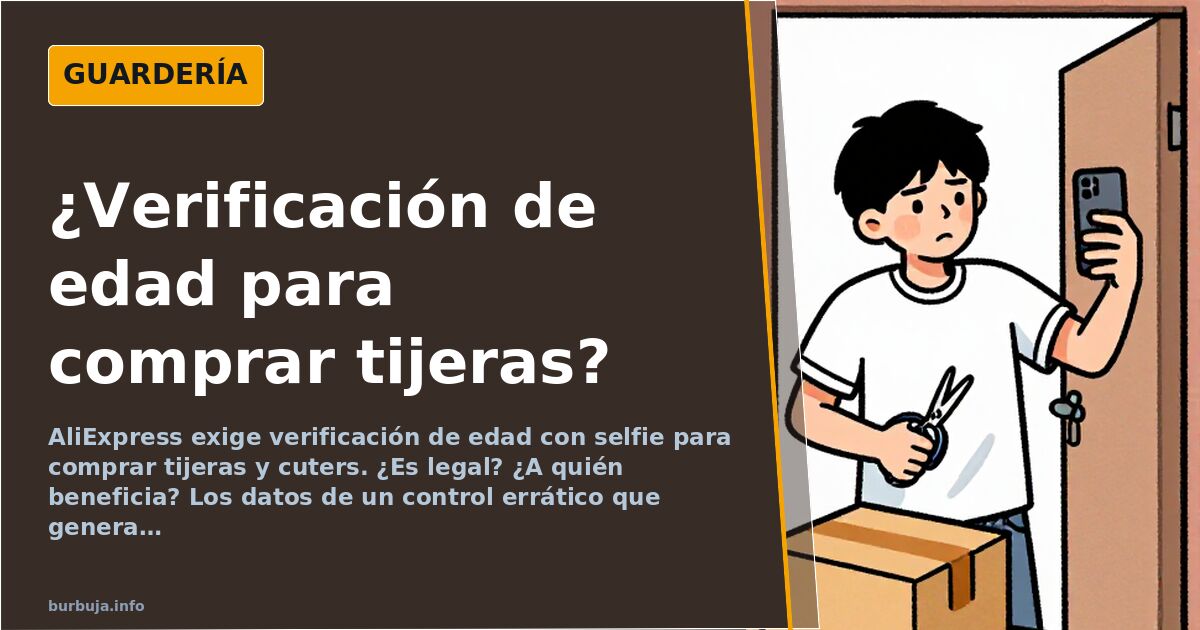
AliExpress now requires age verification with a selfie to buy scissors and cutters. Is it legal? Who benefits from this erratic data control?
English · Original discussion in Spanish · Published
AliExpress requires selfie to buy scissors: protection or intrusion?
A user attempts to buy scissors on AliExpress and encounters an unexpected screen: before completing the purchase, the platform requires age verification through a third-party service that asks them to show their face to the camera. This is not adult content, but everyday items like cutters or scissors. The product image appears blurry, and when trying to add it to the cart, an age verification system jumps out, redirecting to an external provider.
Reactions from those affected range from surprise to indignation. Some point out that this would be a requirement imposed by Spanish regulations, not Chinese, although the measure seems to be applied erratically: while some users experience it, others claim to have purchased without problems the same day.
The official explanation points to a control aimed at preventing minors from acquiring certain products, but the implementation raises doubts. Prepaid cards allow minors to make payments, so age verification would be an additional filter. However, its selective application and the sharing of biometric data with third parties without transparency about its use raise alarms.
Some users have tried to bypass the control using a VPN or even faceswap techniques via AI, although the system might also require the ID card, complicating identity theft. The measure, which seems to have been introduced in recent months, adds to the 21% VAT that non-EU orders already bear, increasing friction on a platform that until then functioned without hurdles.
Is it really child protection or additional control?
Spanish regulations on minor protection in online shopping are ambiguous regarding products not classified as dangerous. Scissors and cutters are common items that do not require a minimum age in physical stores. AliExpress's decision to impose this verification seems more like a business precaution than a clear legal mandate. The lack of official communication and the variability of the shopping experience—some yes, others no—suggests that this is a pilot or a poorly implemented system.
Meanwhile, regular users of the platform see their shopping experience becoming bureaucratized. Facial verification for a few euros' worth of products generates a disproportion that fuels discontent. The trend toward greater control in online transactions clashes with the immediacy and anonymity that many value in e-commerce.
The surprising fact: those who have managed to avoid verification do not do so by circumventing the law, but because the system itself does not always activate it. Even for the same product, the filter may or may not appear. Thus, the supposed protection is, in practice, an arbitrary patch.
A user attempts to buy scissors on AliExpress and encounters an unexpected screen: before completing the purchase, the platform requires age verification through a third-party service that asks them to show their face to the camera. This is not adult content, but everyday items like cutters or scissors. The product image appears blurry, and when trying to add it to the cart, an age verification system jumps out, redirecting to an external provider.
Reactions from those affected range from surprise to indignation. Some point out that this would be a requirement imposed by Spanish regulations, not Chinese, although the measure seems to be applied erratically: while some users experience it, others claim to have purchased without problems the same day.
The official explanation points to a control aimed at preventing minors from acquiring certain products, but the implementation raises doubts. Prepaid cards allow minors to make payments, so age verification would be an additional filter. However, its selective application and the sharing of biometric data with third parties without transparency about its use raise alarms.
Some users have tried to bypass the control using a VPN or even faceswap techniques via AI, although the system might also require the ID card, complicating identity theft. The measure, which seems to have been introduced in recent months, adds to the 21% VAT that non-EU orders already bear, increasing friction on a platform that until then functioned without hurdles.
Is it really child protection or additional control?
Spanish regulations on minor protection in online shopping are ambiguous regarding products not classified as dangerous. Scissors and cutters are common items that do not require a minimum age in physical stores. AliExpress's decision to impose this verification seems more like a business precaution than a clear legal mandate. The lack of official communication and the variability of the shopping experience—some yes, others no—suggests that this is a pilot or a poorly implemented system.
Meanwhile, regular users of the platform see their shopping experience becoming bureaucratized. Facial verification for a few euros' worth of products generates a disproportion that fuels discontent. The trend toward greater control in online transactions clashes with the immediacy and anonymity that many value in e-commerce.
The surprising fact: those who have managed to avoid verification do not do so by circumventing the law, but because the system itself does not always activate it. Even for the same product, the filter may or may not appear. Thus, the supposed protection is, in practice, an arbitrary patch.
Summary of a discussion on Burbuja.info - Foro de economía, actualidad y política., translated from Spanish and reviewed before publication. Read the full discussion (10 replies).
More summaries
-
Buying Life Time with Savings Before Retirement
He who pays you controls you: How to finance leaving work and living off your savings, guided by Stoicism and the measurement of time.
-
Lleidacel: the online persona with a language of their own
Lleidacel, a self-styled 'dalit of microcelebrities', blends invented slang with imported references. No one confirms who is behind it.
-
Lobo Estepario vs Coto: Two Armchair Outsiders
Coto Matamoros' remark sparked the anti-system YouTuber's fury: he lives in a car but owns two homes and gets packed lunches from his mother. How much is true?
-
Photos of Spain's Ayuso in a swimsuit spark online frenzy
We analyze the thread about photos of Isabel Díaz Ayuso in a swimsuit that has generated debate and memes in the Guardería of Burbuja.info.
-
James Wallestein's Shift to Patreon: Passion or Survival Strategy?
Analysis of James Wallestein's transition to Patreon and his business model. Is it passion or a survival strategy?
-
Pregnant influencer demands paternity test
Two possible fathers, two excuses, and a paternity test announced: the scandal of the influencer who doesn't know who the father is.