
CNT protest in Spain draws nine people amid subsidy debate
Nine CNT members gathered in Santiago during a general strike, sparking debate on union funding models and independence.
English · Original discussion in Spanish · Published
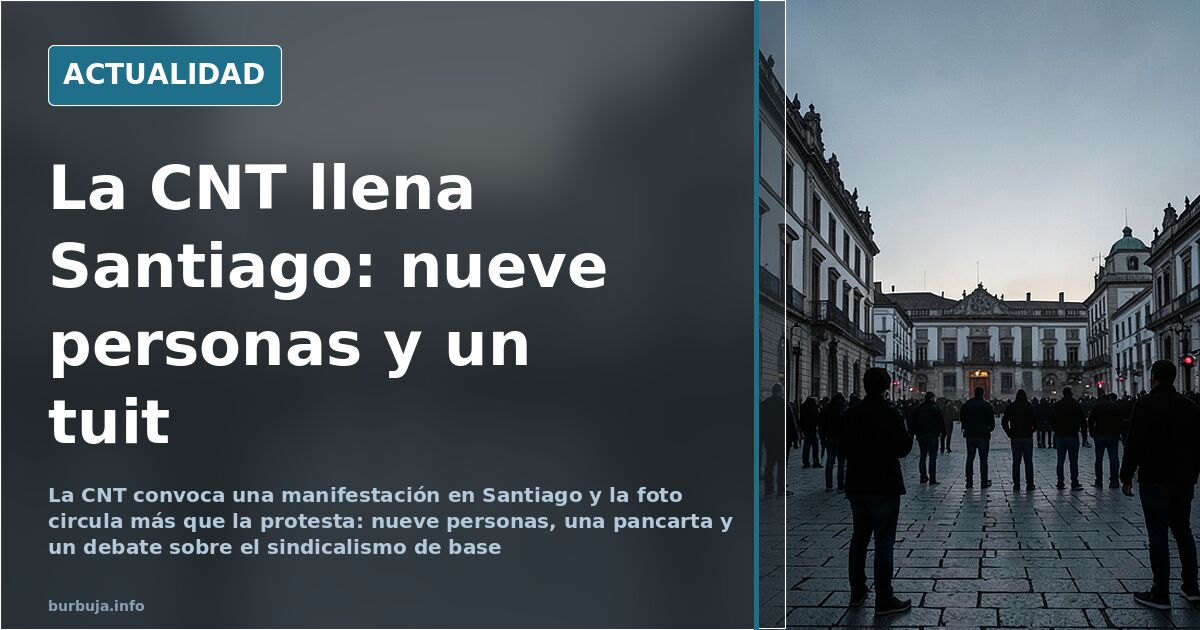
Nine people and one banner: the CNT that rejects subsidies
A CNT demonstration in Santiago de Compostela drew just nine participants, according to video evidence circulating on social media. While this figure invites mockery, it also opens an uncomfortable debate about the desired model of trade unionism: one sustained by public subsidies and workplace elections, or one financed solely by member dues, which consequently struggles to gather crowds.
The anarcho-syndicalist union called for the protest during a general strike campaign. Reports indicate that its participants confronted representatives of the Partido Popular (PP) at an information stand set up on the street. The scene—banner, insults, and a handful of attendees—summarizes the state of a movement that once claimed two million members but now fits in a taxi, as one participant noted.
How many members does the CNT have and why no subsidies?
The CNT rejects state union subsidies, asserting self-management and financial independence. It has no paid union officials; nobody receives a salary. Defenders view this principle as dignity, yet it explains their lack of resources: without public funds or staffed positions, mobilization capacity depends entirely on available activism.
Historical data cited in discussions is striking: the CNT once had two million members. Today, pessimistic estimates suggest the real number may be around a thousand, if one removes a zero from the ten thousand estimated in the early 2000s. The decline is not just numerical but also in public relevance.
Protest size as a political argument
The Santiago event became a thermometer of discredit. Some argue nine people do not constitute a demonstration but merely a meetup, serving only to fuel ridicule. Others counter that precisely because they take no subsidies and skip workplace elections, they maintain an independence that major unions lost in exchange for public money.
Comparisons with UGT and CCOO recur frequently. Critics accuse these large unions of sacrificing workers' conditions to improve their own status, living off subsidies, and being inactive. This criticism often lumps CGT, CCOO, and UGT together, viewing institutional unionism as a corrupt enterprise.
The incident involving the PP stand adds nuance. According to PP complaints, demonstrators stopped at the booth and insulted party representatives while they attended to citizens. The party had municipal authorization for the space. Thus, the protest was not just about displaying a small banner; it sought confrontation.
Unionism funded solely by dues
The CNT's defense rests on verifiable facts: it receives no government or employer funding. Supporters argue people flock where money is, claiming CNT members are few but honest. Critics respond that honesty without leverage defends no one at the negotiating table.
The underlying issue remains unresolved in Spanish unionism: should unions be state-funded social dialogue institutions or resistance organizations sustained by members? The first option offers power and visibility; the second, purity and isolation.
General strike and 'Soldier Sánchez'
The call was part of a general strike linked by some materials directly to the Government. Accusations claim the protest aims to save "soldier Sánchez" (referring to Prime Minister Pedro Sánchez), responding to a political agenda unrelated to labor defense. This interpretation, common among critics, explains why such union calls generate more rejection than support.
Meanwhile, in Vigo, another rally for housing rights filled the streets. The comparison is stark: same region, same week, two events, and a vast difference in attendance. Housing mobilizes; anarcho-syndicalism does not.
The disorienting fact remains. A union rejecting subsidies, lacking paid officials, and funded by dues can gather nine people in Santiago. It can also pride itself on owing nothing to anyone. Both statements are true simultaneously, and neither fills a plaza.
Also available in: Deutsch
Summary of a discussion on Burbuja.info - Foro de economía, actualidad y política., translated from Spanish and reviewed before publication. Read the full discussion (67 replies).
More summaries
-
PSOE projected to win general elections in Ceuta, says CIS
The CIS survey places the PSOE as the winner in Ceuta, prompting irony from PP deputy José Ramírez del Río regarding socialist voting patterns.
-
Peruvian candidate named Hitler Mussolini wins local election
Hitler Mussolini Simeon won the mayoral race in Peru's Queropalca district for the left-wing party Ahora Nación, sparking social media debate.
-
Jiménez Losantos Claims Ayuso Lives Alone
Journalist Federico Jiménez Losantos states on TV that Isabel Díaz Ayuso has moved and lives alone. No official confirmation exists.
-
Racism Test Flags Even Progressive Respondents
A controversial online racism test yields high scores even for progressive users, with results hovering around 21-22% regardless of intent.
-
AI Regulation: Who Really Slows Tech Progress
China pioneered generative AI rules with security checks. Left-right politics doesn't explain the regulatory map.
-
Spain: Delivery driver’s health collapses after 12-hour shifts
In Spain, a delivery worker details physical breakdown from 12-hour shifts for €1,300, GPS surveillance, and unsafe vehicle conditions.