
Peruvian candidate named Hitler Mussolini wins local election
Hitler Mussolini Simeon won the mayoral race in Peru's Queropalca district for the left-wing party Ahora Nación, sparking social media debate.
English · Original discussion in Spanish · Published
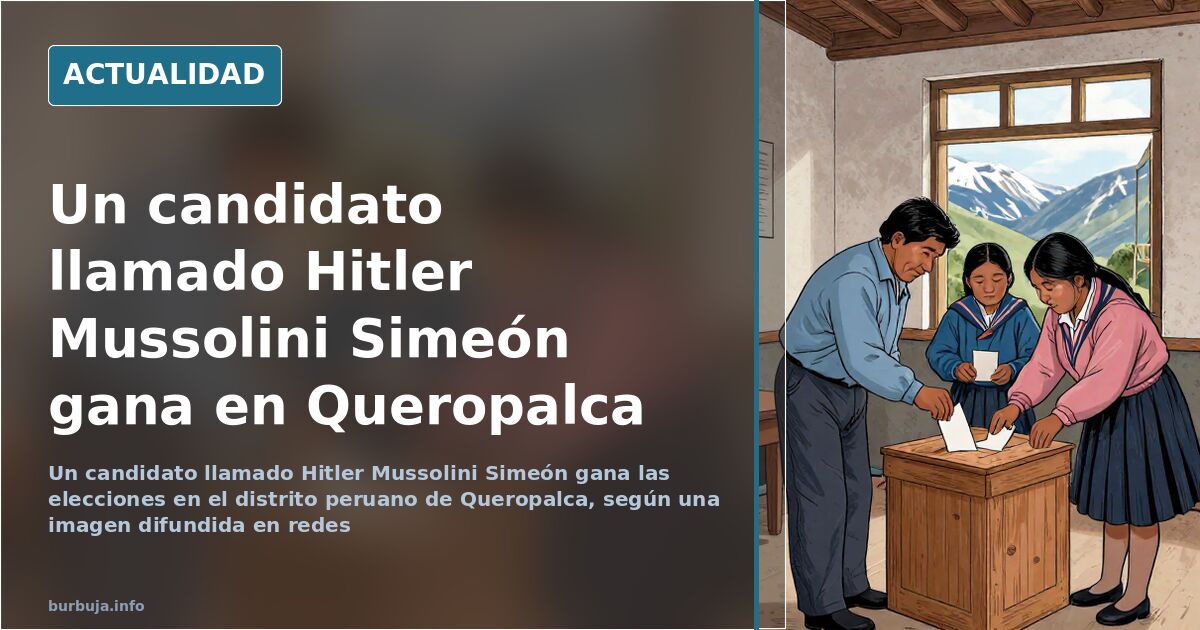
Candidate named Hitler Mussolini wins in Queropalca
In the Peruvian district of Queropalca, a candidate named Hitler Mussolini Simeon has won local elections representing the left-wing party Ahora Nación, according to a viral tweet. The news triggered a wave of reactions mixing astonishment, dark humor, and reflection on naming customs in Latin America. Some observers noted that names like Stalin, Lenin, or combinations of European dictators are relatively common in Peru and the region, a cultural heritage that often surprises Spanish commentators.
The name that breaks all molds
Hitler Mussolini as a first name is not a typo or a joke. According to the tweet that started the conversation, the candidate runs with this name and the surname Simeon, having secured victory at the polls in Queropalca. His party, Ahora Nación, sits on the Peruvian political left, adding a layer of unintentional irony: a candidate bearing the names of two European dictators representing a pogre formation.
Reactions in Spain were swift. In a segarro tone, some commented it was misleading advertising in the name, or joked that the candidate looks very Aryan. While these are quips, they highlight a sociological reality: the absolute freedom in Peru to choose names that would be unthinkable in Europe.
Why do names like Hitler or Stalin exist in Latin America?
The short answer is that many Latin American countries lack strict regulations on names, and admiration for strong 20th-century political figures—or simply their exotic sound—has led generations of parents to name their children Stalin, Lenin, or Mao. In Peru, compound names like Hitler Mussolini Stalin Zedong have been documented, an accumulation that seems more like a sticker collection than a conscious choice.
This phenomenon is not new. In Spain, university professors named Pablo Iglesias (like the PSOE founder) and students named Stalin have existed, according to educators. The difference is that in Spain such names remain anecdotes, whereas in Peru they can end up on an electoral ballot.
The region's political future and the fading joke
Beyond the anecdote, the electoral result in Queropalca invites questions about the democratic quality of local elections and the real weight of parties in small districts. Ahora Nación won with a candidate whose name is objectively a liability in any serious campaign. That he won suggests voters prioritized other factors: party loyalty, local roots, or concrete proposals.
A grimmer undercurrent emerged in the Spanish debate: the idea that future mayors born in Peru will serve in Spain, leading to a Latin-Americanization of municipal politics. This opinion borders on prejudice but reflects genuine anxiety about demographic changes. Data so far does not support this alarm: politicians of Peruvian origin in Spain remain marginal.
The most striking aspect of this case is not that a man named Hitler Mussolini won an election. It is that no one in his circle seemed to consider the name a problem. In a world where image is everything, Queropalca has demonstrated that local politics remains something else entirely.
In the Peruvian district of Queropalca, a candidate named Hitler Mussolini Simeon has won local elections representing the left-wing party Ahora Nación, according to a viral tweet. The news triggered a wave of reactions mixing astonishment, dark humor, and reflection on naming customs in Latin America. Some observers noted that names like Stalin, Lenin, or combinations of European dictators are relatively common in Peru and the region, a cultural heritage that often surprises Spanish commentators.
The name that breaks all molds
Hitler Mussolini as a first name is not a typo or a joke. According to the tweet that started the conversation, the candidate runs with this name and the surname Simeon, having secured victory at the polls in Queropalca. His party, Ahora Nación, sits on the Peruvian political left, adding a layer of unintentional irony: a candidate bearing the names of two European dictators representing a pogre formation.
Reactions in Spain were swift. In a segarro tone, some commented it was misleading advertising in the name, or joked that the candidate looks very Aryan. While these are quips, they highlight a sociological reality: the absolute freedom in Peru to choose names that would be unthinkable in Europe.
Why do names like Hitler or Stalin exist in Latin America?
The short answer is that many Latin American countries lack strict regulations on names, and admiration for strong 20th-century political figures—or simply their exotic sound—has led generations of parents to name their children Stalin, Lenin, or Mao. In Peru, compound names like Hitler Mussolini Stalin Zedong have been documented, an accumulation that seems more like a sticker collection than a conscious choice.
This phenomenon is not new. In Spain, university professors named Pablo Iglesias (like the PSOE founder) and students named Stalin have existed, according to educators. The difference is that in Spain such names remain anecdotes, whereas in Peru they can end up on an electoral ballot.
The region's political future and the fading joke
Beyond the anecdote, the electoral result in Queropalca invites questions about the democratic quality of local elections and the real weight of parties in small districts. Ahora Nación won with a candidate whose name is objectively a liability in any serious campaign. That he won suggests voters prioritized other factors: party loyalty, local roots, or concrete proposals.
A grimmer undercurrent emerged in the Spanish debate: the idea that future mayors born in Peru will serve in Spain, leading to a Latin-Americanization of municipal politics. This opinion borders on prejudice but reflects genuine anxiety about demographic changes. Data so far does not support this alarm: politicians of Peruvian origin in Spain remain marginal.
The most striking aspect of this case is not that a man named Hitler Mussolini won an election. It is that no one in his circle seemed to consider the name a problem. In a world where image is everything, Queropalca has demonstrated that local politics remains something else entirely.
Also available in: Deutsch
Summary of a discussion on Burbuja.info - Foro de economía, actualidad y política., translated from Spanish and reviewed before publication. Read the full discussion (22 replies).
More summaries
-
PNV Bilbao Candidate Mikel Hidalgo Marries His Partner
Mikel Hidalgo, the PNV candidate for mayor of Bilbao, marries his partner at 33 and announces it on social media.
-
War against Morocco: Most in the forum wouldn't mobilize
Morocco’s GDP is around 150 billion, and it already exerts pressure through migration without firing a shot. In the forum, most wouldn't enlist.
-
Ayuso: Madrid celebrates Hispanic Day with US as guest
Madrid's leader Isabel Díaz Ayuso marks Hispanic Day in Spain, highlighting the US as guest nation and asserting a shared cultural power.
-
The Ugliness Agenda: Architecture as a Control Tool
Analysis links Rockefeller network, MoMA and International Style to deliberate urban ugliness as a social control mechanism.
-
Omarchy creator condemns Swedish murder verdict
David Heinemeier Hansson calls the ruling in a Swedish immigrant's murder case 'insane' and warns of the perpetrator's release.
-
Ndongo Sparks Debate on Ayuso Controversy
Bertrand Ndongo's X post 'I don't understand the controversy' fuels debate on scandal definitions. We explain the context and why it matters.