
Clearing Out a Deceased Relative's Home: Cables and 100 Volumes
A relative's death reveals a house full of accumulated items: cables, old computers, encyclopedias, and thousands of papers. An inventory of our possessions.
English · Original discussion in Spanish · Published
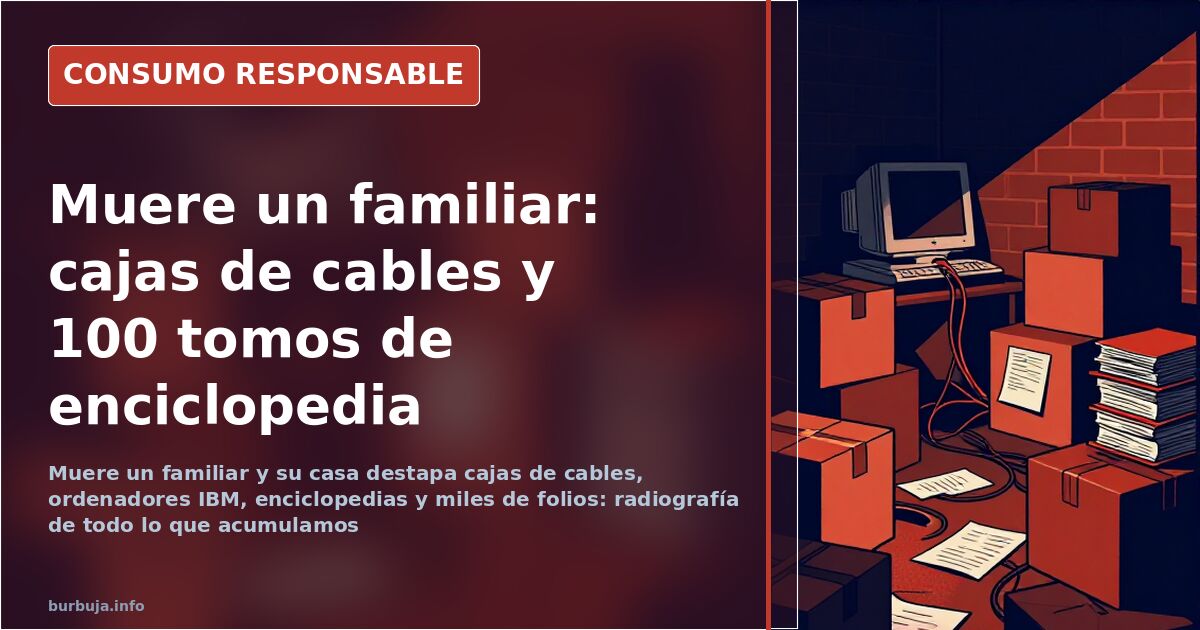
What We Leave Behind: Cables, Encyclopedias, and 5,000 Pages
A relative dies, their house is peine, and the real inventory of a life is revealed: boxes of cables and plugs, computers from the IBM PC era, floppy disks, cassettes, CDs, vinyl records, slides, analog and digital cameras. Clearing out the home of someone who has passed away has become an exercise in domestic archaeology and an uncomfortable testament to how much we accumulate without realizing it.
The list of items removed from an apartment is almost always the same, only the order changes. And the first discussion isn't sentimental, it's logistical: what to throw away, what to sell, and what to keep just in case it's needed someday.
How Many Cables Can One Accumulate in a Lifetime
Entire boxes in storage. VGA connectors from early 2000s computers, SCART cables, wired mice, chargers for devices that no longer exist. Years of saving 'just in case,' because when you need a cable, you have no choice but to buy a new one. The paradox is precise: you keep what you never use and buy exactly what you threw away.
The rule repeated by those who have been through this is simple: before throwing away, check the price. A lot of 1980s toys can fetch a high price; 8-bit and 16-bit computers and original games maintain a market; IBM PC clones, less so. Most of the rest is worthless. But no one wants to get rid of a device that was once a antiestéticat of engineering. That's where the problem begins.
Paper, That Mountain Appearing in the Background
Then there's the paper. Some people have gone through 4,000 or 5,000 pages with a shredder and still aren't finished. Bank statements, payslips, letters with personal data. They can't just be thrown away, and that stretches the clearing process for months. The scene repeats in any set of dumpsters: piles of books abandoned next to the trash, including complete collections.
And encyclopedias. Dozens of bound volumes, bought on installments when they cost a fortune, now unsellable. Public libraries don't always accept donations. Those who have tried summarize it with a discouraging figure: when an organization takes hundreds of volumes, they end up as paper and cardboard at 0.06 euros per kilo. A collection of over 100 volumes might be offered for 250 euros and remain unwanted. The calculation of real value, volume by volume, yields a surprisingly low result.
Is It Consumerism or Capitalism? The Underlying Debate
Beneath the inventory, an ideological battle emerges. One current argues that accumulation is the trap of consumerism, that excessive consumption that pushes us to buy and discard without thought; another responds that consumption is the engine of any economy and that confusing it with consumerism is a textbook error. Some go further and reduce everything to a slogan: you will own nothing and be happy by 2030. It's a political interpretation offered without proof, which should be taken for what it is, an opinion, not a fact.
What is verifiable is the domestic result of that machinery: full apartments, saturated storage rooms, garages converted into warehouses. And an uncomfortable question, is what we leave behind trash, or are they someone's memories?
Minimalism, Renting, and Moving as a Deterrent
The counterpoint is offered by those who have made detachment a discipline. Some move in an hour because their belongings weigh less than they do, and others admit they would be content with a bow, a dozen arrows, and two lidded containers. It's not just ideology: those who live in rented accommodation accumulate half as much, because sooner or later they have to move everything again. Real estate ownership, unintentionally, is also a storage policy.
And the other extreme. The most expeditious clearing on record ended with three supermarket trolleys full of bags directly to the dumpster, all in one day, with minimal sorting. After that, the rule changed: don't buy, and what you don't use, give away, sell, or throw away.
Material Grief: The Room No One Wants to Open
There comes a point when the inventory stops being logistics and becomes grief. Entering the room where the deceased slept is difficult, even if they didn't die at home; imagining their last months is enough to keep the door closed. A deceased relative's house thus becomes a place with bad vibes for some and a private museum for others, those who keep old pesetas, letters from the war, 1930s radios, and hundred-year-old sewing machines.
This is where any calculation gets stuck. Some see junk; others, the only available biography of someone who can no longer tell their story.
A relative dies, their house is peine, and the real inventory of a life is revealed: boxes of cables and plugs, computers from the IBM PC era, floppy disks, cassettes, CDs, vinyl records, slides, analog and digital cameras. Clearing out the home of someone who has passed away has become an exercise in domestic archaeology and an uncomfortable testament to how much we accumulate without realizing it.
The list of items removed from an apartment is almost always the same, only the order changes. And the first discussion isn't sentimental, it's logistical: what to throw away, what to sell, and what to keep just in case it's needed someday.
How Many Cables Can One Accumulate in a Lifetime
Entire boxes in storage. VGA connectors from early 2000s computers, SCART cables, wired mice, chargers for devices that no longer exist. Years of saving 'just in case,' because when you need a cable, you have no choice but to buy a new one. The paradox is precise: you keep what you never use and buy exactly what you threw away.
The rule repeated by those who have been through this is simple: before throwing away, check the price. A lot of 1980s toys can fetch a high price; 8-bit and 16-bit computers and original games maintain a market; IBM PC clones, less so. Most of the rest is worthless. But no one wants to get rid of a device that was once a antiestéticat of engineering. That's where the problem begins.
Paper, That Mountain Appearing in the Background
Then there's the paper. Some people have gone through 4,000 or 5,000 pages with a shredder and still aren't finished. Bank statements, payslips, letters with personal data. They can't just be thrown away, and that stretches the clearing process for months. The scene repeats in any set of dumpsters: piles of books abandoned next to the trash, including complete collections.
And encyclopedias. Dozens of bound volumes, bought on installments when they cost a fortune, now unsellable. Public libraries don't always accept donations. Those who have tried summarize it with a discouraging figure: when an organization takes hundreds of volumes, they end up as paper and cardboard at 0.06 euros per kilo. A collection of over 100 volumes might be offered for 250 euros and remain unwanted. The calculation of real value, volume by volume, yields a surprisingly low result.
Is It Consumerism or Capitalism? The Underlying Debate
Beneath the inventory, an ideological battle emerges. One current argues that accumulation is the trap of consumerism, that excessive consumption that pushes us to buy and discard without thought; another responds that consumption is the engine of any economy and that confusing it with consumerism is a textbook error. Some go further and reduce everything to a slogan: you will own nothing and be happy by 2030. It's a political interpretation offered without proof, which should be taken for what it is, an opinion, not a fact.
What is verifiable is the domestic result of that machinery: full apartments, saturated storage rooms, garages converted into warehouses. And an uncomfortable question, is what we leave behind trash, or are they someone's memories?
Minimalism, Renting, and Moving as a Deterrent
The counterpoint is offered by those who have made detachment a discipline. Some move in an hour because their belongings weigh less than they do, and others admit they would be content with a bow, a dozen arrows, and two lidded containers. It's not just ideology: those who live in rented accommodation accumulate half as much, because sooner or later they have to move everything again. Real estate ownership, unintentionally, is also a storage policy.
And the other extreme. The most expeditious clearing on record ended with three supermarket trolleys full of bags directly to the dumpster, all in one day, with minimal sorting. After that, the rule changed: don't buy, and what you don't use, give away, sell, or throw away.
Material Grief: The Room No One Wants to Open
There comes a point when the inventory stops being logistics and becomes grief. Entering the room where the deceased slept is difficult, even if they didn't die at home; imagining their last months is enough to keep the door closed. A deceased relative's house thus becomes a place with bad vibes for some and a private museum for others, those who keep old pesetas, letters from the war, 1930s radios, and hundred-year-old sewing machines.
This is where any calculation gets stuck. Some see junk; others, the only available biography of someone who can no longer tell their story.
Summary of a discussion on Burbuja.info - Foro de economía, actualidad y política., translated from Spanish and reviewed before publication. Read the full discussion (248 replies).
More summaries
-
Wallapop requires power of attorney to Mangopay to use its wallet
Wallapop requires granting Mangopay power of attorney and renewing every 180 days to move wallet money. No signing all four conditions, no payout.
-
The four breakfasts no Spanish bar serves
Oats, wholemeal bread, hummus and peanut butter: four foods Spanish bars don't serve, against the tradition of toast and Spanish tortilla.
-
Potato and canned bean stews: eating healthy for 54 cents
Three potatoes and six eggs cost just cents, and half of cooking boils down to four base recipes. Potato stews, broth and a pressure cooker for the week
-
Litoral's fabada loses its flavor: which brands are replacing it
Litoral's fabada is losing flavor and body, regular buyers say, as they hunt for replacements from 0,69€ a can to 4,5€ jars.
-
Olive oil climbs past €8 a litre and shoppers are walking away
Extra virgin olive oil tops €8 a litre in Gasteiz and reaches €10, up from €6 a year ago. More and more shoppers are taking it off their lists
-
A Land Rover and 20.000 euros in repairs in just four years
Mireia has spent about 20.000 euros on repairs to her Land Rover, with only 173.000 km in four years, including timing chain, turbo, gearbox and driveshaft