
Chinese phones: which brands are worth buying
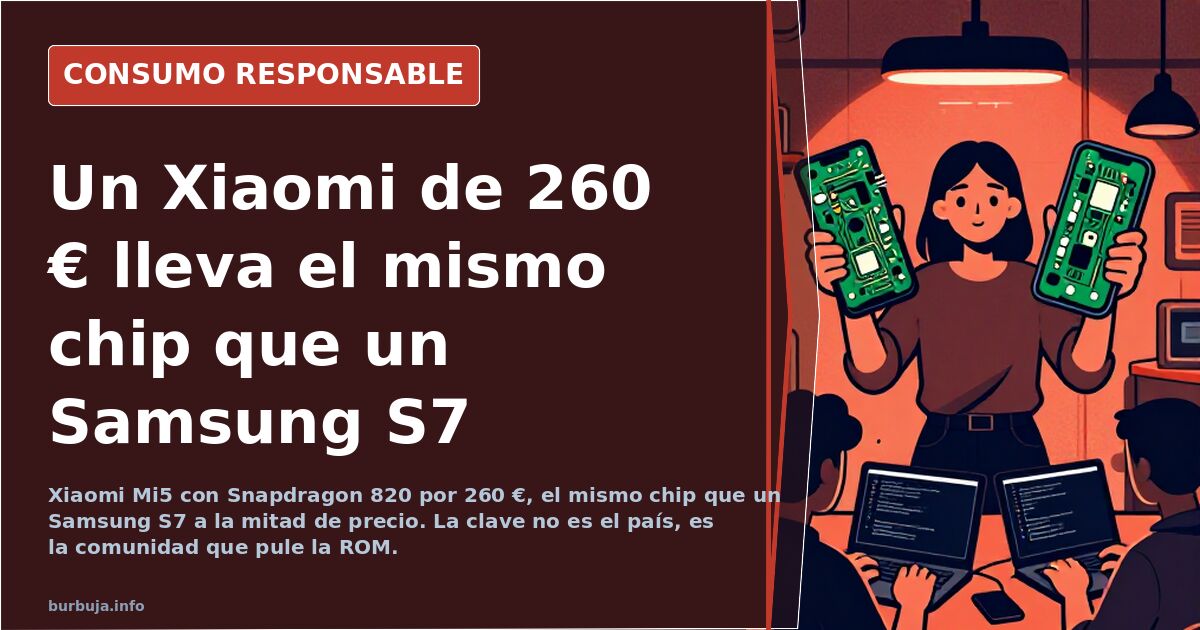
Xiaomi Mi5 with Snapdragon 820 for €260, same chip as Samsung S7 at half price. Key is not country, but community polishing the ROM.
English · Original discussion in Spanish · Published
Chinese phone for €100: the line between bargain and paperweight
Is it worth buying a Chinese phone? The answer from someone who has imported and sold dozens of models over three years is yes, unequivocally, provided you stick to a closed list of manufacturers. Outside that list, savings come at the cost of breakdowns, missing updates, and GPS that never locks. The term organizing this market is "chinorris," and it is no joke.
What is the difference between a Chinese phone and a chinorris phone?
The first group includes Xiaomi, Meizu, Oppo, Huawei, ZTE, or Lenovo: careful assembly, decent finishes, and above all, scene, the developer community that polishes the operating system until it is functional. Everything else—Elephone, Mlais, Oukitel, Jiayu, Cubot, Ulefone, UMI, Blackview, Leagoo, or Doogee—falls into the second category: cheap components, irregular assembly, and little to no community support.
Power has never been the issue. Manufacturers stack RAM, storage, and even fingerprint readers, but neglect software. The recurring image is a Ferrari with a broken ECU: lots of horsepower but poor performance. Without anyone polishing the ROM, factory bugs remain unfixed, and the device ends up in a drawer.
Why do cheap Chinese phones fail on GPS or Wi-Fi?
Because the OS ships in Chinese or English and passes through several intermediaries. Shops install multilingual ROMs that are not always operational and take the opportunity to sneak in intrusive apps: aggressive ads, data harvesting, or premium rate messages. The solution for the savvy buyer is to flash the terminal, i.e., replace the OS trinc specialized guides and tutorials.
Reliability of established brands is measured by volume. An importer claims over 150 Xiaomis have passed through their hands, with only two ending up in technical service, one due to owner misuse. Against this statistic, several owners defend their Doogee, Cubot, or three Mlais with an unbeatable argument: mine works fine. The response is always the same: one specific unit not failing says nothing about the model, batch, or assembly.
Is a Chinese phone worth it compared to a Samsung?
Here, savings are hard to dispute. According to the importer, a €150 Chinese terminal doubles the antiestéticatures of a Samsung at the same price, exposing the Korean manufacturer's mid and low ranges without mercy. In the high-end segment, some place Xiaomi ahead of Samsung in overall user satisfaction.
The counterweight comes from the other side. Some bought cheap twice and recount devices that stopped responding after months, batteries that wouldn't charge, screens that turned off alone, or messages appearing in Chinese. The phrase summarizing this stance—cheap buys expensive mistakes—circulates with the same force as defending imports.
From €50 to €260: the cost of Samsung-level processors
Prices are the most repeated argument and also the easiest to verify.
Those claiming no low-cost terminal carries high-end Qualcomm processors are wrong: they do, and have for a long time. What gets cut to reach that price is screen, camera, or finish quality.
What warranty do I get buying a Chinese phone?
In China, coverage is brand-based, not seller-based, lasting six months to a year and requiring shipping the device to Asia, a tedious process. In Spain, any retailer legally provides two-year warranty and technical service. At customs, avoid private couriers like DHL, TNT, or FedEx: fees, VAT, and handling charges apply.
Misleading spec sheets
Part of the sector advertises Gorilla Glass, 21-megapixel cameras, or 3,000 mAh batteries without verification, accompanying specs with photos better than DSLR shots. Chinese legislation is lax on misleading advertising, so distrusting numbers is reasonable.
Ultimately, the question isn't the phone's country of origin, but who pays for the invisible software. A €190 Xiaomi opens email without blinking, while a traditional brand's low-end stutters. The math favors imports when you know what you're buying. And if you still think manufacturing country is the problem, check the ECU first.
Is it worth buying a Chinese phone? The answer from someone who has imported and sold dozens of models over three years is yes, unequivocally, provided you stick to a closed list of manufacturers. Outside that list, savings come at the cost of breakdowns, missing updates, and GPS that never locks. The term organizing this market is "chinorris," and it is no joke.
What is the difference between a Chinese phone and a chinorris phone?
The first group includes Xiaomi, Meizu, Oppo, Huawei, ZTE, or Lenovo: careful assembly, decent finishes, and above all, scene, the developer community that polishes the operating system until it is functional. Everything else—Elephone, Mlais, Oukitel, Jiayu, Cubot, Ulefone, UMI, Blackview, Leagoo, or Doogee—falls into the second category: cheap components, irregular assembly, and little to no community support.
Power has never been the issue. Manufacturers stack RAM, storage, and even fingerprint readers, but neglect software. The recurring image is a Ferrari with a broken ECU: lots of horsepower but poor performance. Without anyone polishing the ROM, factory bugs remain unfixed, and the device ends up in a drawer.
Why do cheap Chinese phones fail on GPS or Wi-Fi?
Because the OS ships in Chinese or English and passes through several intermediaries. Shops install multilingual ROMs that are not always operational and take the opportunity to sneak in intrusive apps: aggressive ads, data harvesting, or premium rate messages. The solution for the savvy buyer is to flash the terminal, i.e., replace the OS trinc specialized guides and tutorials.
Reliability of established brands is measured by volume. An importer claims over 150 Xiaomis have passed through their hands, with only two ending up in technical service, one due to owner misuse. Against this statistic, several owners defend their Doogee, Cubot, or three Mlais with an unbeatable argument: mine works fine. The response is always the same: one specific unit not failing says nothing about the model, batch, or assembly.
Is a Chinese phone worth it compared to a Samsung?
Here, savings are hard to dispute. According to the importer, a €150 Chinese terminal doubles the antiestéticatures of a Samsung at the same price, exposing the Korean manufacturer's mid and low ranges without mercy. In the high-end segment, some place Xiaomi ahead of Samsung in overall user satisfaction.
The counterweight comes from the other side. Some bought cheap twice and recount devices that stopped responding after months, batteries that wouldn't charge, screens that turned off alone, or messages appearing in Chinese. The phrase summarizing this stance—cheap buys expensive mistakes—circulates with the same force as defending imports.
From €50 to €260: the cost of Samsung-level processors
Prices are the most repeated argument and also the easiest to verify.
- Homtom HT7: €50, enough for WhatsApp and little more.
- Cubot Note S: €89 in Spanish stores, €70 imported.
- Xiaomi Mi4c: €102 with Snapdragon 808.
- Vernee Apollo: €165 in its Lite version.
- Xiaomi Redmi Note 3 Pro: €190 with Snapdragon 650.
- Xiaomi Mi5: €260 with the same Snapdragon 820 as a Samsung S7, at half the price.
Those claiming no low-cost terminal carries high-end Qualcomm processors are wrong: they do, and have for a long time. What gets cut to reach that price is screen, camera, or finish quality.
What warranty do I get buying a Chinese phone?
In China, coverage is brand-based, not seller-based, lasting six months to a year and requiring shipping the device to Asia, a tedious process. In Spain, any retailer legally provides two-year warranty and technical service. At customs, avoid private couriers like DHL, TNT, or FedEx: fees, VAT, and handling charges apply.
Misleading spec sheets
Part of the sector advertises Gorilla Glass, 21-megapixel cameras, or 3,000 mAh batteries without verification, accompanying specs with photos better than DSLR shots. Chinese legislation is lax on misleading advertising, so distrusting numbers is reasonable.
Ultimately, the question isn't the phone's country of origin, but who pays for the invisible software. A €190 Xiaomi opens email without blinking, while a traditional brand's low-end stutters. The math favors imports when you know what you're buying. And if you still think manufacturing country is the problem, check the ECU first.
Also available in: Deutsch
Summary of a discussion on Burbuja.info - Foro de economía, actualidad y política., translated from Spanish and reviewed before publication. Read the full discussion (117 replies).
More summaries
-
Best budget phones under €150: Moto G vs Lumia 640
The Moto G dropped to €139, ending the search for a phone under €150. It competes with the Lumia 640, Xiaomi, and Huawei.
-
Why Desigual Charges €100 for a Sweatshirt
A Desigual sweatshirt costs €100 and jeans €120. For many users, the price is set by the label and brand, not the fabric.
-
Roquefort sparks debate among cheese enthusiasts
A forum user discovers Roquefort with wine, igniting a debate comparing it to Cabrales and Gorgonzola while others warn about its high salt content.
-
Online Clothing Shopping: Real Savings or Logistics Trap?
Analysis of online clothing sources, comparing sale bargains against sizing risks and hidden costs.
-
Who Really Makes Hacendado Products?
Analysis reveals Hacendado manufacturers and price discrepancies versus competitors, offering data and alternatives for Spanish shoppers.
-
Security doors: grades, costs, and why installation matters
Security doors in Spain range from €1,600 to €6,000. Experts note that the cylinder and installation quality outweigh the door leaf itself.